Loading...


Unit 1 Review (Dual-Credit Chemistry)
Quiz by Aaron Holley
Tag the questions with any skills you have. Your dashboard will track each student's mastery of each skill.
What is the charge of an electron?
What is the charge of a proton?
What is the charge of a neutron?
The following image is a simplified version of an atom. In what regions do we find the protons, electrons, and neutrons?

The number of protons and neutrons in the nucleus of an atom is called the ____.
The number of protons in the nucleus of an atom is called the ____.
You have an atom with an atomic number of 26 and a mass number of 56. How many protons does the atom have?
You have an atom with an atomic number of 26 and a mass number of 56. How many neutrons does the atom have?
You have an atom with 51 protons, 51 electrons, and 71 neutrons. What is the atomic number for this element?
You have an atom with 51 protons, 51 electrons, and 71 neutrons. What is the mass number for this element?
Atoms of the same element with different numbers of neutrons but the same number of protons are called ____.
Region A on the image shown indicates the ____ for the isotope notation.
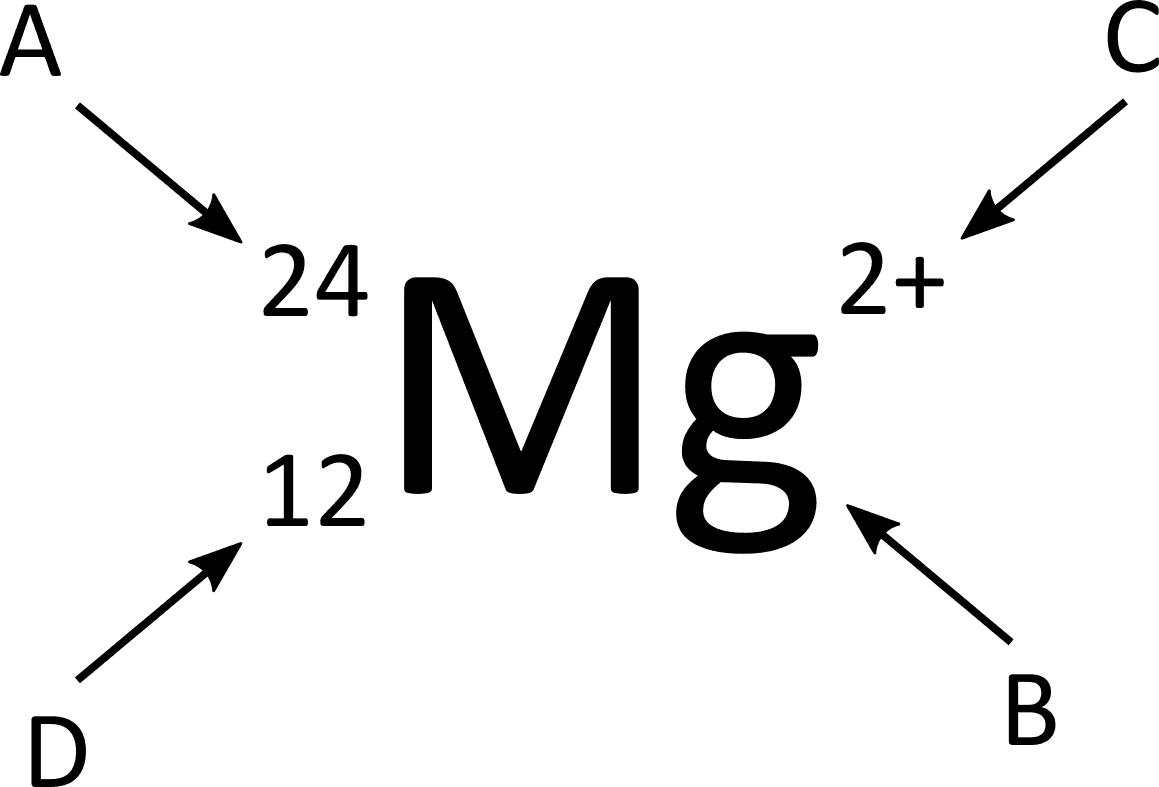
Region B on the image shown indicates the ____ for the isotope notation.
Region C on the image shown indicates the ____ for the isotope notation.
Region D on the image shown indicates the ____ for the isotope notation.
Which of the following represents an isotope of an element containing 28 protons, 28 electrons, and 30 neutrons?
How many neutrons are in the element represented by the following isotope notation?
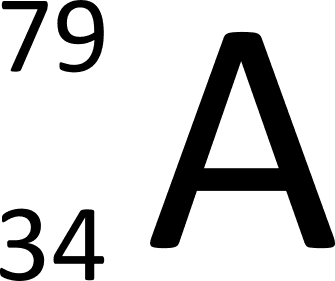
How many protons are in the element represented by the following isotope notation?
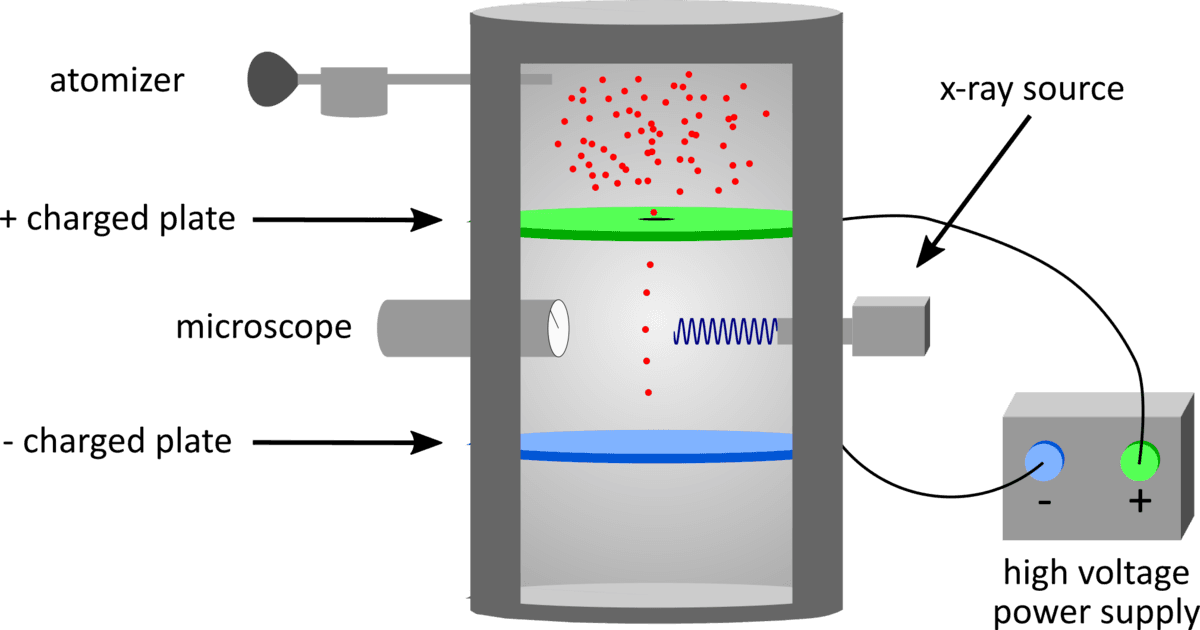
What is this device and what did it discover about the atom?

What is this device and what did it discover about the atom?
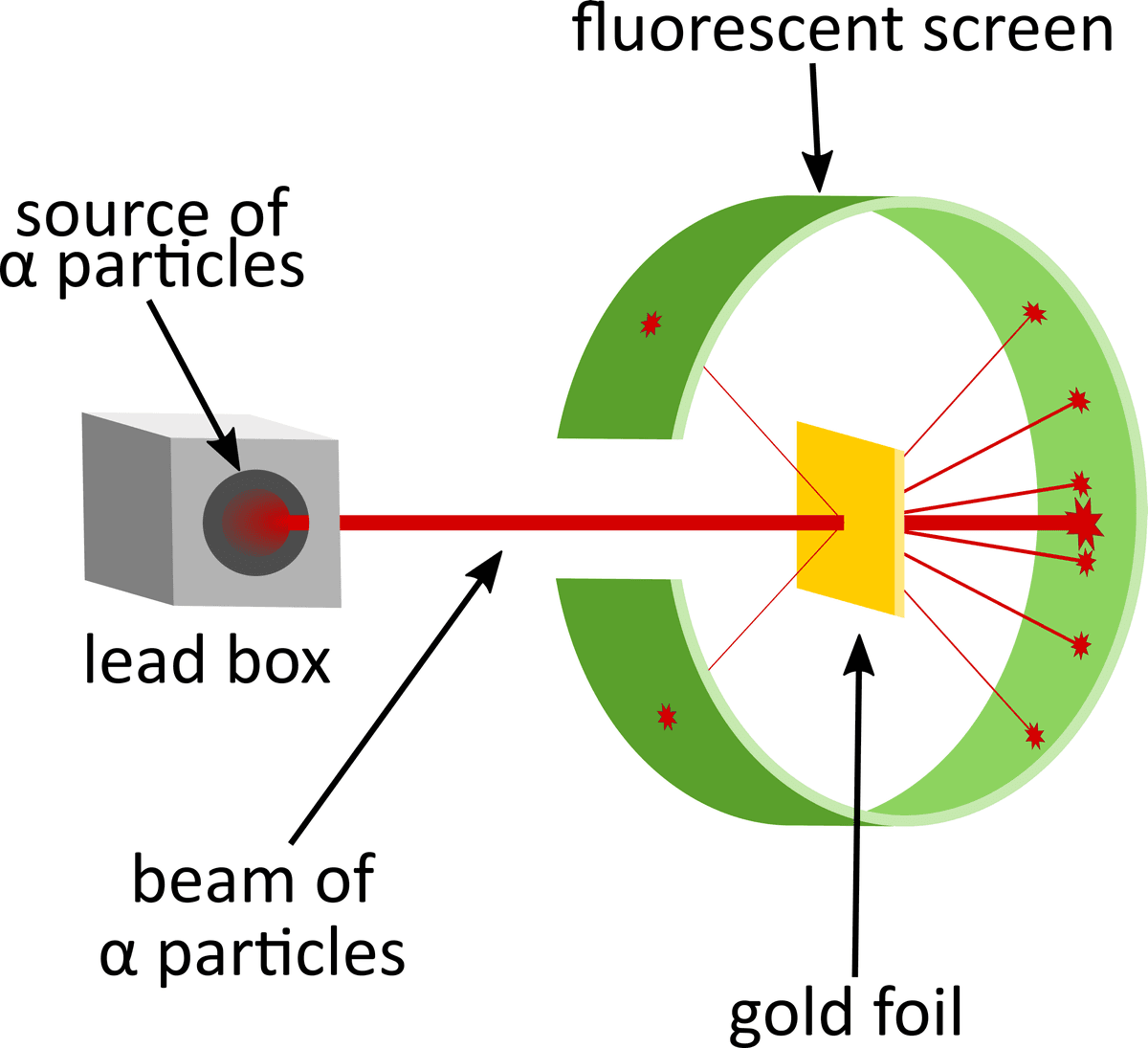
What is this device and what did it discover about the atom?
Match the image with the corresponding model.
On which two natural laws did Dalton base his model of matter?
According to Bohr's model of the atom, electrons move in fixed orbits of certain energies called ____.
The amount of energy required for an electron to move between energy levels is called a(n)
There is a principle in quantum mechanics that states it is impossible to know precisely both the location and speed of an electron. What is this principle called and who developed it.
The number of complete cycles of a wave that pass per unit time is called ____.
The distance between adjacent crests of a wave is called the ____.
The height of a wave from the zero point to its crest is called the ____.
Low energy light has a ____ frequency and a ____ wavelength.
Electrons in the lowest possible energy levels are said to be in the ____.
Electrons that have gained energy and are in higher energy levels than the ground state are said to be in the ____.
Which of the following transitions correspond to the emission of light and which correspond to the absorption of light?
What is another name for the quantum mechanical model of the atom?
A series of equations that calculate the probability of finding an electron within a certain volume of space around the nucleus of an atom are called ____.
What do we call the values used to describe atomic orbitals?
The quantum number that describes the shapes of the atomic orbitals is called ____.
The quantum number that determines the amount of energy an electron has is called the ____.
All orbitals with the same value of the principal quantum number and angular momentum quantum number are collectively called ____.
How many types of subshells does the 3rd principal energy level have?
The quantum number that indicates how many orbitals are in each subshell and their orientation in 3D space is the ____.
Match the following images with the type of orbital depicted.
The rule for filling orbitals in which electrons must fill orbitals in the same subshell with electrons of the same spin first is ____.
The rule for filling orbitals in which orbitals can have a maximum of two electrons of opposite spin is ____.
The rule for filling orbitals in which electrons occupy orbitals of lowest energy first is ____.
The following orbital notation violates which rule for filling orbitals?
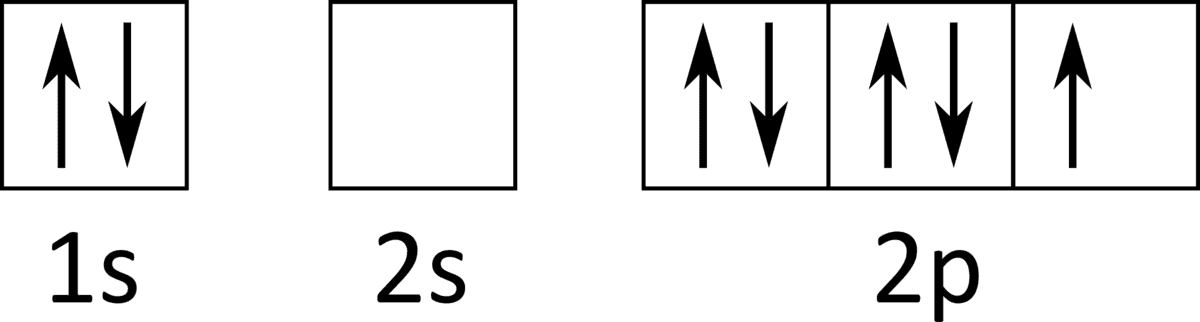
The following orbital notation violates which rule for filling orbitals?

The following orbital notation violates which rule for filling orbitals?

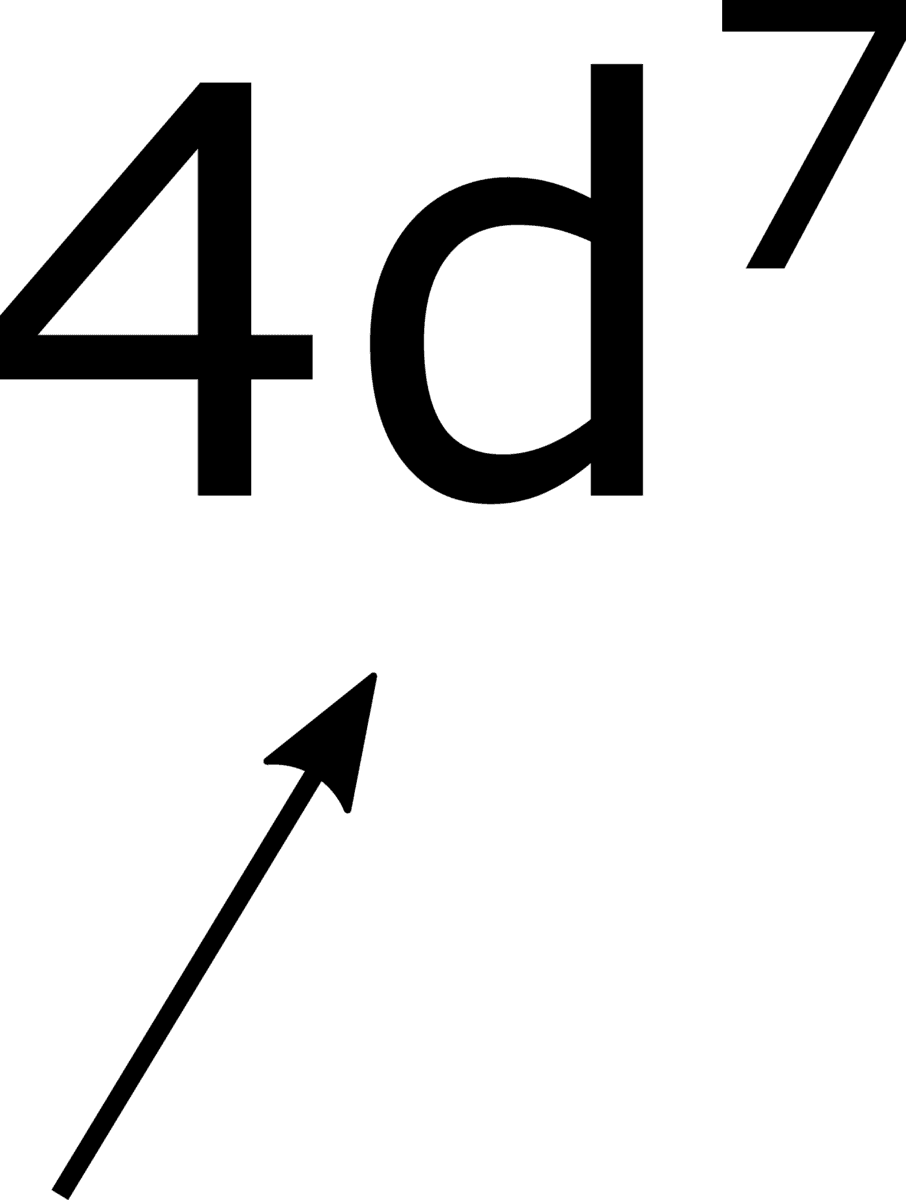
The arrow in the image shown indicates what component of an electron configuration?
Match the region of the periodic table with its associated subshell.
What is the electron configuration for titanium?
What is the electron configuration for arsenic?
The following electron configuration corresponds to what element? 1s²2s²2p⁶3s²3p²
The following electron configuration corresponds to what element? 1s²2s²2p⁶3s²3p⁶4s²3d¹⁰4p⁶5s²4d⁷
The phenomenon in which light of certain frequencies causes electrons to be emitted from a metal surface under vacuum is called the ____
Who was the first to describe the phenomenon in which light of certain frequencies causes electrons to be emitted from a metal surface under vacuum?
Who was the person who successfully explained how the phenomenon in which light of certain frequencies causes electrons to be emitted from a metal surface under vacuum worked?
Light is made up of tiny energy packets called ____.
What is the identity of this element based on the photoelectron spectrum shown?
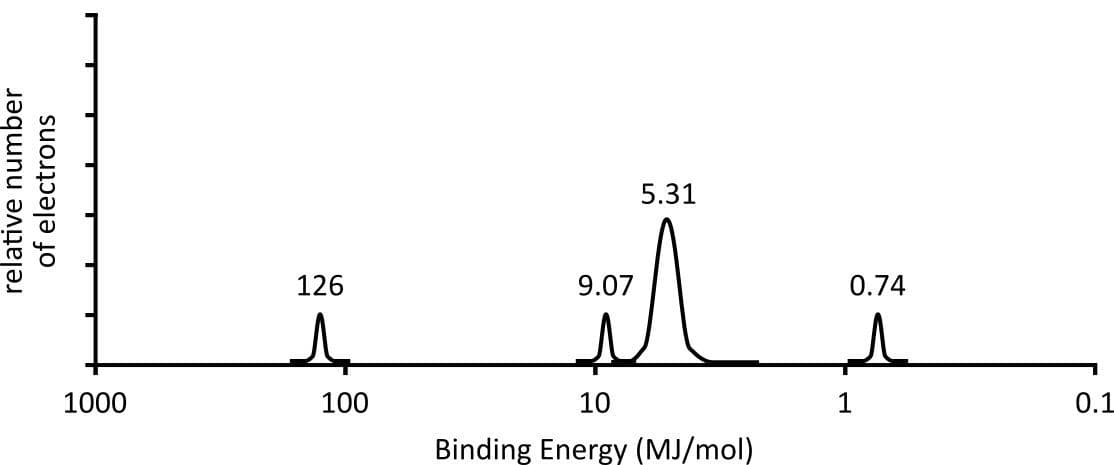
What is the identity of this element based on the photoelectron spectrum shown?
