Tag the questions with any skills you have. Your dashboard will track each student's mastery of each skill.
Give this quiz to my class
Q 1/50
Score 0
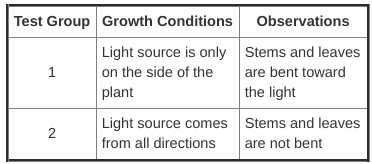
Valerie designed and conducted an experiment on pothos plants, which are common houseplants. Her hypothesis is that the direction of light will affect the growth pattern of a pothos plant. To test the hypothesis, she sets up two test groups of pothos plants and observes them three weeks later. The table summarizes the test groups and observations.
What are the roles of the two test groups in this investigation?
120
Both are experimental groups, and each individually shows the effect of the direction of light.
Both are control groups, but only Test Group 1 shows the effect of the direction of light.
One is the experimental group and one is the control group, and together they show the effect of the direction of light.
Both are experimental groups, but only Test Group 1 shows the effect of the direction of light.
Q 2/50
Score 0
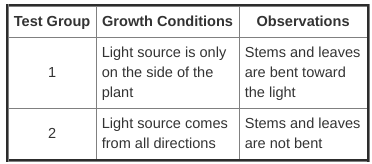
Valerie designed and conducted an experiment on pothos plants, which are common houseplants. Her hypothesis is that the direction of light will affect the growth pattern of a pothos plant. To test the hypothesis, she sets up two test groups of pothos plants and observes them three weeks later. The table summarizes the test groups and observations. After analyzing the results of the experiment, Valerie asks if her hypothesis should be classified as a theory. Which is the best response to Valerie’s question?
120
No, because the experiment did not provide enough data to support the hypothesis.
No, because a theory is a highly reliable explanation that incorporates many well-tested hypotheses.
Yes, because her data support the hypothesis.
Yes, but only if additional experiments show similar results.
50 questions
Q.
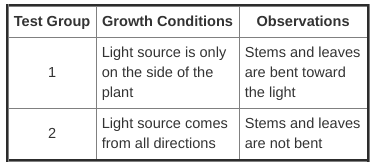
Valerie designed and conducted an experiment on pothos plants, which are common houseplants. Her hypothesis is that the direction of light will affect the growth pattern of a pothos plant. To test the hypothesis, she sets up two test groups of pothos plants and observes them three weeks later. The table summarizes the test groups and observations.
What are the roles of the two test groups in this investigation?
1
120 sec
Q.
Valerie designed and conducted an experiment on pothos plants, which are common houseplants. Her hypothesis is that the direction of light will affect the growth pattern of a pothos plant. To test the hypothesis, she sets up two test groups of pothos plants and observes them three weeks later. The table summarizes the test groups and observations. After analyzing the results of the experiment, Valerie asks if her hypothesis should be classified as a theory. Which is the best response to Valerie’s question?
2
120 sec
Q.
Evolutionary theory has become the central organizing principle of biological science. Could this scientific theory ever become a scientific law?
3
120 sec
Q.
A griffin is a mythical creature that appears in many stories. It has the head of an eagle and the body of a lion. What role, if any, could the griffin have in the science of biology?
4
120 sec
Q.
After a team of scientists completes an investigation, they submit an article about the investigation to a scientific journal. Before the journal publishes the article, they send it to other scientists for an anonymous, independent review. What is the purpose of this review?
5
120 sec
Q.
When news of a scientific discovery is reported, readers must assess the credibility of the claim. For scientific discoveries in general, which statement indicates a valid and credible claim?
6
120 sec
Q.
In 1999, teams in Colorado and California were working together to put NASA’s Mars Climate Orbiter in orbit around Mars. The mission of the orbiter was to look for evidence of water. One team used English units of measurement. The other team used metric measurement. As a result, the spacecraft was lost. What would be the simplest and most cost-effective way to avoid mistakes like this in the future?
7
120 sec
Q.
Refer to the following diagram. The diagram is a model of the structure of glucose. Which is a primary function of glucose molecules?
8
60 sec
Q.
Refer to the following diagram. The diagram is a model of the structure of glucose. What is true about the structure of this molecule?
9
60 sec
Q.
Roger is comparing a model of a sugar molecule to a model of an amino acid. Which of the following evidence statements would be supported by the two models?
10
120 sec
Q.
Many cells make and use an enzyme, called catalase, to facilitate the decomposition of hydrogen peroxide (H2O2). The products of the decomposition are hydrogen (H2) and oxygen (O2).
What is the effect of catalase on the decomposition of hydrogen peroxide?
11
120 sec
Q.
Many cells make and use an enzyme, called catalase, to facilitate the decomposition of hydrogen peroxide (H2O2). The products of the decomposition are hydrogen (H2) and oxygen (O2).
Which of these changes to the cell would cause the greatest reduction in the activity of catalase?
12
120 sec
Q.
Water has many special properties, such as a high heat capacity and cohesive behavior. Which of the following best explains why water has these properties?
13
60 sec
Q.
Lee and Marisol are conducting a science experiment to identify different kinds of macromolecules in food. They prepare the following table to help them remember the chemical reactions that indicate the presence of each type of macromolecule they are studying.
Suppose that one of the substances they are testing turns bright red when they add a few drops of Sudan stain. What is the basic molecular structure of the substance?
14
120 sec
Q.
A cellular enzyme is effectively deactivated by an increase in temperature of 10°C. Which is the most likely mechanism of the deactivation?
15
120 sec
Q.
Which observation directly illustrates the adhesive properties of water?
16
60 sec
Q.
As food travels through the digestive system, it is exposed to a variety of pH levels. The stomach has a pH of 2 due to the presence of hydrochloric acid (HCl), and the small intestine has a pH ranging from 7 to 9. HCl converts pepsinogen into pepsin, an enzyme that digests proteins in the stomach. Which of the following most likely happens to pepsin as it enters the small intestine?
17
120 sec
Q.
Michael wants to test the effect that different concentrations of stomach acid will have on the dissolution of a particular kind of oral medication. As he sets up and completes his experiment, which of the following experimental designs would be most likely to help him answer his question?
18
120 sec
Q.
Which property of water supports the circulation of nutrients and electrolytes through the human body?
19
60 sec
Q.
Water expands and becomes less dense as it freezes. Which statement best describes how this property of water makes life possible in cold climates?
20
120 sec
Q.
Which of the following sequences represents the hierarchy of biological organization from the least to the most complex level?
21
120 sec
Q.
In a single molecule of water, two hydrogen atoms are bonded to a single oxygen atom by
22
60 sec
Q.
An example of a hydrogen bond is the bond between
23
60 sec
Q.
What gives rise to the cohesiveness of water molecules?
24
60 sec
Q.
Which of the following contains nitrogen in addition to carbon, oxygen, and hydrogen?
25
60 sec
Q.
What is the structure shown in the figure?
26
60 sec
Q.
Which property of water allows it to dissolve a wide variety of substances
throughout the human body?
27
60 sec
Q.
Many solids will sink if they are placed in a liquid, however, when ice is placed in
water the ice floats to the surface. Which property of water explains why this
happens?
28
120 sec
Q.
Redwood trees are among the tallest trees in the world, reaching more than
110 meters (m) in height. Which property of water allows it to travel such
large distances from the roots of the redwood tree to the leaves?
29
120 sec
Q.
Water makes up approximately 60% of the human body and plays a vital role in
regulating body temperature. Which property of water allows it to prevent large
fluctuations in body temperature?
30
120 sec
Q.
Which building blocks are correctly matched to the macromolecule they form?
31
60 sec
Q.
Which of the following statements illustrates why carbon atoms are so important
in living organisms?
32
120 sec
Q.
Which of the following groups of macromolecules are composed of three fatty
acid chains bonded to a glycerol?
33
60 sec
Q.
Which of the following structures is circled and labeled X in the figure above?
34
60 sec
Q.
All of the following are characteristics of proteins EXCEPT:
35
120 sec
Q.
All of the following are characteristics of Nucleic Acids EXCEPT:
36
120 sec
Q.
What does an analysis of the diagram show us?
37
120 sec
Q.
All of the following are characteristics of a carbohydrate EXCEPT:
38
120 sec
Q.
All of the following are characteristics of lipids EXCEPT:
39
120 sec
Q.
All of the following are important properties of water as they relate to organisms EXCEPT:
40
120 sec
Q.
A student placed groups of 25 seeds in a variety of temperatures ranging from 0 to 55°C. A difference in the rate of germination observed in the groups at different temperatures was most likely due to the effect of temperature on
41
120 sec
Q.
How does the control setup in an experiment differ from the other setups in the same experiment?
42
120 sec
Q.
Which sentence represents a hypothesis?
43
60 sec
Q.
Which procedure must be followed for the results of an experiment to be considered valid?
44
60 sec
Q.
A biologist reported success in breeding a tiger with a lion, producing healthy offspring. Other biologists
will accept this report as a fact only if
45
120 sec
Q.
When heating a solution in a test tube, a student should
46
60 sec
Q.
The analysis of data gathered during a particular experiment is necessary in order to
47
60 sec
Q.
A sample of small, soluble, organic molecules was analyzed and found to contain the elements carbon, oxygen, hydrogen, and nitrogen. It is most likely that the molecules were
48
120 sec
Q.
All of the following are characteristics of enzymes EXCEPT:
49
120 sec
Q.
A student has gathered all the data needed to answer her question and has even developed a hypothesis. What should she do next?