Tag the questions with any skills you have. Your dashboard will track each student's mastery of each skill.
Give this quiz to my class
Q 1/18
Score 0
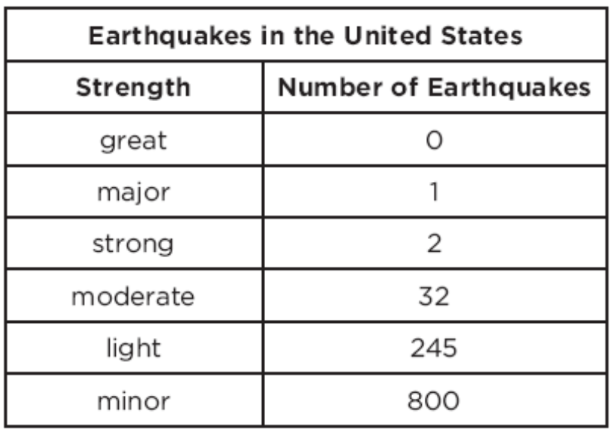
1. A scientist collected data on earthquakes in the United States for four years. She recorded her data in this chart.
Which inference can she make from the data below?
30
A moderate earthquake is not likely to happen in the United States.
A major earthquake is likely to happen somewhere in the United States every year.
A minor earthquake is likely to happen somewhere in the United States every year.
A light earthquake can never happen in the United States.
Q 2/18
Score 0
2. An earthquake is usually caused by a _____.
30
glacier
very large storm
landslide
movement along a fault
18 questions
Q.
1. A scientist collected data on earthquakes in the United States for four years. She recorded her data in this chart.
Which inference can she make from the data below?
1
30 sec
Q.
2. An earthquake is usually caused by a _____.
2
30 sec
Q.
3. Why do earthquakes usually occur near plate boundaries?
3
30 sec
Q.
4. Fill in the blanks using the available answer choices.
A ________________ is an instrument that detects and
measures waves produced by earthquakes.
4
30 sec
Q.
5. Which best describes how earthquakes and volcanoes shape the land?
5
30 sec
Q.
7. 5. Based on the Earthquake map, select the BEST answer where is the next Earthquake most likely to occur?
6
30 sec
Q.
8. Which part of the diagram below shows the wavelength?
7
30 sec
Q.
9. Fill in the blanks using the available answer choices.
____________ waves spread out in all directions from the focus, the point where an earthquake begins.
8
30 sec
Q.
10. True or False
Seismologist can tell when an earthquake occurs.
9
30 sec
Q.
11. What is magnitude?
10
30 sec
Q.
12. A group of students are designing a model house that is safe in strong winds. Which house would be the safest?
11
30 sec
Q.
13. The distance between wave crests is called _____.
12
30 sec
Q.
14. If you use walking as a model for wavelength and amplitude, what would a long and high step represent?
13
30 sec
Q.
15. What structures can be used to help a building resist the lateral forces of an earthquake?
14
30 sec
Q.
16. ________ is the height of a wave from its trough to its midpoint
15
30 sec
Q.
17. How can you determine the amplitude of the wave pattern shown below?
16
30 sec
Q.
B. Select the best option for how Todd could use this way of making a wave to make a new wave with a greater amplitude.
17
30 sec
Q.
C. Todd puts a floating ball into the pan of water and makes a wave. He observes the motion of the ball. Then, he makes a new wave with a greater amplitude.
Describe how the pattern of motion for the floating ball changes for the wave with a greater amplitude."