Loading...


Unit 4 Study Guide Part 1 (Nature of Covalent Bonding, 2021-2022)
Quiz by Aaron Holley
Tag the questions with any skills you have. Your dashboard will track each student's mastery of each skill.
A chemical bond formed by the sharing of electrons between two atoms is called a ___.
A chemical bond formed by the transfer of electrons from a metal to a nonmetal is called a ___.
What elements form covalent bonds?
When forming chemical bonds, elements try to gain ____ by looking like ____.
In what way do the other elements look like noble gases when forming chemical bonds?
Atoms are willing to gain, lose, or share what subatomic particle when forming chemical bonds to look like a noble gas?
Electrons in the highest occupied energy level of an atom are called ___.
Electrons that are not in highest occupied energy level of an atom are called ___.
The rule that states that atoms form chemical bonds in order to have the same electron configuration as a noble gas (with eight valence electrons) is called the ___.
The behavior of hydrogen, beryllium, and lithium in which they form chemical bonds in order to have the same electron configuration as helium is referred to as the ___.
What noble gas is oxygen trying to look like in order to obey the octet rule?
What noble gas is phosphorus trying to look like in order to obey the octet rule?
What is the electron configuration of sulfur when it forms covalent bonds?
What is the electron configuration of arsenic when it forms covalent bonds?
Covalent bonding is a balancing act between all of the following forces of attraction and repulsion EXCEPT ___
On the potential energy vs. distance graph shown, at what point is the covalent bond most stable between the two atoms
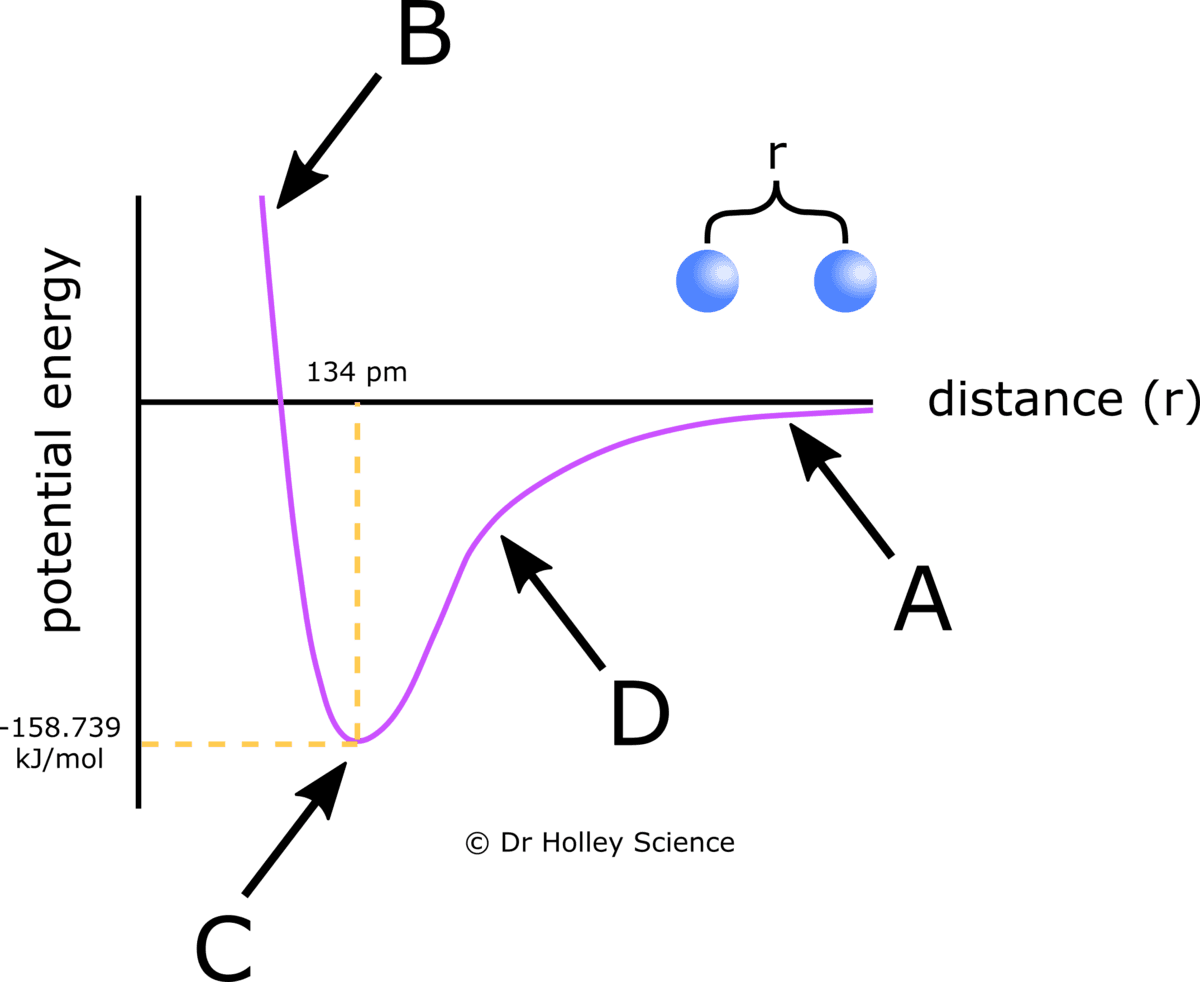
A chemical bond in which two atoms share one pair of electrons is called a ____.
A chemical bond in which one atom contributes both electrons to the bond is called a ____.
A chemical bond in which two atoms share three pairs of electrons is called a ____.
A chemical bond in which two atoms share two pairs of electrons is called a ____.
Which of the following elements can form diatomic molecules?