Loading...


Unit 4 Study Guide Part 2 (Bond Polarity, 2021-2022)
Quiz by Aaron Holley
Tag the questions with any skills you have. Your dashboard will track each student's mastery of each skill.
When electrons are shared equally between two atoms, a ____ forms.
When electrons are not shared equally between two atoms, a ____ forms.
What property of atoms determines the polarity of a chemical bond?
A pair of opposite charges that are separated by a distance with one end being slightly positive and the other being slightly negative is called a ____.
What Greek letter is used to represent the presence of a dipole in a polar covalent bond or molecule?
If a molecule contains polar bonds, then the molecule must also be polar.
A molecule that contains a permanent separation of charge due to the uneven distribution of bonding electrons and lone pairs of electrons is called a ____
The term used to describe the overall separation of positive and negative charge in a molecule is ____.
Which of the following shows the correct behavior of a polar molecule within an electric field?

Use the table of electronegativity values below to determine the type of bond that will form between them: C and F
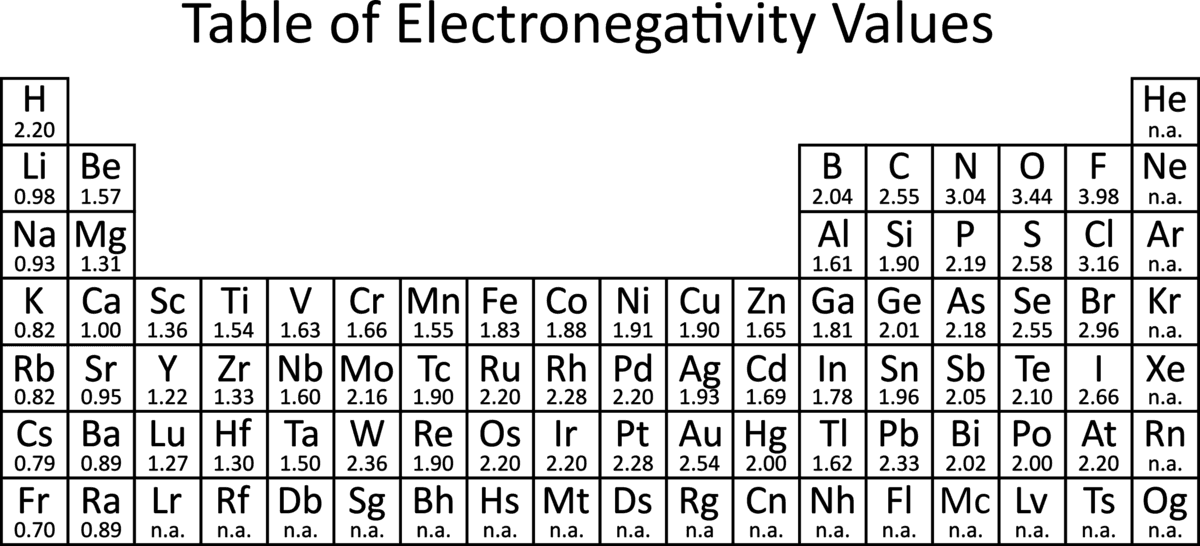
Use the table of electronegativity values below to determine the type of bond that will form between them: C and C
Use the table of electronegativity values below to determine the type of bond that will form between them: P and Si
Use the table of electronegativity values below to determine the type of bond that will form between them: Sr and Cl
Use the table of electronegativity values below to determine the type of bond that will form between them: Br and Cl
Use the table of electronegativity values below to determine the type of bond that will form between them: Br and Cl
Use the table of electronegativity values below to determine the type of bond that will form between them: Se and O