Tag the questions with any skills you have. Your dashboard will track each student's mastery of each skill.
Give this quiz to my class
Q 1/33
Score 0
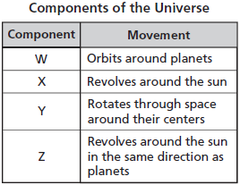
The data table describes the movements of components in the universe. Which component is best described by letter W?
30
moons
Q 2/33
Score 0
a sphere-shaped mass of rock or gas that orbits a star
30
planet
33 questions
Q.
The data table describes the movements of components in the universe. Which component is best described by letter W?
1
30 sec
Q.
a sphere-shaped mass of rock or gas that orbits a star
2
30 sec
Q.
The table lists some characteristics of objects in our solar system. Scientists observe an object with a diameter of 950 km in an orbit around the sun. Scientists will most likely identify it as which type of object?
3
30 sec
Q.
Four components of the universe are described in the table. Which component is most likely a solar system?
4
30 sec
Q.
The sun appears to observers in Tennessee as the brightest star in the sky. The sun appears brighter than other stars because it is:
5
30 sec
Q.
An astronomer observed four celestial bodies with a telescope. The table shows some properties of the objects. Which celestial object appeared smallest to the astronomer?
6
30 sec
Q.
Over several years, astronomers observed the alignment of planets. One year, astronomers observed Jupiter and noticed it appeared larger than normal. What caused Jupiter to appear larger when viewed from Earth?
7
30 sec
Q.
Some comets are visible to the naked eye from Earth because they:
8
30 sec
Q.
Which activity within our solar system takes approximately one year to complete?
9
30 sec
Q.
The diagram represents Earth rotating on its axis. As Earth rotates, how long will it take Alaska to return to this same position?
10
30 sec
Q.
The moon orbits Earth about once each:
11
30 sec
Q.
After Earth has completed one revolution around the sun, approximately how much time has passed?
12
30 sec
Q.
The diagram shows the Earth, sun, and moon. In order to see a new moon from Earth, where should the moon be positioned?
13
30 sec
Q.
This diagram shows the moon revolving around Earth. Which moon phases is shown in this diagram?
14
30 sec
Q.
Which moon phase is shown in the diagram?
15
30 sec
Q.
The diagram shows the positions of the sun, the moon, and Earth at one point in time. What moon phase is viewed from the Northern Hemisphere of Earth at this point in time?
16
30 sec
Q.
The sun, earth, and moon are all in alignment/straight line
17
30 sec
Q.
Which two positions could the moon possibly be located if a spring tide is occurring at point X?
18
30 sec
Q.
The diagram shows the sun, Earth, and the moon at one point in time. Which of these will most likely be observed at point X?
19
30 sec
Q.
Which location on Earth is experiencing a high tide?
20
30 sec
Q.
The diagram shows the positions of Earth and the sun at one point in time. In six months, which season will begin in the Southern Hemisphere?
21
30 sec
Q.
What season is it in the Southern Hemisphere?
22
30 sec
Q.
The diagram represents the revolution of Earth around the sun. What should be added to the diagram to better demonstrate how seasons are caused on Earth?
23
30 sec
Q.
The diagram shows the positions of the sun and Earth. What season will begin in the Southern Hemisphere when Earth reaches point X?
24
30 sec
Q.
What does this picture represent?
25
30 sec
Q.
Does the diagram depict a solar or lunar eclipse?
26
30 sec
Q.
The diagram shows the locations of the sun, Earth, and the moon. Which of these is possible only when the sun, Earth, and the moon are aligned as shown?
27
30 sec
Q.
Can you describe the conditions for a solar eclipse?
28
30 sec
Q.
Identify all 8 moon phases in the diagram shown.
29
30 sec
Q.
See image
30
30 sec
Q.
See image
31
30 sec
Q.
See image
32
30 sec
Q.
Identify the 4 seasons for both the Northern and Southern Hemispheres