


Untitled quiz
Quiz by Mike Smith
Feel free to use or edit a copy
includes Teacher and Student dashboards
Measure skillsfrom any curriculum
Measure skills
from any curriculum
Tag the questions with any skills you have. Your dashboard will track each student's mastery of each skill.
With a free account, teachers can
- edit the questions
- save a copy for later
- start a class game
- automatically assign follow-up activities based on students’ scores
- assign as homework
- share a link with colleagues
- print as a bubble sheet
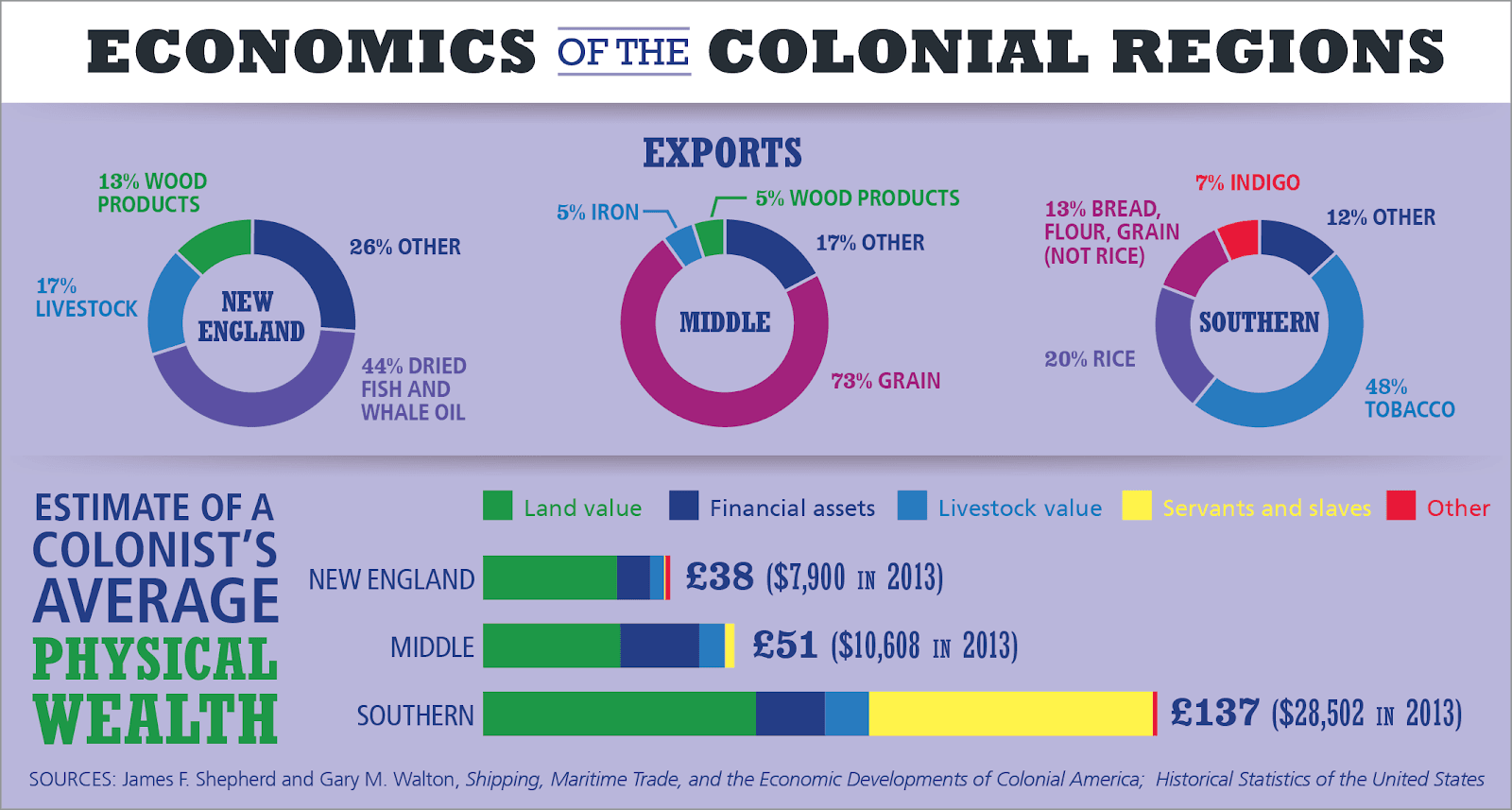
- Q 1/17Score 0According to the infographic, what did the New England and Middle Colonies have in common?29B Both regions imported wood products.A Neither region had any wealth in enslaved workers.D Both regions had large shipping industries.C Both regions exported mostly food products.


17 questions
Show answers
- Q1According to the infographic, what did the New England and Middle Colonies have in common?B Both regions imported wood products.A Neither region had any wealth in enslaved workers.D Both regions had large shipping industries.C Both regions exported mostly food products.30s
- Q2What could be a reason for the average colonist’s wealth in the Southern Colonies being so much higher than that of the New England and the Middle Colonies?B Southerners relied heavily on cheap or free labor.A Land in the Southern Colonies had a much higher value than land in the Middle and New England Colonies.D Southerners exported most of their livestock to other colonies.C Their abundant tobacco crops were in greater demand than other colonial crops.30s
- Q3What set Pennsylvania apart from other colonies?A its founding based on religious freedomD its settlement by people seeking religious freedomC its effort to attract people of different ethnicitiesB its founding by a proprietor30s
- Q4Why was the Maryland Act of Toleration enacted?C to establish separation between church and stateB to provide freedom of religion for JewsD to protect freedom of worship for CatholicsA to ensure Africans could maintain their religious practices30s
- Q5In colonial society, a person’s social status depended upon his or herB religion.C family background and wealth.D talent and skill.A education.30s
- Q6Based on the illustration, what can be inferred about the transportation of newly enslaved Africans?B Sometimes enslaved Africans were allowed to leave the hold and go up on deck.D Enslaved Africans were usually grouped with their families during transport.A Most of the enslaved Africans transported to the Americas were men.C The enslaved Africans were often put on overcrowded ships bound for America.30s
- Q7“After 1769, the life of the California natives [American Indians] who came in contact with the Spanish was reshaped by the mission fathers, not the townspeople of the pueblos or the soldiers of the presidios. The Franciscans came to California not merely to convert the tribes to Christianity but to train them for life in a European colonial society. Conversion was seldom an entirely voluntary process, and converts (neophytes) were not left to return to their old ways but were required to live in the walled mission enclosure or on rancherías, separate settlements sponsored by missions although located some distance from the mission proper. There they were taught Spanish as well as the tenets of their new religion and trained in skills that would fit them for their new lives: brickmaking and construction, raising cattle and horses, blacksmithing, weaving, tanning hides, etc.” —Library of Congress Inferring from this text, why might the Spanish have felt it important to train the natives of California for a “European colonial society”?A to make it easier to govern the IndiansB to prevent the Indians from leavingD to spread European beliefs and languageC to make the Indians equals in colonial society30s
- Q8American Indians were replaced as slaves by Africans largely due to the fact that it was believed that Africans wereB less likely to try to escape.D better able to grow the crops the Spanish desired.C less likely to die from European diseases.A better able to work in the climate.30s
- Q9Because he believed there should be strict limits on government, Thomas HookerB held anti-government rallies in New England and New York.A established the colony of Rhode Island and encouraged religious tolerance.D settled the town of Hartford and established a representative government.C started the first newspaper in Britain’s North American colonies.30s
- Q10Which of the following was a Quaker belief that set Quakers apart from other religious groups that settled in the American colonies?D Quakers believed they could find religious freedom in the colonies.A Quakers believed that all people are equal in God’s eyes.B Quakers believed in freedom of religion.C Quakers believed that others should convert to their religion.30s
- Q11Based on your reading and this map, why did colonists choose this location for Jamestown?B The location allowed water travel in several different directions.D The location was the most convenient one for ships coming from England.C The location was on the water but sheltered from larger bodies of water.A The location was surrounded by water that could be used for crops.30s
- Q12The Puritan belief that all Christians have a duty to study the Bible directly led toC efforts to convert other colonists and American Indians to their religion.A many New Englanders’ desire to teach their children to read.B a heavy New England tax to fund the construction of churches.D the establishment of several colleges in New England dedicated to educating ministers.30s
- Q13What was significant about the House of Burgesses?D It mediated conflicts between the colonial government and religious leaders.C It governed the colony of Virginia harshly, like a military outpost, leading to a mass exodus of settlers.A It limited the king by making him consult with the nobles and church leaders in order to raise taxes.B It was the first instance of limited self-government in the English colonies.30s
- Q14Read the passage. “After the monopoly charter of the New Netherland Company expired in early 1618, a group of powerful merchants in the Netherlands began to lobby for the formation of a West India Company (WIC) to develop trade in the New World. The model was the Dutch East India Company that had been founded in 1602 and that controlled the highly profitable spice trade with Asia. The WIC was founded in 1621, with a twenty-four-year monopoly from the Dutch government on all trade with West Africa, the Caribbean, and the Americas. Although they were mainly interested in trade, the directors of the WIC, the Lords Nineteen, decided to start a permanent colony in the region where the New Netherland Company had held its charter. These colonists formed the nucleus of the future Dutch presence in the area. Some settled at present-day Albany and along the Delaware and Connecticut Rivers. Others settled at the southern tip of present-day Manhattan, where they built simple houses and Fort Amsterdam.” —Library of Congress Based on this passage, what can be inferred about why Dutch merchants decided to establish their colony in North America?C to have settlements where traders could be basedD to control strategic rivers in the regionB to control more territory than other European countriesA to create a new place for their refugees to live and work30s
- Q15What effect did the headright system have on slavery?A It established a set of laws that spelled out the rights denied to enslaved people in the Southern Colonies.B It improved the lives of enslaved people by mandating better working conditions on plantations.C It expanded slavery by encouraging planters to purchase more enslaved people in order to gain more land.D It reduced slavery because planters now had to pay a tax on enslaved people.30s

