Loading...


Upper and Lower Limb Peer Instruction
Quiz by Jenny Ousley
Tag the questions with any skills you have. Your dashboard will track each student's mastery of each skill.
A 24-year old woman is brought to the emergency department after she slipped on wet pavement and fell against the curb, injuring her right arm. Physical examination shows loss of sensation of the posterior forearm and dorsal hand. An x-ray of the right upper limb shows a mid-body fracture of the humerus. Which pair of structures is most likely injured at the fracture site?
A 25-year-old woman is brought to the emergency department after being involved in a motor vehicle collision. Physical examination shows that the right arm appears swollen, pale, and cool. Radial pulse is absent and any movement of the arm causes severe pain. An x-ray of the right arm shows a fracture at the radial groove of the humerus and a cast is placed. Three days later she has severe pain over the length of her arm. Which of the following conditions will most likely explain the findings on physical examination?
A 67-year-old woman is brought to the emergency department after injuring her left shoulder from a fall. She has a history of osteoporosis. Physical examination shows bruising and dimpling of the upper part of the arm with exquisite tenderness over the affected area. An x-ray of the left shoulder is shown in the image below. Which of the following nerves is most likely injured?

A 25-year-old man is brought to the emergency department because he fell on a slippery trail and injured his right upper limb. Physical examination shows abrasions over his triceps brachii muscle. An x-ray of his arm shows a fracture at the mid-body of the humerus. Which of the following muscles is most likely paralyzed?
A 29-year-old man is brought to the emergency department after a painful fall against a rocky ledge. His temperature is 37.5°C (99.5°F), pulse is 95/min, respirations are 18/min, and blood pressure is 118/70 mm Hg. He has dull pain in the lateral shoulder with radiation to the proximal arm. An x-ray of the arm shows a hairline fracture of the surgical neck of the humerus. Which of the following tests is best for assessing the status of the nerve associated with this injury?
A 65-year-old man is brought to the emergency department after falling on his outstretched hand. The patient complains of severe right shoulder pain. Physical examination shows an externally rotated and slightly abducted right arm. Flattening of the deltoid muscle is noted and sensation is also absent over the right deltoid muscle. Which of the following is the most likely diagnosis?
A 29-year-old man comes in with a stabwound, cannot raise his arm above horizontal, and exhibits a condition known as “winged scapula.” Which of the following structures of the
brachial plexus would most likely be damaged?
A patient has a torn rotator cuff of the shoulder joint as the result of an automobile accident. Which of the following muscle tendons is intact and has normal function?
A patient bleeding from the shoulder secondary to a knife wound is in fair condition because there is vascular anastomosis around the shoulder. Which of the following arteries is most likely a direct branch of the subclavian artery that is involved in the anastomosis?
A 20-year-old man fell from the parallel bar during the Olympic trial. A neurologic examination reveals that he has a lesion of the lateral cord of the brachial plexus. Which of the following muscles is most likely weakened by this injury?
A 41-year-old woman comes to the physician for a follow-up examination. One year ago, she underwent a mastectomy of her left breast. She is scheduled for a latissimus dorsi muscle flap to cosmetically augment the site of her absent left breast. During surgery, part of the latissimus dorsi muscle is advanced to the anterior thoracic wall. Which artery forms the vascular base of this flap?
A 27-year-old man is brought to the emergency department because of pain and swelling of his right arm after falling from a ladder. He is unable to abduct his right arm more than 15 degrees and resists lateral rotation due to pain. The patient also has a loss of sensation over the right shoulder. An x-ray of the arm shows an oblique fracture of the humerus. The most likely cause of these symptoms is a fracture affecting which of the following locations?
A 29-year-old woman is brought to the emergency department 2 hours after falling from her balcony. Physical examination shows noticeable swelling and bruising over the clavicle. There is tenderness, crepitus on palpation, and decreased range of motion of her left upper limb. An x-ray of the left shoulder shows a fracture of the clavicle and internal bleeding is strongly suspected. Which of the following vessels is most likely to be injured in a clavicular fracture?
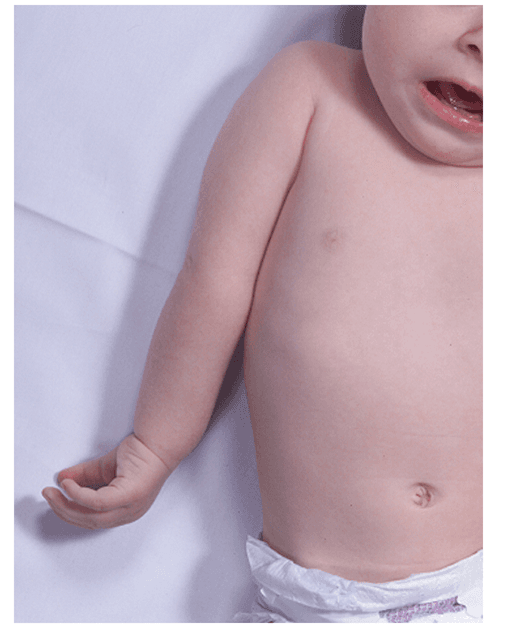
A 22-year-old G1P0, at 32 weeks of gestation was admitted urgently to the hospital in preterm labor. Physical examination shows a breech footling presentation. The baby is delivered vaginally with considerable amounts of traction. The newborn is shown in the image below. Which of the following structures was most likely injured during the childbirth?
A 32-year-old woman is brought to the emergency department 30 minutes after she was involved in a motor vehicle collision. Physical examination shows swelling, multiple bruises, and minor lacerations over the lateral aspect of the left midthigh. X-rays of the lower limb show a distal fracture of the femur. The patient is in severe pain, and a nerve block proximal to the injury is administered. What landmark is accurate for localizing the nerve for injection of anesthetics?
A 53-year-old woman comes to the physician because of a 6-month history of progressive difficulty in walking. Physical examination shows a positive Trendelenburg sign when she is asked to stand on her right leg. Which of the following nerves has been affected to produce the positive sign?
A 45-year-old man comes to the physician because of a 10-day history of sharp back pain while he was lifting a box of books. He told the physician that he “felt the pain in my backside, the back of my thigh, my leg, and the side of my foot.” Physical examination shows weakened calcaneal (Achilles) tendon jerk on the affected side. Which of the following is the most likely cause of the finding?
During an interview, a 30-year-old man who is a psychiatric patient suddenly becomes aggressive. To calm him down, the patient is given an intramuscular injection in the upper lateral quadrant of the buttock. The injection is given at this specific location to prevent damage to which of the following nerves?
A 65-year-old man is admitted to the hospital to undergo an iliofemoral bypass because of an occlusion of the proximal aspect of the femoral artery. The operation is performed successfully and the blood flow between the iliac and femoral arteries is restored. During rehabilitation, which of the following arteries should be palpated to monitor good circulation of the lower limb?
A 69-year-old man is brought to the emergency department because of a 30-minute history of chest pain. A coronary arterial angiography shows myocardial infarction due to complete occlusion of the anterior interventricular (left anterior descending) artery. The patient undergoes a coronary bypass graft procedure using the great saphenous vein. Postoperatively, the patient has pain and loss of sensation on the medial surface of the leg and foot on the limb from which the graft was harvested. Which nerve was most likely injured during the bypass surgery?
A 21-year-old man is brought to the emergency department because of severe knee pain. During a football game, he was blocked by a linebacker, who threw himself against the lateral aspect of the receiver’s left knee. The receiver grasped his knee in obvious pain. Physical examination shows swelling and tenderness over the knee joint. Which of the following structures is frequently subject to injury from this type of force against the knee?
A 43-year-old woman comes to the physician because of 6-month history of pain in her lower limb. She says she has pain in the hip, thigh, and leg of the affected limb and pain during sexual intercourse. Physical examination shows reduced sensation over the first web space, dorsum, and lateral side and weakness in eversion of the involved foot. A diagnosis of a piriformis entrapment syndrome is made, with compression of the common fibular division of the sciatic nerve. Which of the following conditions is also most likely found during physical examination?
A 73-year-old man comes to the physician because of a 6-month history of progressive cold and pale foot. Physical examination shows a nontender, cyanotic cold foot. The pulse of the posterior tibial artery is absent. A Doppler ultrasound of the leg indicates a thrombotic occlusion of his popliteal artery. Absence of pulse during physical examination will most likely be found in which of the following locations?
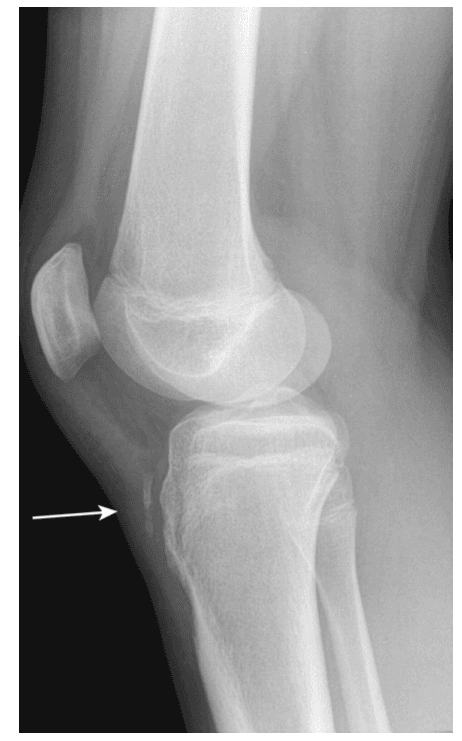
A 10-year-old girl is brought to the emergency department by her parent after falling from a tree while she was playing with her friends. She is able to walk, but she has severe knee pain. Physical examination shows tenderness at the distal aspect of the knee and swelling. An x-ray of the knee shows Osgood-Schlatter disease (see image below). Which of the following bony structures is most likely affected?
A 45-year-old is brought to the emergency department by an ambulance after his left leg impacted a fence post when he was thrown from a powerful four-wheel all-terrain vehicle. Physical examination shows minor lacerations and swelling of the left knee and positive posterior drawer test. Which of the following structures was most likely injured?
A 72-year-old woman is brought to the emergency department because she lost consciousness. A CT scan of the brain shows an area of ischemic stroke. Neurologic examination shows no response to the ankle reflex test. Which of the following nerve roots is most likely responsible for this reflex?
A 29-year-old man is brought to the physician for removal of a cast from his left leg. He had sustained a fracture of the left lower limb 6 weeks prior, which was immobilized in a cast that extended from just below the knee to the foot. At the time of injury, there was severe pain but normal strength in the lower limb. When the cast was removed, physical examination showed a pronounced left foot drop with paresthesia and sensory loss over the dorsum of the left foot and lateral leg. Injury to which of the following nerves is the most likely cause of this patient’s symptoms?
A 50-year-old man comes to the physician for a follow-up examination. He has been diabetic and hypertensive for the past 20 years. Physical examination shows paresthesia in a classic glove and stocking distribution and low pulse of the dorsalis pedis artery. Which of the following locations is typically this artery palpated?