Loading...

U.S. Constitution/Government Review
Quiz by Ryan Both
Customize this quiz to suit your class
Instantly translate to 100+ languages
Tag the questions with any skills you have. Your dashboard will track each student's mastery of each skill.
Give this quiz to my class







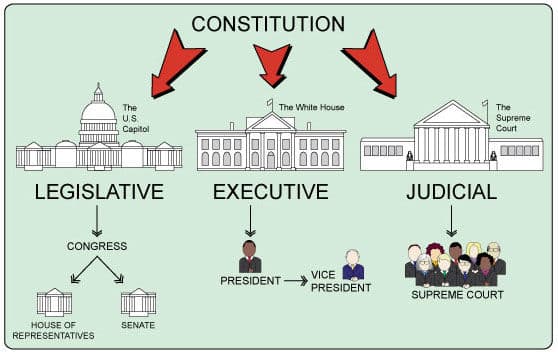


Consists of federal courts and judges Constitution gives Congress the power to create inferior (lower) courts to meet the nation’s needs -- two main types: District courts -- most cases involving federal laws are first heard in district courts -- U.S. divided into large geographic districts (which covers several states) Appellate courts -- courts that review cases that have been appealed from a lower court -- only considers whether the original trial was fair and legal -- their decisions can be appealed to the Supreme Court Supreme Court -- the highest court in the land (Congress has set the number of justices at nine, and they usually serve for life). Judicial Powers: To protect the Constitution Federal courts have the power to resolve disputes that involve national laws, the federal government, or the states. -- can also try people accused of breaking national laws Dispute only goes directly to Supreme Court if it involves a state or an ambassador from another country; otherwise has to come from a trial and then an appeal in lower courts -- could come eventually from national or state courts -- usually only review cases if they think a decision from a lower court might conflict with the Constitution or a federal law Supreme Court -- has the power of judicial review -- the power of the Supreme Court to decide whether laws and acts made by the legislative and executive branches are unconstitutional
Analyze how the U.S. Constitution reflects the principles of limited government, republicanism, checks and balances, federalism, separation of powers, popular sovereignty, and individual rights; and
Describe the structure and powers of the executive branch of the U.S. government. Executive Structure: Chief Executive: President -- needs a majority (270 votes) of the electoral vote to win -- if no majority -- goes to House of Reps (each state’s reps collectively get one vote for President: V.P. decided by Senate (each Senator getting one vote); 4 year term; can only be re-elected once (22nd Amendment); must be at least 35 years old and a natural-born citizen of the United States and resident for 14 years President’s Cabinet -- his formal advisors made up of the heads of executive departments (over a dozen departments today) (i.e. State Department (Secretary of State), Justice Department (Attorney General), Department of Defense (Secretary of Defense), Department of Health and Human Services, Department of Education, Department of the Interior, Department of Labor, Department of Commerce, Department of Agriculture, Department of Homeland Security, Department of Energy, Department of Transportation, Department of Housing and Urban Development) Executive Powers: Enforces the laws Can issue executive orders Can veto proposed legislation Acts as commander in chief of military With the consent of the Senate -- makes treaties with other nations Nominates ambassadors and Supreme Court justices, court of appeals judges, and district court judges (confirmed by the United States Senate) Can grant pardons to people convicted of violating federal (national) laws How can a U.S. President be removed? If commits certain crimes related to their duties -- House of Representatives can vote to impeach the president (to impeach = to formally accuse the president of the crimes specified in the Constitution) -- only three so far -- Donald Trump (2020), Bill Clinton (1998), and Andrew Johnson (1868); Nixon resigned before could be impeached (1974) If the House of Reps votes to impeach, the Senate puts the president on trial, with the senators serving as the jury. -- If found guilty, the president is removed.
Powers granted to the national government by the United States Constitution which are spelled out (written) specifically in the Constitution are called ___________ powers. Denied Concurrent Federal Enumerated This was the first plan of government for the United States. It was meant to be a league of friendship between the states. It was too weak and failed. Magna Carta Mayflower Compact Petition of Right Articles of Confederation What gave Congress the power to regulate both foreign and interstate trade? Commerce Clause Kansas-Nebaska Act Supremacy Clause Santa Clause What is the structure of the national government? a) Unitary b) Federal c) Confederal d) Autocratic What is the relationship between the three branches of government, including separation of powers? a) They have no relationship b) They work independently of each other c) They share powers and work together d) They have overlapping powers 16. What is the relationship between the state governments and national government? a) State governments have more power than the national government b) State governments have no power compared to the national government c) State governments and the national government have equal power d) State governments and the national government have separate powers 17. What powers are denied by the state governments but given to the national government? a) Reserved powers b) Concurrent powers c) Denied powers d) Implied powers 18. What powers are shared by both the state governments and national government? a) Reserved powers b) Enumerated powers c) Concurrent powers d) Implied powers 19. States had no government at all when the United States was born. a) True b) False 20. The central government of the U.S. is known as the federal government. a) True b) False
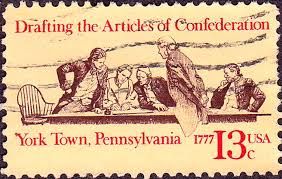
John Adams the first Vice President and second President of the United States James Armistead black slave who served in the colonial army as a spy General Edward Braddock commander of all British forces in North America during the French and Indian War Nathan Hale "I only regret that I have but one life to lose for my country." Patrick Henry Virginian who said, "Give me liberty, or give me death!" New York City our nation's first capital Battle of Bunker Hill the first major battle in the War for Independence judicial the branch of government that interprets the law executive the branch of government that enforces the law legislative the branch of government that makes the law Articles of Confederation the first plan of government that the United States had agreed upon Bill of Rights lists the rights or freedoms the Constitution gives to Americans; written in the form of ten amendments Constitution of the U.S. plan of government our country still follows today Declaration of Independence document written by Jefferson declaring the independence of the colonies from England First Amendment gives Americans the following freedoms: religion, speech, press, and assembly Treaty of Paris document signed by England giving up the American colonies and making them officially free and independent Inauguration Day The day the President takes his oath of office Valley Forge Washington's army spent the harsh winter of 1777-1778 Second Continental Congress The decision to organize the Continental Army was made at the ??? in 1775. constitutional republic The form of government in which the people and their elected representatives are limited by a constitution patriots Those who wanted America to be free from Britain's control
Principles of Government-US Constitution
US Government Test Part 2 - Constitution
Democratic Constitution in South Africa Struggle against Apartheid • Apartheid was the name of a system of racial discrimination unique to South Africa. • This system was particularly oppressive for the blacks. → They were forbidden from living in white areas. • Since 1950, the blacks, coloured and Indians fought against the apartheid system. • The African National Congress (ANC) was the umbrella organisation that led the struggle against the policies of segregation. • In 1964, Nelson Mandela and seven other leaders were sentenced to life imprisonment in 1964 for daring to oppose the apartheid regime in his country. Towards a New Constitution • As protests and struggles against apartheid had increased, the white regime changed its policies. • After 28 years of imprisonment, Nelson Mandela released from jail. • At the midnight of 26 April 1994, democracy was adopted as a form of government in South Africa. • After two years, a constitution came out which gave to its citizens the most extensive rights available in any country. Why do we need a Constitution? • A constitution is necessary because: → It generates a degree of trust and coordination that is necessary for different kind of people to live together. → It specifies how the government will be constituted, who will have power to take which decisions. → It lays down limits on the powers of the government and tells us what the rights of the citizens are. → It expresses the aspirations of the people about creating a good society. Making of the Indian Constitution • In 1928, Motilal Nehru and eight other Congress leaders drafted a constitution for India. • In 1931, the resolution at the Karachi session of the Indian National Congress dwelt on how independent India’s constitution should look like. • Factors contributed to the making of our Constitution. → Ideals of French Revolution → The practice of parliamentary democracy in Britain → The Bill of Rights in the US → The socialist revolution in Russia The Constituent Assembly • In July 1946, Elections to the Constituent Assembly were held. → The drafting of the document called the constitution was done Constituent Assembly. → Dr. Rajendra Prasad was the Chairman of the Constituent Assembly. → In December 1946, the first meeting was held. • After the country was divided into India and Pakistan, the Constituent Assembly also got divided. • The Assembly adopted the Constitution on 26 November 1949 but it came into effect on 26 January 1950. • To mark this day we celebrate January 26 as Republic Day every year. • The Constituent Assembly worked in a systematic, open and consensual manner. → First some basic principles were decided and agreed upon. → Then a Drafting Committee chaired by Dr. B.R. Ambedkar prepared a draft constitution for discussion. → More than two thousand amendments were considered. Philosophy of the Constitution • The Constitution begins with a short statement of its basic values which is called the Preamble to the constitution. The preamble focuses on: → Justice, social, economic and political. → Liberty of thoughts, expression, belief, faith and worship. → Equality of status and of opportunity. → Fraternity assuring the dignity of the individual and the unity and integrity of the nation.
