Loading...


Volume of Square Pyramid
Quiz by Rondel John Forjes
Customize this quiz to suit your class
Instantly translate to 100+ languages
Tag the questions with any skills you have. Your dashboard will track each student's mastery of each skill.
Give this quiz to my class
Find the volume of the given square pyramid.
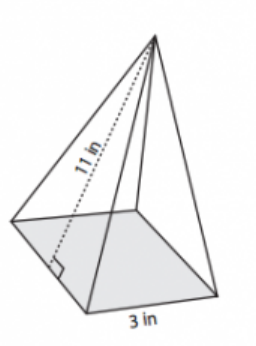
33 in3
35in3
44in3
45in3
A grade 6 AIS learner created a square pyramid model made out of recycled materials. The side length is 3in and the height is 9in. What is the volume of the pyramid?
29in3
30in3
28in3
27in3
Find the volume of the given square pyramid.

A grade 6 AIS learner created a square pyramid model made out of recycled materials. The side length is 3in and the height is 9in. What is the volume of the pyramid?
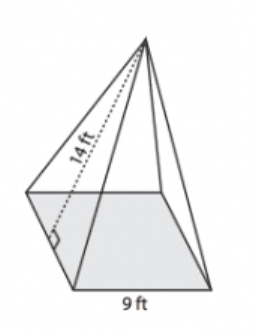
Find the volume of the figure
 Duplicate of Volume Cylinders Cones Square PyramidsFigure 18-11 represents the amount of energy stored as organic material in each trophic level in an ecosystem. The pyramid shape of the diagram indicates the low percentage of energy transfer from one level to the next. On average, 10 percent of the total energy consumed in one trophic level is incor- porated into the organisms in the next. Why is the percentage of energy transfer so low? One reason is that some of the organisms in a trophic level escape being eaten. They eventually die and become food for decomposers, but the energy contained in their bodies does not pass to a higher trophic level. Even when an organism is eaten, some of the molecules in its body will be in a form that the consumer cannot break down and use. For example, a cougar cannot extract energy from the antlers, hooves, and hair of a deer. Also, the energy used by prey for cellu- lar respiration cannot be used by predators to synthesize new bio- mass. Finally, no transformation or transfer of energy is 100 percent efficient. Every time energy is transformed, such as during the reactions of metabolism, some energy is lost as heat. Limitations of Trophic Levels The low rate of energy transfer between trophic levels explains why ecosystems rarely contain more than a few trophic levels. Because only about 10 percent of the energy available at one trophic level is transferred to the next trophic level, there is not enough energy in the top trophic level to support more levels. Organisms at the lowest trophic level are usually much more abundant than organisms at the highest level. In Africa, for exam- ple, you will see about 1,000 zebras, gazelles, and other herbivores for every lion or leopard you see, and there are far more grasses and shrubs than there are herbivores. Higher trophic levels con- tain less energy, so, they can support fewer individuals.A population is a group of organisms that belong to the same species and live in a particular place at the same time. All of the bass living in a pond during a certain period of time make up a pop- ulation because they are isolated in the pond and do not interact with bass living in other ponds. The boundaries of a population may be imposed by a feature of the environment, such as a lake shore, or they can be arbitrarily chosen to simplify a study of the population. The humans shown in Figure 19-1 are part of the pop- ulation of a city. The properties of populations differ from those of individuals. An individual may be born, it may reproduce, or it may die. A population study focuses on a population as a whole—how many individuals are born, how many die, and so on. Population Size A population’s size is the number of individuals that the population contains. Size is a fundamental and important population property but can be difficult to measure directly. If a population is small and composed of immobile organisms, such as plants, its size can be determined simply by counting individuals. Often, though, individ- uals are too abundant, too widespread, or too mobile to be counted easily, and scientists must estimate the number of individuals in the population. Suppose that a scientist wants to know how many oak trees live in a 10 km2 patch of forest. Instead of searching the entire patch of forest and counting all the oak trees, the scientist could count the trees in a smaller section of the forest, such as a 1 km2 area. The scientist could then use this value to estimate the population of the larger area. SECTION 1 OBJECTIVES ● Describe the main properties that scientists measure when they study populations. ● Compare the three general patterns of population dispersion. ● Identify the measurements used to describe changing populations. ● Compare the three general types of survivorship curves. VOCABULARY population population density dispersion birth rate death rate life expectancy age structure survivorship curve FIGURE 19-1 A population can be widely distributed, as Earth’s human population is, or confined to a small area, as species of fish in a lake are. Copyright © by Holt, Rinehart and Winston. All rights reserved. 382 CHAPTER 19 If the small patch contains 25 oaks, an area 10 times larger would likely contain 10 times as many oak trees. A similar kind of sampling technique might be used to estimate the size of the pop- ulation shown in Figure 19-2. To use this kind of estimate, the sci- entist must assume that the distribution of individuals in the entire population is the same as that in the sampled group. Estimates of population size are based on many such assumptions, so all esti- mates have the potential for error. Population Density Population density measures how crowded a population is. This measurement is always expressed as the number of individuals per unit of area or volume. For example, the population density of humans in the United States is about 30 people per square kilome- ter. Table 19-1 shows the population sizes and densities of humans in several countries in 2003. These estimates are calculated for the total land area. Some areas of a country may be sparsely popu- lated, while other areas are very densely populated. Dispersion A third population property is dispersion (di-SPUHR-zhuhn). Dispersion is the spatial distribution of individuals within the popu- lation. In a clumped distribution, individuals are clustered together. In a uniform distribution, individuals are separated by a fairly con- sistent distance. In a random distribution, each individual’s location is independent of the locations of other individuals in the popula- tion. Figure 19-3 illustrates the three possible patterns of dispersion. Clumped distributions often occur when resources such as food or living space are clumped. Clumped distributions may also occur because of a species’ social behavior, such as when animals gather into herds or flocks. Uniform distributions may result from social behavior in which individuals within the same habitat stay as far away from each other as possible. For example, a bird may locate its nest so as to maximize the distance from the nests of other birds. These migrating wildebeests in East Africa are too numerous and mobile to be counted. Scientists must use sampling methods at several locations to monitor changes in the population size of the animals. FIGURE 19-2 TABLE 19-1 Population Size and Density of Some Countries Population size Population density Country (in millions) (in individuals/km2) China 1,289 135 India 1,069 325 United States 292 30 Russia 146 8 Japan 128 337 Mexico 105 54 Kenya 32 54 Australia 20 3 dispersion from the Latin dis-, meaning “out,” and spargere, meaning “to scatter” Word Roots and Origins Copyright © by Holt, Rinehart and Winston. All rights reserved. POPULATIONS 383 The social interactions of birds called gannets, which are shown in Figure 19-3b, result in a uniform distribution. Each gannet chooses a small nesting area on the coast and defends it from other gannets. In this way, each gannet tries to maximize its distance from all of its neighbors, which causes a uniform distribution of individuals. Few populations are truly randomly dispersed. Rather, they show degrees of clumping or uniformity. The dispersion pattern of a population sometimes depends on the scale at which the popu- lation is observed. The gannets shown in Figure 19-3b are uni- formly distributed on a scale of a few meters. However, if the entire island on which the gannets live is observed, the distribution appears clumped because the birds live only near the shore. POPULATION DYNAMICS All populations are dynamic—they change in size and composition over time. To understand these changes, scientists must know more than the population’s size, density, and dispersion. One important measure is the birth rate, the number of births occur- ring in a period of time. In the United States, for example, there are about 4 million births per year. A second important measure is the death rate, or mortality rate, which is the number of deaths in aIn a single domesticated grain seed, one might see the bud of great civilizations. The birth of agriculture was a turning point in humans' social development, as stable food supplies enabled people to transcend the constraints of food gained by hunting and gathering. After that, people were able to settle down and experience population booms. As one of the major areas around the globe where agriculture originated, China has contributed to the world's domesticated rice, millet, buckwheat and soybeans. Archaeological studies have unveiled that the planting of rice originated around 10,000 years ago in the lower reaches of the Yangtze River, leading to the eventual replacement there of hunting and gathering practices dating back 5,000 to 6,000 years. "It marked the formation of a rice-based agricultural society in the area," said Zhao Zhijun, an archaeologist at the Chinese Academy of Social Sciences. Archaeological studies of the origins of rice-based agriculture are an important part of a national project tracing the origins of Chinese civilization itself. President Xi Jinping has greatly valued the project. At a group study session of the Political Bureau of the Communist Party of China Central Committee on May 27, 2022, Xi, who is also general secretary of the CPC Central Committee, emphasized the significance of the project and the role that archaeological studies play in better understanding Chinese civilization. The project to trace the origins of Chinese civilization, in addition to finding signs of human activity more than 1 million years ago, has also proved that China's history includes 10,000 years of culture and more than 5,000 years of civilization. The project has provided clear knowledge of the origins and formation of Chinese civilization, the history of its development, the process of the formation and development of its pluralistic and integrated pattern, and the characteristics of the civilization and why it was formed in such a way, he added. This was not the first time that Xi emphasized the importance of the origin-tracing project. Since the 18th National Congress of the CPC in 2012, Xi has toured more than 100 historical and cultural locations and issued many instructions related to archaeology and the origin-tracing project. During the 23rd group study session of the Political Bureau of the CPC Central Committee in 2020, Xi called for giving more attention to archaeological research and letting historical facts speak for themselves. "This will provide strong support for our efforts to carry forward the best of traditional Chinese culture and increase our cultural confidence," said Xi. The origin-tracing project has been carried out since 2002. Its ongoing fifth phase, which started in 2020, involves the participation of more than 500 researchers from 29 institutes across the country. It primarily centers on several ancient capital sites, including the Liangzhu site in Hangzhou, Zhejiang province, the Taosi site in Xiangfen county, Shanxi province, the Shimao site in Shenmu, Shaanxi province, and the Erlitou site in Luoyang, Henan province, from 3,500 to 5,500 years ago, as well as other settlements mainly along the basins of the Yellow, Yangtze and Liaohe rivers. The project has also expanded to a wider geographic and chronological framework to decode how Chinese civilization emerged and how its diverse elements formed a unity. Excavation of the Liangzhu site, which is over 5,000 years old and is one of the major sites covered in the origin-tracing project, has yielded an inner city covering 3 million square meters and an outer city of 6.3 million sq m, making it the world's largest capital at the time. It also had a giant water control system, which contributed to the formation of a rice-based agricultural society. By calculating the earthwork volume, archaeologists found that building the entire ancient city, the water control system and Mojiaoshan — a 10-meter-tall man-made terrace in the center of the city — required 10,000 people working daily for seven-and-a-half years. The discoveries show that Liangzhu had a kingship able to organize people for large-scale public construction, and its social differentiation, emergence of the city concept and existence of a kingship prove that it became a civilized society, said Wang Wei, a veteran archaeologist at the Chinese Academy of Social Sciences. Significant topic Wang said that tracing the origins of a civilization is a significant topic in the research of human history. Over the years, the Chinese project has provided China's answer to how to define civilizations. In 2022, Xi commended the efforts and stressed that the project has made creative contributions to the research on tracing the origins of the world's civilizations. Wang said: "International academia has proposed three indispensable elements for a civilized society based on features of Mesopotamian and Egyptian civilizations: written characters, metallurgy and the city concept. But we can find that some of the three elements were absent in many ancient civilizations. For example, the Mayan civilization had no metallurgy, while the Incan civilization didn't have written characters." Western scholars believe that Chinese civilization began with the Yinxu Ruins in Anyang, Henan province, a capital of the late Shang Dynasty (c.16th century-11th century BC), based on the discovery of inscribed oracle bones from that time. However, Chinese archaeologists don't agree. With continued archaeological research, international academia now believes that places around the world can propose criteria for civilization based on their own ancient social development. China's archaeological studies have shaped the nation's criteria in defining a civilization: the development of productivity, an increase in population, the appearance of cities, social differentiation and the emergence of kingship and state. "These criteria are suitable for identifying other civilizations as well," said Wang. "Civilizations have in common the appearance of kingship and state. They are only different in the ways of imposing kingship and the forms of state." In China, kingship and state "were shown by exquisite jade and bronze ritual artifacts, grand palaces and magnificent mausoleums imitating aboveground palaces", he added. "In Mesopotamia and ancient Egypt, they were demonstrated through superb stone temples, pyramids and large-scale tombs." Multidisciplinary subject President Xi said in 2020 that archaeologists should work closely with researchers from other fields to make an interpretive analysis of material remains. Zhang Chi, a professor of archaeology at Peking University, said that since material remains are often the research focus of archaeological studies, these should not only be observed with the eyes, but also studied using scientific and technological tools. Therefore, from the perspective of research methods, archaeology is by nature a multidisciplinary subject, Zhang added.Volume of Rectangular PrismsVolume of pyramids, prism, and cylinder Volume of Cylinders - Starter QuizVolume of prismsVolume of 2 Prisms