Our brand new solo games combine with your quiz, on the same screen

Correct quiz answers unlock more play!

New Quizalize solo game modes
10 questions
Show answers
  • Q1
    Which atmospheric variable will increase before precipitation?
    dew point
    temperature
    relative humidity
    barometric pressure (air pressure)
    60s
    6.E.2A.3
  • Q2
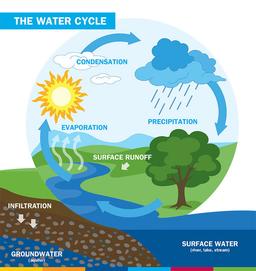
    Mr. Sims is working in his garage. He goes and gets a glass of water and ice and sits it near where he is working. When he reaches for the glass, he realizes there is water droplets on it. What step of the water cycle would create these water droplets?
    Evaporation
    Transpiration
    Condensation
    Precipitation
    60s
    6.E.2A.3
  • Q3
    How is transpiration important to the water cycle?
    Question Image
    It permits the diffusion of water from the surface to water tables deep underground which restores groundwater supplies.
    It allows plants to absorb water through their roots which is then precipitated back into the atmosphere.
    It results in the deposition of water vapor directly as ice, so water changes states causing the cycle to move to the next phase.
    It is the evaporation of water from the leaves of plants back into the atmosphere allowing the cycle to continue.
    60s
    6.E.2A.3
  • Q4
    A storm that produces very heavy precipitation passes over Columbia, South Carolina. It the surface that the rain falls on is not porous, what will most likely happen to the rain?
    evaporation
    condensation
    transpiration
    run off
    60s
  • Q5
    A student wants to find out how much water is present in the soil in her garden. She places a sample of soil from her backyard in a container and measures its mass on a triple beam balance. The student places that sample in an oven at 121 degrees Celsius (250 degrees F) for one hour before measuring the sample again. What should the student do to calculate the amount of water in the coil accurately?
    The mass of the container in which the soil sample is measured should be measured before placing the soil in it.
    The initial and final masses of the soil sample after heating should be measured on two different triple beam balances.
    The decimal values in the final mass of the soil sample should be rounded to the nearest whole number.
    The initial and final masses of the soil sample should be added together to find the quantity of water.
    60s
  • Q6
    What would happen if the Sun was removed from the water cycle?
    Question Image
    The water cycle would not include precipitation but would continue with groundwater flow.
    The water cycle would not include evaporation and transpiration but would continue with condensation.
    The water cycle would no longer occur because the Sun provides the energy for evaporation and transpiration.
    The water cycle would no longer occur because the Sun provides the energy for the formation of clouds.
    60s
  • Q7
    Dew and frost are formed from water. How are dew and frost related?
    Question Image
    Dew forms when liquid water vaporizes, and frost forms when water condenses.
    Frost forms at temperatures above freezing, and dew forms at temperatures below freezing.
    Dew forms at temperatures above freezing, and frost forms at temperatures below freezing.
    Frost forms when liquid water vaporizes, and dew forms when water condenses.
    60s
  • Q8
    A student examines the process of condensation and evaporation in the water cycle by filling a beaker with water and covering the beaker with a glass lid. She positions the lamp so that its light shines on the beaker, as shown by the image. The student finds that condensation did not significantly collect on the glass lid. What change should the student make in the design process to make her results more accurate?
    Question Image
    Remove the lid and leave the beaker open to the light from lamp.
    Turn the lid over and pour some warm water on it.
    Remove the lid and cover the beaker with a dark cloth.
    Turn the lid over and place some ice cubes on it.
    60s
  • Q9
    Bob sees some water droplets on the outside surface of a glass of lemonade as shown. What process of the water cycle can explain this phenomenon?
    Question Image
    Condensation
    Precipitation
    Evaporation
    Transpiration
    60s
  • Q10
    Bella performs an experiment to study transpiration in the water cycle. She takes a plant cutting, pulls the plant stem down through a hole in a piece of cardboard, and seals the hole. The lower end of the stem is dipped in water, and the top part of the plant is covered with a clear plastic cup as shown. After leaving the plant in a closet for one day, Bella finds a few water droplets on the inner walls of the plastic cup. How should Bella change the experimental design so that more water droplets are formed in the same amount of time?
    Question Image
    Place the setup in direct sunlight.
    Add more water to the bottom cup.
    Reduce the length of the plant covered by the plastic cup.
    Make holes in the plastic cup that covers the plant.
    60s

Teachers give this quiz to your class