Loading...

Week 12: Anthropology
Quiz by Professor J. Crowson
Tag the questions with any skills you have. Your dashboard will track each student's mastery of each skill.
What happened during a major case in Hartford that occurred in 1944 that involved anthropology examinations in the last 10-15 years?
A university had severe flooding, which caused the death of 60 students.
An apartment building collapsed and killed 45 people.
A large circus tent caught fire and killed 167 people.
A major car accident involving multiple cars killed 72 people.
What are the four subfields of anthropology?
Archaelogy, Linguistics, Cultural, and Physical
Linguistics, Cultural, Bioarchaeology, and Paleoanthropology
Biological, Forensic, Physical, and Cultural
Cultural, Ecology, Primatology, and Biological
What happened during a major case in Hartford that occurred in 1944 that involved anthropology examinations in the last 10-15 years?
What are the four subfields of anthropology?
______________ is the study of humanity including its cultures, populations, biology, and languages.

Forensic anthropologists will use their specialized knowledge in what and apply it to legal investigations?
________________ are specialists who study the changes that occur in biological specimens from the time of death until they are recovered and analyzed.
Forensic __________ are trained in plants and plant parts, and apply that specialized knowledge to legal investigations.
Which of the following is NOT a function of our bones?
_________ bones are usually thin, broad, and protect vital organs. An example of these would be the ribs or shoulder blades.
___________ bones are sometimes called cuboidal due to their similarities in length and width. Carpals or tarsals found in the hands and feet are examples of these.

________ bones are longer than wide with a shaft that contains marrow; examples of these are the femora, humeri, or ulnae.
_________ bones are ones that are small and flat, they are usually found at joints within tendons. Your patella is an example of one of these.
__________ bones are ones that are unusually shaped and may have various types of surface features. Your vertebrae or hip bones would be examples of these.
_______ bones refer to small, flat, irregularly shaped bones that have edges that are fusion lines. This category would fit many cranial bones.
The two important questions a forensic anthropologists needs to answer are:

________ bone is dense, solid bone material that is on the external portions of bones and also within the walls of the bone shaft of the long bones; it usually has a smooth and sometimes, shiny appearance.
____________ bone also called cancellous bone, is the permeable and lightweight bone structure that is found within the bones; its appearance is similar to a kitchen sponge in that it looks porous and webbed.
In order to determine whether or not bones are human are non-human, an anthropologists will consider what two concepts related to skeletal material?
___________ are also called teaching skeletons, which refer to remains that have been treated and prepared for use in educational settings.

MNI or MLNI, helps to determine what in forensic anthropology cases?
All of the following EXCEPT FOR are part of the big four of a biological profile estimated by a forensic anthropologists?

Which two parts of the skeleton are best for determining a person's sex?

A person with a pelvis that is narrow overall, has a heart-shaped pelvic inlet, and an acute subpubic angle most likely belongs to?

A skull that is smooth and gracile with smaller brow ridges, but a pointed mandible, most likely belongs to?
While the skull is the best part of the skeleton to determine ancestry from- this area, also called the facial skeleton, is where anthropologists will pay most attention to.
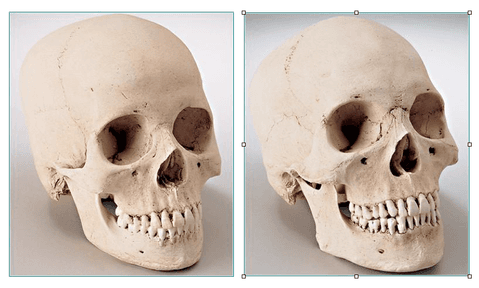
All of the following facial features can be helpful to determine ancestry EXCEPT FOR what?
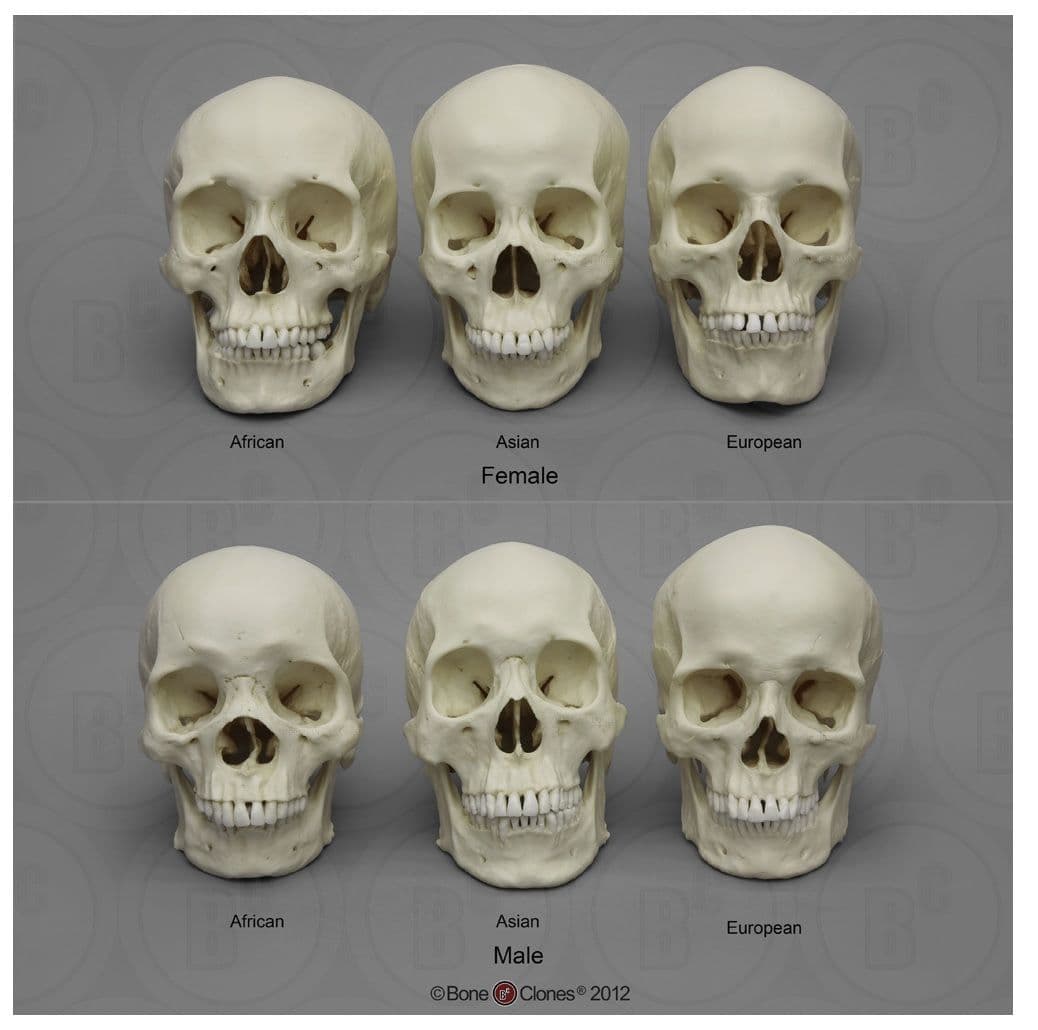
A skull with a prominent alveolar projection, a smaller brow ridge, and a low nose, most likely belongs to which ancestral group?
A skull with a high nasal bridge, reduced alveolar projection, and a straight or jagged palatine suture, most likely belongs to a person from which ancestral background?

Forensic anthropologists determined the age of a skeleton, which refers to....
All of the following EXCEPT FOR what is used to age a skeleton?
All of the following are reasons why stature cannot be determined from skeletal remains by measuring it, EXCEPT FOR....

A ___________ wound is a GSW where a bullet has entered the body but did not exit.

A _________ wound is a GSW that has both entered and exited the body.
As a projectile strikes and perforates bone, it displaces the material as it moves through causing the exiting surface to be larger than the initial point of impact. This displacement of bone is termed as ____________.

Using Puppe's rule, we can sequence wound based on fracture lines because?

