Tag the questions with any skills you have. Your dashboard will track each student's mastery of each skill.
Give this quiz to my class
Q 1/20
Score 0
A bacterium is 0.5 μm long. A student makes a drawing of the bacterium. The student’s drawing is 100 mm long.
What is the magnification of the student’s drawing?
60
×0.005
×200 000
×50
×200
Q 2/20
Score 0
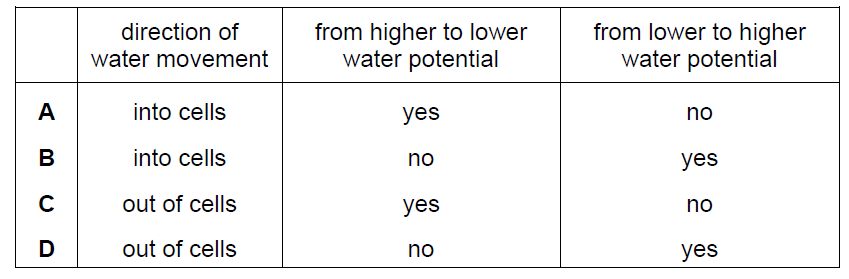
Red blood cells were placed in pure water.
Movement of water across the cell membrane caused a change in their appearance.
What caused this change in appearance?
60
D
C
A
B
20 questions
Q.
A bacterium is 0.5 μm long. A student makes a drawing of the bacterium. The student’s drawing is 100 mm long.
What is the magnification of the student’s drawing?
1
60 sec
Q.
Red blood cells were placed in pure water.
Movement of water across the cell membrane caused a change in their appearance.
What caused this change in appearance?
2
60 sec
Q.
The diagram shows a root hair cell. Why does a root hair cell contain a large number of mitochondria?
3
60 sec
Q.
Enzyme X digests protein in the stomach.
Four test-tubes were set up, each contained the same amounts of protein and enzyme X. The
test-tubes are kept at different levels of pH and temperature, as shown in the table.
In which test-tube will protein digestion be quickest?
4
60 sec
Q.
The pie charts show the composition of 100 g of four different foods.
Which food provides the most energy?
5
60 sec
Q.
The diagram shows the effect of an enzyme working in the human digestive system. What would reduce the rate of production of amino acids?
6
60 sec
Q.
The diagram shows part of a plant root in the soil. The root is absorbing water.
At which labelled point is the water potential highest?
7
60 sec
Q.
One strand of a DNA molecule contains the base sequence AGT.
What is the base sequence on the other strand of the DNA molecule?
8
60 sec
Q.
Which process is involved in the uptake of glucose by the epithelial cells of kidney tubules?
9
60 sec
Q.
The graph shows how an enzyme-controlled reaction is affected by temperature Which statement explains the change in activity between X and Y?
10
60 sec
Q.
Discs of raw potato tissue are weighed (initial mass). They are then placed in sucrose solutions of different concentrations. After one hour their masses are measured again (final mass).
The graph shows how the ratio of initial mass :final mass changes with concentration of sucrose solution. Which concentration of sucrose solution has the same water potential as that of the cells in the potato discs?
11
60 sec
Q.
The diagram shows some cells in the root of a plant that is absorbing water from the soil. How does the water potential of the cell marked 2 differ from the water potentials of the cells marked 1 and 3?
12
60 sec
Q.
Some organisms live at the bottom of the sea where it is very dark. To synthesise glucose, they use energy from chemicals in the very hot water that comes out of volcanoes.
What is a distinguishing feature of these organisms?
13
60 sec
Q.
In an enzyme’s action, where is the active site and where are the lock and the key?
14
60 sec
Q.
Which symptom of malnutrition can be treated by an increased amount of protein in the diet?
15
60 sec
Q.
The actual thickness of the leaf is 2000 μm, but its thickness in the diagram is 50 mm. What is the magnification of the diagram?
16
60 sec
Q.
Commercial fishermen use ice to store the fish that they catch.
How does the ice keep the fish fresh?
17
60 sec
Q.
The graph shows the effect of temperature on an enzyme-controlled reaction. Which statement describes the effect of temperature on this reaction?
18
60 sec
Q.
A student draws a diagram of a mitochondrion. The diagram has a magnification of ×20000. The diagram is 5 cm long.
What is the actual size of the mitochondrion?
19
60 sec
Q.
The diagram shows a tooth with signs of decay. What has made the hole in the enamel of the tooth?