Loading...

What is my topic?
Quiz by Donna Stanmore
Customize this quiz to suit your class
Instantly translate to 100+ languages
Tag the questions with any skills you have. Your dashboard will track each student's mastery of each skill.
Give this quiz to my class
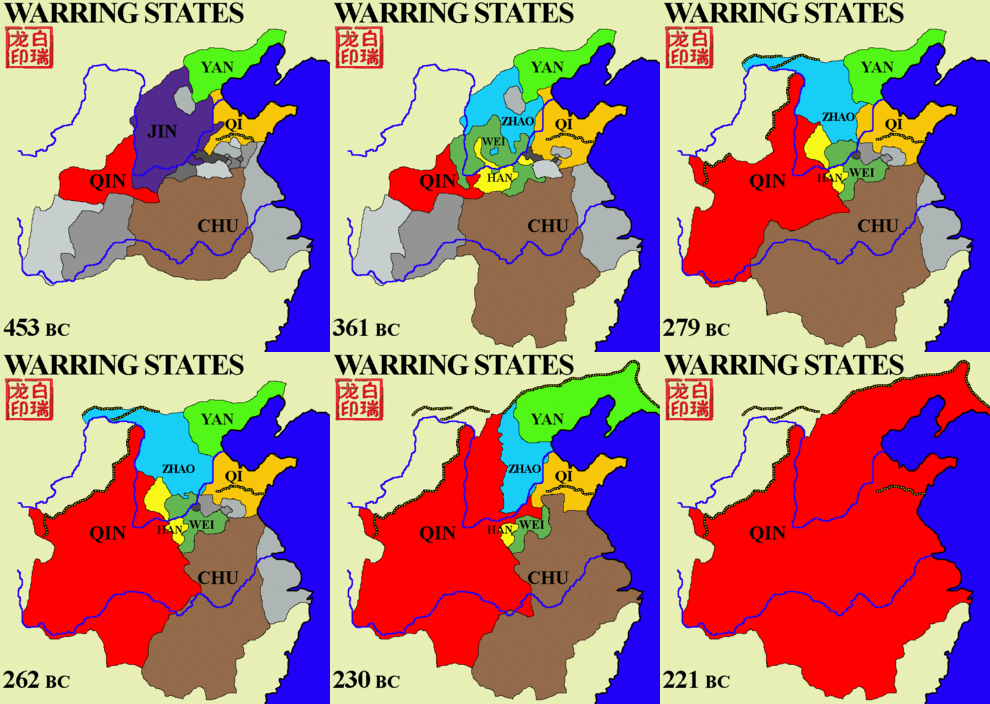
 Source B: A Strong Army R. R. Wertz (2017) Qin Mausoleum and Terra Cotta Army, Exploring Chinese History - website The terra cotta figures were buried with the first Emperor of Qin (Qin Shi Huang) in 210 - 209 BCE. Consequently, they are also sometimes referred to as "Qin's Army." All 8,099 soldiers are unique and distinguishable with different height and facial features. The soldiers are modelled after selected soldiers from the time period who were considered to be the finest of China. The figures are in several poses including standing infantry and kneeling archers as well as charioteers with horses. There are three separate pits, which represent three different sections of the army. The largest pit, and most famous, holds the infantry. The second pit contains the cavalry, and the third contains the officers. A fourth pit, which was planned but never built, is thought to be the supply unit. What is the topic of my paragraph?Health 11/12 Review for Final Exam Core Concepts - Mental and Emotional Health, Substance Abuse Prevention, Safety and Violence Prevention, Family Life and Human Sexuality, Disease Prevention and Control, Healthy Eating Health Education Skills - goal setting, decision making, accessing information/resources, analyzing influences, communication, self-management, advocacy DIMENSIONS of Wellness - social, spiritual, emotional/mental, environmental, financial, intellectual, multicultural, occupational, physical, sexual RISK factors - anything that increases the risk of disease, injury, or illness. PROTECTIVE factors - anything that decreases the risk of disease, injury, or illness. INTERNAL health factors - health factors that can be either hereditary and genetic or acquired elements -- include smoking and personal diet or eating habits. Example – a genetic predisposition to an illness. EXTERNAL health factors - health factors that are part of the direct outer environment, the geographical location, micro-organisms, socio-economic elements that could affect an individual's health. Example – being unable to afford mental health services. Unit 1- Managing Personal and Community Wellness Explain Maslow’s Hierarchy of Needs in your own words using the image provided. Explain how each Social Determinant of Health may impact a person’s health. Levels of Disease Prevention • PRIMARY The goal is to avoid conditions altogether. • SECONDARY The goal is early detection. • TERTIARY The goal is to minimize the damage (manage). Define the following terms. Fads/Trends Sleep hygiene Driver safety Unit 2- Investigating Social Ecological Factors on Well-Being Socio-Ecological Model – The SEM examines how health behaviors form based on characteristics of individuals, communities, nations and levels in between. Each level overlaps with other levels signifying how the best public health strategies are those that encompass and target a wide range of perspectives. Interpersonal (personal) health vs. intrapersonal (relationship) health Health INEQUITY - systemic, ingrained and unjust barriers that prevent segments of the population from having the opportunity of health leading to health disparity. IMPLICIT BIAS - a form of bias that occurs automatically and unintentionally, that nevertheless affects judgments, decisions, and behaviors. Research has shown implicit bias can contribute to unequal access to quality healthcare, negative patient-provider relationships and interactions; and create mistrust in the healthcare system and practitioners among patients. This can contribute to health disparities. Health DISPARITY - represents a difference in health between populations. It is often used to describe disease burden and other negative health outcomes socially disadvantaged groups may face. Health EQUITY - The opposite of health inequity. It describes a system that supports a high standard of health and healthcare for all people. Racism - Beliefs, attitudes, institutional arrangements, and acts that tend to denigrate individuals or groups because of phenotypic characteristics or ethnic group affiliation. DISCRIMINATION - An unjust differential treatment of a person or a group. PRIVILEGE- The unearned access to resources and social power that are only available to some because of their membership within certain social groups. OPPRESSION is the act of taking away choices from others and can be defined as a system that maintains advantage and disadvantage based on social identities and that acts on multiple levels from interpersonal to institutional and societal. (internalized, interpersonal, institutional, structural) Systematic Oppression - Intentional disadvantage of groups of people based on their identity while advantaging members of dominant group (race, gender, sexual orientation, language, size, ability, etc.). Intersectionality - The complex, cumulative way in which the effects of multiple forms of discrimination (such as racism, sexism, and classism) combine, overlap, or intersect especially in the experiences of marginalized individuals or groups Unit 3- Accessing Resources and Communicating to Support Mental and Emotional Health What is anger? What is anxiety? What is stress? STRESSORS are the things that cause stress. Stressors can be internal and external. A stressor may be a one-time or short-term occurrence, or it can happen repeatedly over a long time. INTERNAL Stressors - are made by your belief system and the way you evaluate yourself. Examples include pessimistic attitude, negative self-talk, deep need to be perfect, low self-esteem or body image, unhealthy standards for self. EXTERNAL Stressors - are stressful things that happen in your surroundings and/or in your environment. Examples include busy schedules, work problems, family issues, financial trouble, social problems, injury, unforeseen circumstances. Socio-economic issues are also a part of external stressors such as poverty, violence, and racism. Define the following mental health conditions. Depression Eating disorders NSSI Non-suicidal self-injury Grief/Loss Suicide prevention A.C.T. • ACKNOWLEDGE- Tell them in a caring way that you recognize that they are having a problem • CARE- You can show you care by actively listening - put away anything else you are doing, make eye contact, sit down, ask questions. • TELL-(call 988 for additional help and support) - Tell them it is important that they speak with a trusted adult. Help them figure out who this may be and offer to go with your friend. A social norm is an unwritten, informal rule meant to guide behavior among the of society. It distinguishes between acceptable and unacceptable, good and bad, and so on. Social norms can influence a person with emotional or mental health disorders, access to care and stigmatize their situation. STIGMA- a mark of disgrace associated with a particular circumstance, quality, or person. • Self-stigma - This describes the internalized stigma that people with mental health conditions feel about themselves. • Public stigma - This refers to the negative attitudes around mental health from people in society. • Institutional stigma - This is a type of systemic stigma that arises from corporations, governments, and other institutions. Unit 4- Evaluating Risks of Substance Use and Abuse Harm Reduction - a set of practical strategies and ideas aimed at reducing negative consequences associated with drug use. Explain how each level of the Social Ecological Model is impacted by addiction. Individual Relationship Community Society SEM Level Contributing/Risk Factors to substance use Preventative/Protective Factors for substance use Individual Interpersonal/Relationship Community Society Unit 5- Analyzing Influences to Examine Ways to Increase Safety and Reduce Violence HATE CRIME - a crime, usually violent, motivated by prejudice or intolerance toward an individual’s national origin, ethnicity, color, religion, gender, gender identity, sexual orientation, or disability. Explain how the media influences violence in society. The Pyramid of Hate Explain the escalation of hate using the Pyramid of Hate visual. List several hate crime motivators. Example: age HEALTHY Relationship Signs - comfortable pace, trust, honesty, independence, respect, equality, kindness, taking responsibility, healthy conflict, fun UNHEALTHY Relationship Signs - intensity, possessiveness, manipulation, isolation, sabotage, belittling, guilting, volatility, deflecting responsibility, betrayal Sexual Assault is a sexual behavior WITHOUT consent. Human trafficking - the recruitment, harboring, transportation, provision, or obtaining of a person for labor or services, using force, fraud, or coercion for the purpose of subjection to involuntary servitude, peonage, debt bondage, or slavery. Sex trafficking - commercial sex act induced by force, fraud, or coercion, or in which the person induced to perform such an act has not attained 18 years of age. Trafficking happens using… • Force - using violence to control someone. • Fraud - using lies to control someone. • Coercion - using threats to control someone. Unit 6- Family Life and Human Sexuality Agency - A belief about yourself and the extent to which you can act on that belief. • The ability to choose freely one’s own narrative. • To embrace the idea that I am the cause (or agent) of my own thoughts and actions. • Personal agency is a personal responsibility for who we are, what we experience, what we do about that experience, and how we shape our world to give us more of the experiences we want. SEXUAL Agency • The ability to choose your own interests and desires vs. what we see in the media or others’ perceptions • The ability to identify, communicate, and negotiate one’s sexual needs • The ability to initiate behaviors that allow for the satisfaction of those needs Sexually Explicit Material - photographs, videos, films, magazines, and books whose primary themes, topics, or depictions involve sexuality that may cause sexual arousal. Sexual scripts - thoughts, patterns, or behavior that a person has about themselves in a romantic or sexual context. It is how people picture themselves or want to project themselves in front of others. Reproductive Rights of Teens - In Maryland, teens have the right to an abortion, keep their child, obtain and use birth control, paternity tests, adoption, give up custody of their child within 10 days of birth (Safe Haven Law). • REPRODUCTIVE RIGHTS- legal rights and the freedom of the individual to control decisions regarding contraception, abortion, sterilization and childbirth. • SAFE HAVEN LAW- a distressed parent who is unable or unwilling to care for their infant can safely give up custody of their baby, no questions asked. CONSENT is an agreement between participants to engage in sexual activity. • It is clearly and freely communicated, verbal, and affirmative. Consent CANNOT be given if… • A person is underage, one or both partners is intoxicated or incapacitated by drugs or alcohol, one partner is asleep or unconscious, one partner feels pressured, threatened or intimidated, or one partner holds a position of power or authority over the other. Unit 7- Advocating for Enhanced Nutrition, Food Systems, and Health Outcomes Dietary Guidelines for Americans Guideline 1: Follow a Healthy Dietary Pattern at Every Life Stage Guideline 2: Customize and Enjoy Food and Beverage Choices to Reflect Personal Preferences, Cultural Traditions, and Budgetary Considerations Guideline 3: Focus on Meeting Food Group Needs with Nutrient-Dense Foods and Beverages, and Stay Within Calorie Limits Guideline 4: Limit Foods and Beverages Higher in Added Sugars, Saturated Fat, and Sodium, and Limit Alcoholic Beverages FOOD DESERT- a neighborhood where there is little or limited access to healthy and affordable food such as fruits, vegetables, whole grains, low-fat milk and other foods that make up the full range of a healthy diet. FOOD INSEQURITY lack of access to a sufficient amount of food because of limited funds. More than 49 million American households are considered food insecure and are vulnerable to poor health as a result. PROCCESED FOODS- any raw agricultural commodities that have been washed, cleaned, milled, cut, chopped, heated, pasteurized, blanched, cooked, canned, frozen, dried, dehydrated, mixed or packaged — anything done to them that alters their natural state.Name: Marco Ramirez - “I Am Not Batman” TW: language It’s the middle of the night. And the sky is glowing like mad radioactive red. And if you squint, you could maybe see the moon through a thick layer of cigarette smoke and airplane exhaust that covers the entire city like mosquito net that won’t let the angels in. And if you look up high enough you could see me-standing on the edge of a eighty seven story building. And up there-a place for gargoyles and broken clock towers that have stayed still and dead for maybe like a hundred years-up there is me. And I’m freakin Batman. And I gots Bat-mobiles and Bat-a-rangs and freakin Bat-caves like for real, and all it takes is a broom closet or a back room or a fire escape and Danny’s hand-me-down jeans are gone. And my navy blue polo shirt? – The one that looks kinda good on me but has a hole on it near the butt from when it got snagged on the chain linked fence behind Arturo’s but it isn’t even a big deal cause I tuck that part in and its like all good? –that blue polo shirt? – It’s gone too. And I get like, like transformational. And nobody pulls out a belt and whips Batman for talking back –-Or for not talking back –And nobody calls Batman simple –- Or stupid –- Or skinny –- And nobody fires Batman’s brother from the Eastern Taxi Company ‘cause they was making cutbacks, neither, ‘cause they got nothing but respect, and not like afraid-respect. Just like respect-respect. ‘Cause nobody’s afraid of you. Cause Batman doesn’t mean nobody harm. Ever. Cause all Batman really wants to do is save people and maybe pay Abuela’s bills one day and die happy and maybe get like mad famous. For real.…And kill the Joker. Tonight, like most nights, I’m all alone. And I’m watching…And I’m waiting… Like a eagle. Or like a –no, yea, like a eagle. And my cape is flappin’ in the wind (‘cause it’s freakin’ long), and my pointy ears are on, and that mask that covers like half my face is on too, and I got like bulletproof stuff all in my chest so no one could hurt me and nobody – nobody – is gonna come between Batman, And Justice. From where I am I could hear everything. Somewhere in the city there’s a old lady picking Styrofoam leftovers up outta a trash can and she’s putting a piece of sesame chicken someone spit out into her own mouth. And somewhere there’s a doctor with a whack haircut in a black lab coat trying to find a cure for the diseases that are gonna make us all extinct for real one day. And somewhere there’s a man, a man in a janitor’s uniform, stumbling home drunk and dizzy after spending half his paycheck on forty-ounce bottles of twist-off beer and the other half on a four hour visit to some lady’s house on a street where the lights have all been shot out by people who’d rather do what they do, in this city, in the dark. And half a block away from JanitorMan there’s a group of good-for-nothings who don’t know no better waiting to beat JanitorMan with rusted bicycle chains and imitation Lousiville Sluggers, and if they don’t find a cent on him – which they won’t – they’ll just pound at him till the muscles in their arms start burning, till there’s no more teeth to crack out. But they don’t count on me. They don’t count on no dark night (with a stomach full of grocery store brand macaroni-and-cheese and cut up Vienna sausages), Cause they’d rather believe I don’t exist, And from eighty-seven stories up I could hear one of the good-for-nothings say “Gimmethecash” real fast (like that) just “Gimmethefuckingcash” and I see JAnitorMan mumble something in drunk language and turn pale and from eighty-seven stories up I could hear his stomach trying to hurl its way out of his Dickies. So I swoop down like and fast and I’m like darkness. I’m like SWOOSH –- And I throw a Bat-a-rang at the one naked lightbulb –- And they’re all like “whoa-motherfucker-who-just-turned-out-the-lights?” –“What’s that over there?” –-“What?” –- “Gimme whatchou got old man” –- “Did anybody hear that?!” –- “No, really” –- “There ain’t. No. Bat.” – But then –- One out of three good-for-nothings gets it to the head! And number Two swings blindly into the dark cape before him but before his fist hits anything I grab a trash can lid and –-- Right into the gut, and number One comes back with a jump-kick but I know judo-karate too so I’m like –-- Twice –-- but before I can do any more damage suddenly we all hear a CLIC – CLIC –And suddenly everything gets quiet And the one good-for-nothing left standing grips a handgun and aims straight up, like he’s holding Jesus hostage, like he’s threatening maybe to blow a hole in the moon. And the good-for-nothing who got it to the head who tried to jump-kick me and the other good-for-nothing who got it in the gut is both scrambling back away from the dark figure before him. And the drunk man the JanitorMan is huddled in a corner, praying to Saint Anthony ‘cause that’s the only one he could remember. And there’s me, Eyes glowing white, cape blowing softly in the wind. Bulletporoof chest heaving. My heart beating right through it in a Morse code for “fuck with me, just once, come on, just try.” And the one good-for-nothing left standing, the one with the handgun, he laughs he lowers his arm, and he points it at me and gives the moon a break, and he aims it right between my pointy ears, like goalposts and he’s special teams. And JanitorMan is still calling Saint Anthony but he ain’t pickin’ up, And for a second it seems like…maybe I’m gonna lose. Naw. SHOO – SHOO! FUACATA! --“Don’t kill me man!” –“SNAP! – Wrist CRACK – Neck – SLASH! – Skin – meets – acid – “AHH!!” –And he’s on the floor. And I’m standing over him. And I got the gun in MY hands now. And I hate guns, I hate holding ‘em cause I’m Batman, and –Batman don’t like guns ‘cause his parents got iced by guns a long time ago – but for just a second, my eyes glow white, and I hold this thing, for I could speak to the good-for-nothing in a language he maybe understands…CLIC – CLIC…And the good-for-nothings become good-for-disappearing into whatever toxic-waste-chemical-sludge-shit-hole they crawled out of. And it’s just me and JanitorMan. And I pick him up. And I wipe sweat and cheap perfume off his forehead. And he begs me not to hurt him and I grab him tight by his JanitorMan shirt collar and I pull him to my face, and he’s taller than me, but the cape helps so he listens when I look him straight in the eyes and I say two words to him: “Go home.” And he does, checking behind his shoulder every ten feet. And I SWOOSH from building to building on his way there, ‘cause I know where he lives. And I watch his hands where he lives. And I watch his hands tremble as he pulls out his keychain and opens the door to his building. And I’m back in bed before he even walks in through the front door. And I hear him turn on the faucet and pour himself a glass of warm tap water And he puts the glass back in the sink. And I hear his footsteps, And they get slower as they get to my room. And he creaks my door open like mad slow. And he takes a step in, which he never does. And he’s staring off into nowhere, his face the color of sidewalks in summer, and I act like I’m just waking up, and I say, “What’s up, Pop?” And JanitorMan says nothing to me. But I see, in the dark, I see his arms go limp and his head turns back, like towards me, and he lifts it for I could see his face, For I could see his eyes, And his cheeks is dripping but not with sweat. And he just stands there, breathing, like he remembers my eyes glowing white. Like he remembers my bulletproof chest. Like he remembers he’s my pop. And for a long time I don’t say nothing. And he turns around, hand on the doorknob, and he ain’t looking up my way but I hear him mumble two words to me. “I’m sorry.” And I lean over and open my window just a crack.… If you look up high enough you could see me. And from where I am? I could hear everything.7.018 Safe Injection Practices (Refer to 7.07 Safe Injection Policy) Environment of Care: Active participation with all identified projects to assess compliance with infection control standards. . Surveillance, Control, and Reporting includes: Baseline information about the frequency and type of nosocomial infections. Identification of patients and/or staff with communicable or potentially communicable infections. Patients identified with a communicable disease will be isolated from other patients in the facility or, if this is not possible, they will be transferred to a local hospital for care or rescheduled. Identification of clusters of microorganisms or significant deviations from endemic level. Reporting to committees and outside agencies, when required. Investigation of infections as needed. Immediate implementation of corrective and preventive measures that result in improvements. The Infection Control nurse or designated staff member will perform facility audits and report results to the QI committee and Board of Managers. EVALUATION Evaluation and improvement of the infection prevention and control activities are important steps in the Center’s efforts to control and prevent infection. Infection prevention and control practices should become a routine part of the care, treatment, or services the center provides to patients. Patients expect and deserve hygienic and safe care even if their contact with the Center does not extend beyond a single visit. Continuous review of the goals, activities, and outcomes of the Center’s initiative are therefore followed by improvement activities that are realistic in expectation and, above all, effective. Evaluation of the plan shall include but not be limited to: Evaluation of the infection prevention and control activities annually and whenever risks significantly change. The evaluation includes a review of the following: The infection prevention and control prioritized risks The infection prevention and control goals. Implementation of infection prevention and control Outcomes of infection prevention and control activities. Findings from the evaluation are communicated at least annually to the Quality Management Committee References: http://oneandonlycampaign.org/content/what-are-they-why-follow-them. Centers for Disease Control and Prevention (CDC). (2004). Guidance for the Selection and Use of Personal Protective Equipment (PPE) in Healthcare Settings. Retrieved January 29, 2015 from www.cdc.gov/niosh/topics/bbp/sharps.html. Centers for Disease Control and Prevention (CDC). (2003). Guidelines for Environmental Infection Control in Health-Care Facilities 52(RR10);1-42. Retrieved January 29, 2015 from http://www.cdc.gov/mmwr/preview/mmwrhtml/rr5210a1.htm. Centers for Disease Control and Prevention (CDC). (2002). Guideline for Hand Hygiene in Health-Care Settings: Recommendations of the Healthcare Infection Control Practices Advisory Committee and the HICPAC/SHEA/APIC/IDSA Hand Hygiene Task Force. MMWR. 51(RR-16). Retrieved January 29, 2015 from http://www.cdc.gov/mmwr/preview/mmwrhtml/rr5116a1.htm. Centers for Disease Control and Prevention (CDC). (2008). Sharps Safety Workbook. Retrieved April 24 2014 from http://www.cdc.gov/sharpssafety/pdf/workbookcomplete.pdf. Guideline for Infection Control in Healthcare Personnnel available at: Guideline for Infection Control in Healthcare Personnel available at: http://www.cdc.gov/hicpac/pdf/InfectControl98.pdf Immunization of HealthCare Personnel, guidance available at: http://www.cdc.gov/vaccines/spec-grps/hcw.htm Occupational Safety & Health Administration (OSHA) Bloodborne Pathogens and Needlestick Prevention Standards available at: http://www.osha.gov/SLTC/bloodbornepathogens/index.html Sax H, et al. (2007). My five moments for hand hygiene: A user-centered design approach to understand, train, monitor and report hand hygiene. For the World Health Organization. J Hosp Infect 67(1):9–21. World Health Organization (WHO). (2005). World Alliance for Patient Safety. WHO Guidelines on Hand Hygiene in Health Care. Retrieved January 29 , 2015 from http://www.who.int/patientsafety/events/05/HH_en.pdf.WHat is my favourite colour?WHAT IS MY PROFESSION?What is my fav animal?WHat is my name?