Loading...


While Reading QS-Topstars 1-G6
Quiz by shereen elsharawy
Customize this quiz to suit your class
Instantly translate to 100+ languages
Tag the questions with any skills you have. Your dashboard will track each student's mastery of each skill.
Give this quiz to my class
What can the girls learn at the wildlife rescue centre?
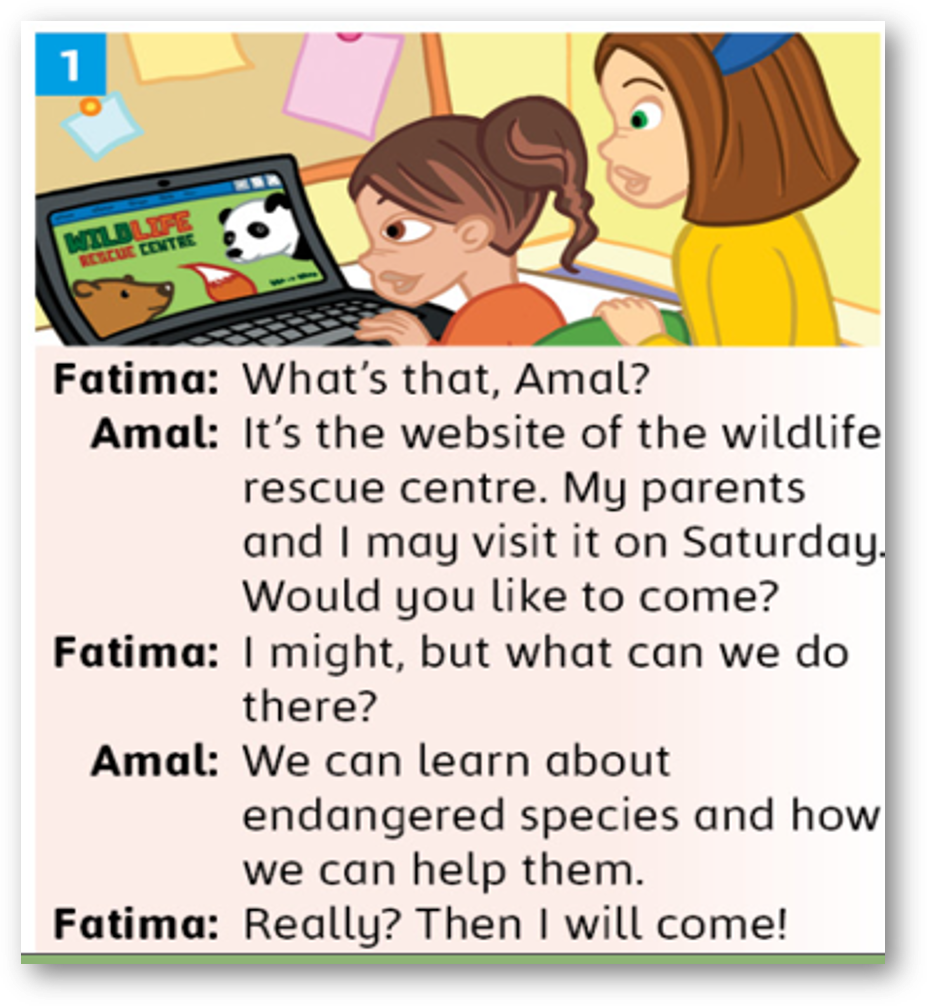
They can learn about endangered species and how to help them.
Frame 1:
When is Amal going to visit the wildlife rescue centre?
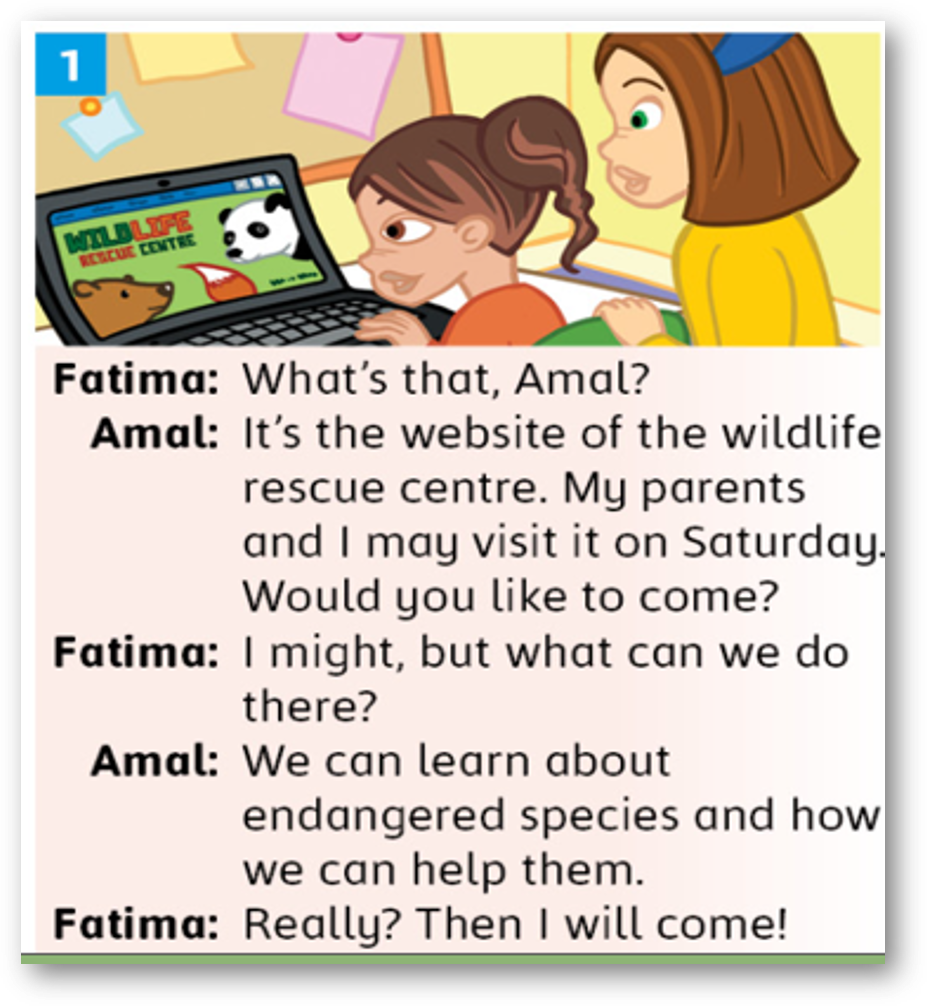
On Saturday
What can the girls learn at the wildlife rescue centre?
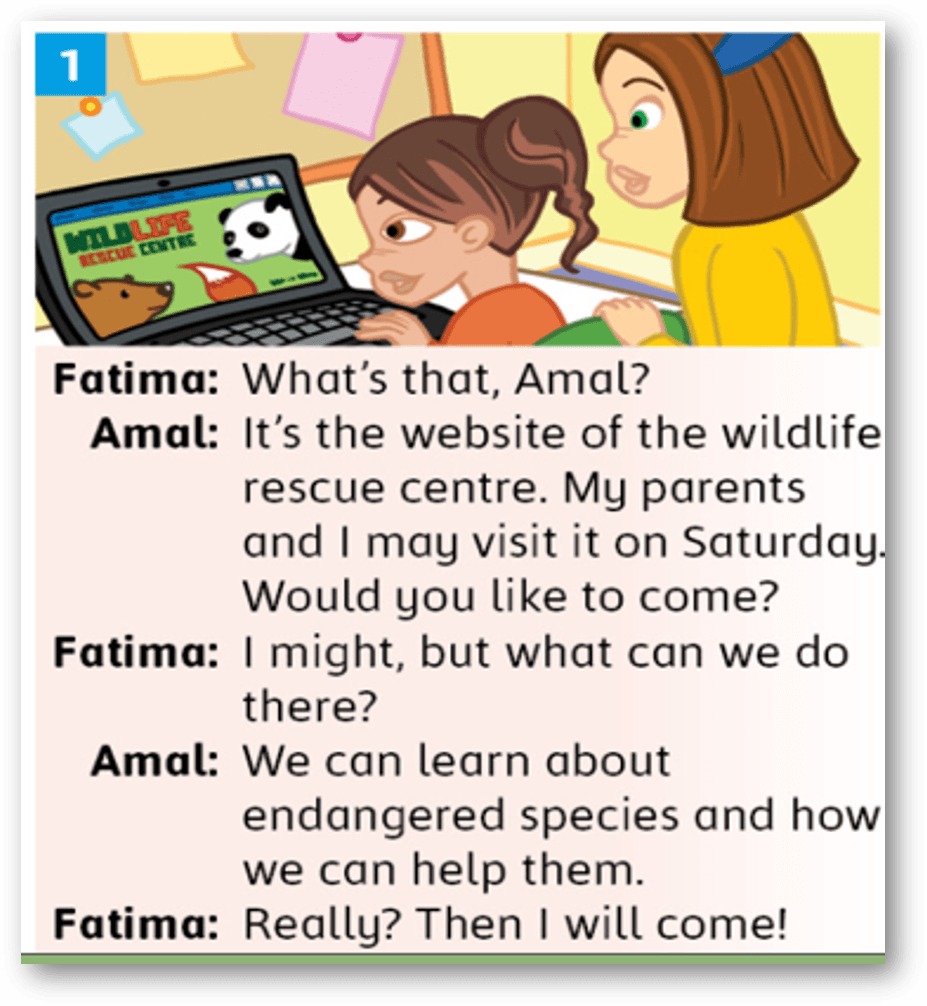
Frame 1:
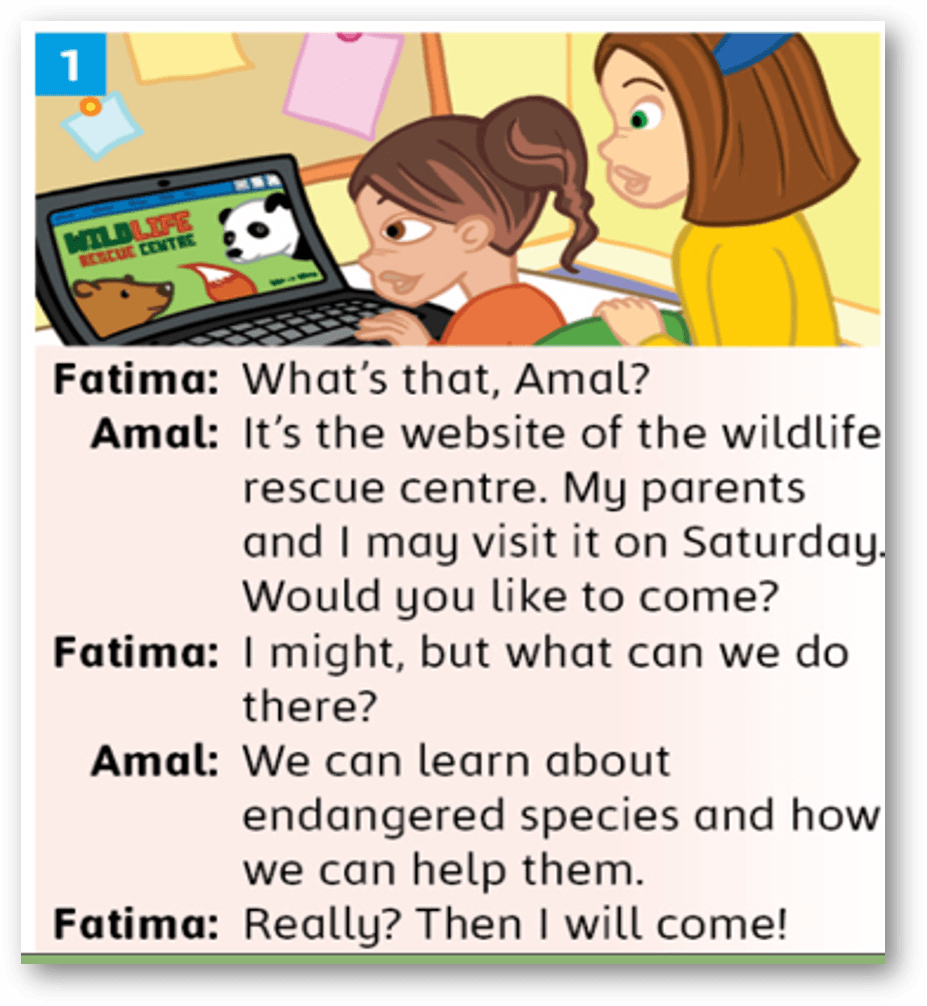
When is Amal going to visit the wildlife rescue centre?
Where do rangers keep the animals safe?
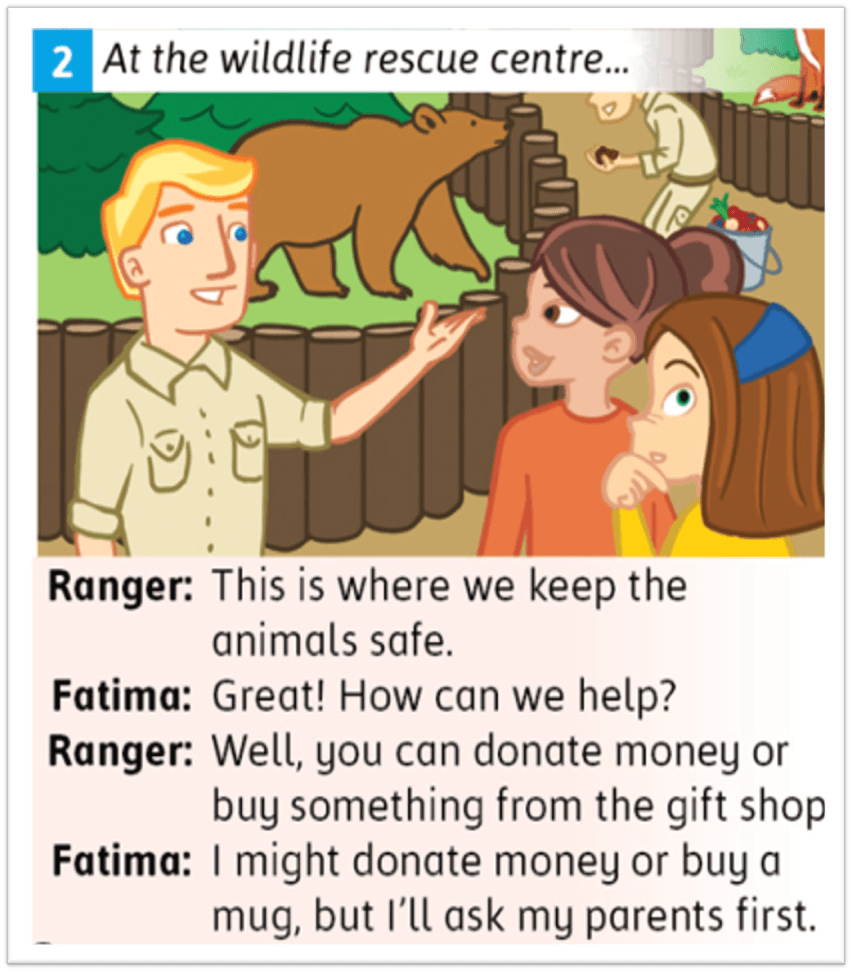
How can the girls help the animals?

Frame 3
Which animal did Amal choose for adoption?
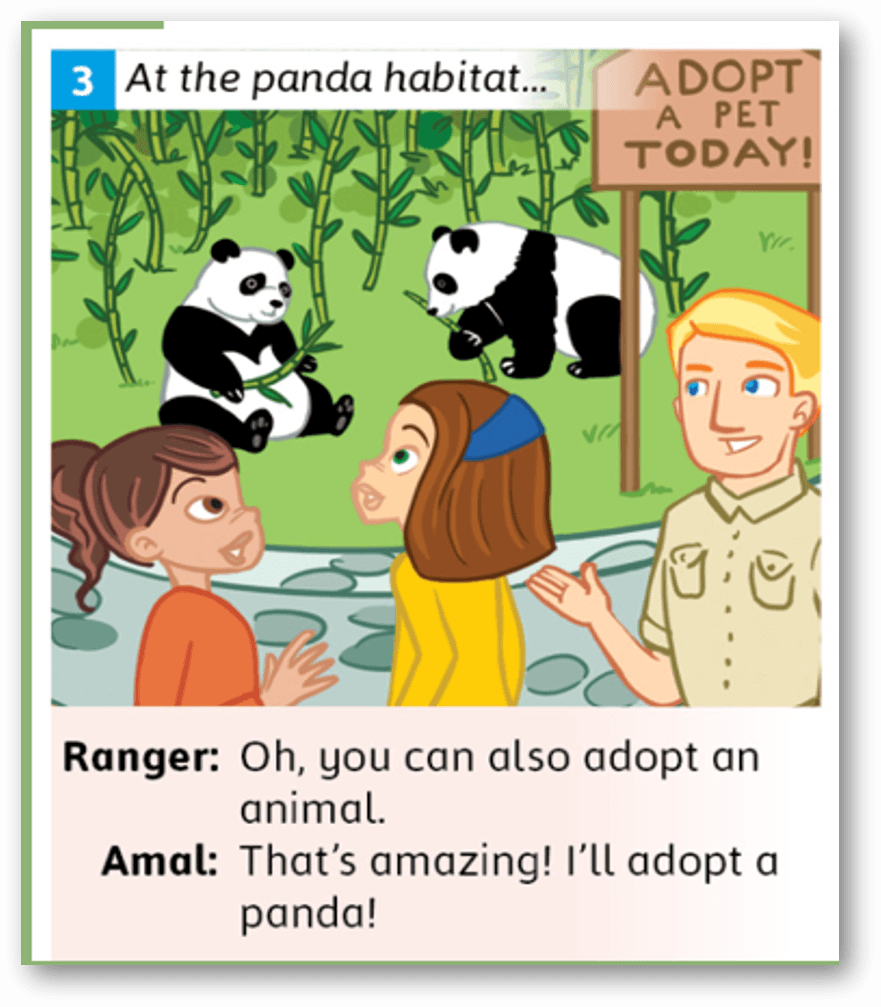
What will Amal take home?
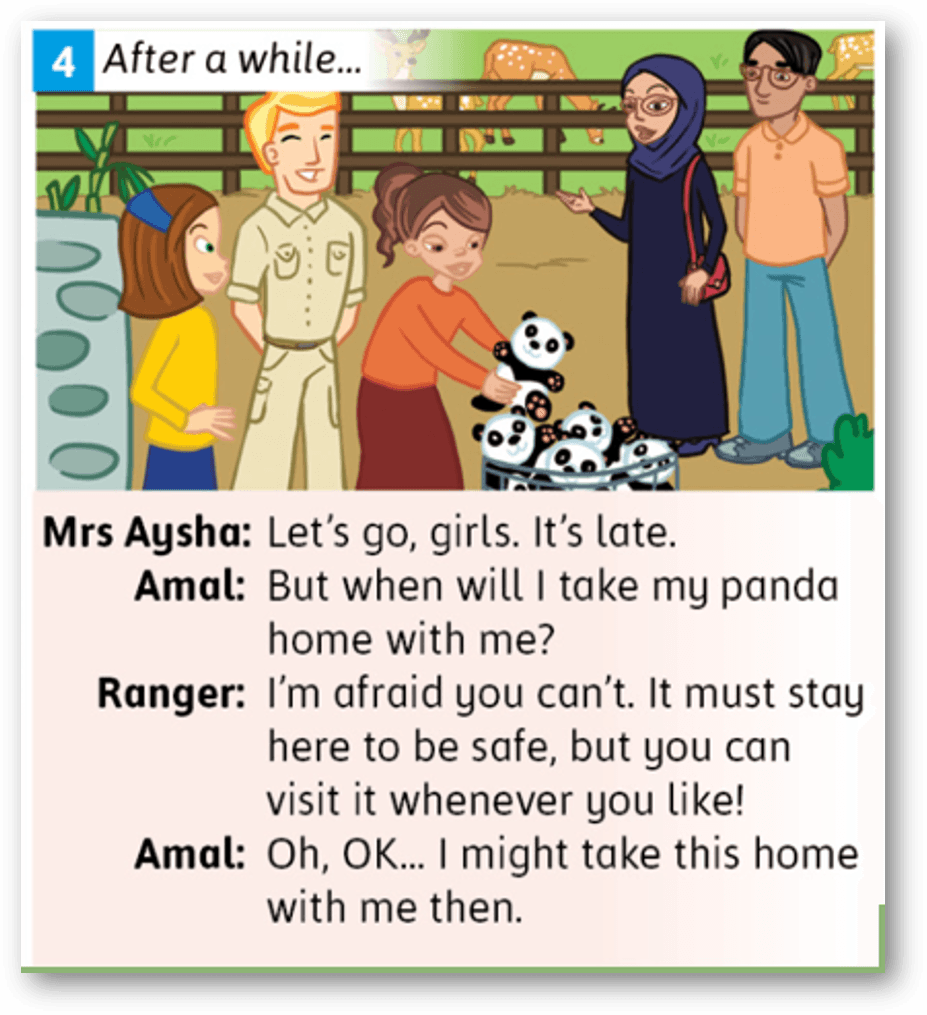
Can Amal take the panda home?
 A real-world example of a control system – growing crops A farm that grows fruit and vegetables makes use of many different control systems. It relies on these systems to make sure that the produce it grows are kept in the correct conditions to make sure that they do grow. It would be a huge task for a farmer to constantly check his produce, so he relies on these systems to do this for him. One control system that he could use is to control the conditions within his greenhouses. The correct level of light and temperature will need to be maintained. The control systems will incorporate light sensors, temperature sensors, microprocessors and actuators to maintain the correct conditions. The farmer wants to make sure the temperature is between 22 °C and 25 °C. 1The control system uses a temperature sensor to read the temperature within the greenhouse on a regular basis. 2The readings are sent to a microprocessor. They will need to be converted from analogue data to digital data to be processed by the microprocessor. 3The microprocessor compares the reading to the set range. 4If the reading is within the range, no further action is taken. 5If the reading is greater than 25 °C, the microprocessor sends a signal to an actuator that could drive an action, such as open a window to the greenhouse. 6If the reading is less than 22 °C, the microprocessor sends a signal to an actuator that could drive an action, such as turn on a heater in the greenhouse. 7The whole process is repeated.Inferences While Reading Practice #1Poetry - Eating While Reading by Gary SotoM8 - Top Stars 1 (While-Reading)1. Which sentence correctly uses the present continuous tense to express a temporary action? A. She works at a bank. B. She is working at a bank for the summer. ✅ C. She worked at a bank last year. D. She has worked at a bank for years. ⸻ 2. Which of the following uses the past continuous tense to describe an interrupted action? A. I was eating dinner when the phone rang. ✅ B. I eat dinner when the phone rings. C. I had eaten dinner before the phone rang. D. I was eat dinner when the phone ringed. ⸻ 3. What is the function of “is/am/are + V.ing” in a sentence? A. To show routine habits B. To describe completed past actions C. To indicate actions in progress at the moment of speaking ✅ D. To express future intentions with certainty ⸻ 4. Which sentence shows incorrect use of the past continuous tense? A. She was singing while I played the piano. ✅ B. They were talking when I arrived. C. I was reading while he was cooking. D. It was raining all night yesterday. (Explanation: A uses mixed tenses incorrectly. It should be: “She was singing while I was playing the piano.”) ⸻ 5. Choose the sentence that uses the present simple tense in a conditional structure. A. If it is raining, we will cancel the trip. ✅ B. If it was raining, we would cancel the trip. C. If it rained, we canceled the trip. D. If it rains, we are canceling the trip. ⸻ 6. Identify the sentence in which the auxiliary verb is incorrectly used. A. He is doing his homework now. B. She was watched a movie last night. ✅ C. They were playing football all afternoon. D. I am going to the store. ⸻ 7. Which sentence best demonstrates the habitual use of the present simple? A. I am jogging every morning. B. I jog every morning. ✅ C. I was jogging every morning. D. I have jogged every morning. ⸻ 8. Choose the best explanation for using “was/were + V.ing”: A. To talk about a permanent state B. To describe future arrangements C. To express a continuous action in the past ✅ D. To indicate hypothetical situationsWrite reading comprehension questions based on the text: Apple's design genius. I've always loved great design. Ever since I can remember I've been fascinated by the shape and look of objects. In n opinion, Apple Inc. is the number one company in the world for product design. In the time that 'you're reading this article, around 750 iPhone and 300 iPads will be sold internationally. These iconic devices generate millions of pounds a day for Apple, and the man behind their iconic look is known as a 'design genius'. In 2013, Time Magazine listed him as one of the 100 most influential people in the world, but can you name him? If you said Steve Jobs, you'd be wrong, although it was Jobs who first recognised this man's talent. His name is Jony Ive. Born in London, Jony Ive studied industrial design at Newcastle Polytechnic. After graduating, he helped set up the London design agency Tangerine. In 1992, while he was working at Tangerine, he accepted a job offer from Apple. His first years in the job were tough and the design work wasn't very interesting. The company was also struggling to make money. However, when Steve Jobs returned to Apple in 1997 and saw the design work that Ive had produced, he immediately recognised Ive's ability and promoted him. Ive's first success in his new role was the design of the original, colourful iMac in 1998, which was quickly followed by the first iPod in 2001. Thanks to Ive's simple, elegant designs, Apple became one of the most successful companies in the world. Since then, he has been responsible for the iPhone, iPad and Apple Watch. Ive's design involves not only the way these products look but also the way they work. He believes devices have to be both beautiful and practical. Jony Ive's key contribution to Apple is now being recognised and he has received numerous awards. There is no doubt that Steve Jobs was a larger-than-life ideas man and businessman who created a hugely successful company. However, without Jony Ive's design talent, Apple may not have become such a huge success. So what have I learnt from Jony Ive? That the best designs are often the simplest.Reading Passage: The Anatomy of a Kill Chain In the lexicon of modern warfare, the term "kill chain" describes the end-to-end process of a military attack, from the initial identification of a target to its eventual destruction and the subsequent evaluation of the strike's effectiveness. Conceptually, the kill chain is a structural model used to understand and optimize the speed and precision of military operations. The fundamental principle of this model is that an attack functions as a sequence of interdependent stages; if any single link in the chain is broken, the entire operation fails. For strategic planners, this creates a dual objective: to accelerate one's own kill chain while simultaneously finding ways to disrupt the adversary's. Strategic Concept: The Kinetic Model (F2T2EA) The traditional military kill chain is often summarized by the acronym F2T2EA, representing a continuous cycle of find, fix, track, target, engage, and assess. The kinetic kill chain begins with Find, the reconnaissance phase where intelligence assets identify a potential target within a theater of operations. Once found, the process moves to Fix, which involves pinning down the target's specific location and ensuring it can be distinguished from friendly forces or non-combatants. Track follows, maintaining a persistent watch on the target's movements to prevent its escape. In the Target phase, commanders select the appropriate weapon system and verify the legality and strategic value of the strike. Engage is the kinetic moment—the actual deployment of ordnance against the objective. Finally, Assess involves battle damage assessment (BDA) to determine if the desired effects were achieved or if further engagement is required. This model emphasizes "compressing the sensor-to-shooter timeline," meaning the faster a military can move through these steps, the more lethal it becomes. The Evolution: The Cyber Kill Chain® As warfare expanded into the digital domain, Lockheed Martin adapted the kinetic model into the Cyber Kill Chain. This framework assists defenders in identifying and stopping Advanced Persistent Threats (APTs). Unlike a physical missile, a cyberattack often unfolds over weeks or months, but the sequential logic remains the same. The model consists of seven distinct stages: Stage Description of Attacker Activity 1. Reconnaissance The harvesting of information. Attackers research targets via social media, public records, and technical scanning to find vulnerabilities. 2. Weaponization Coupling a remote access trojan with an exploit into a deliverable payload (e.g., a malicious PDF or Microsoft Office document). 3. Delivery Transmission of the weapon to the target environment. Common vectors include email attachments, malicious websites, or USB drives. 4. Exploitation The weapon triggers. The code executes on the victim's system, typically by taking advantage of a software or operating system vulnerability. 5. Installation The attacker installs a persistent backdoor or malware on the victim's system, allowing them to maintain access even after a reboot. 6. Command & Control (C2) The compromised system opens a communication channel back to the attacker's server, allowing the intruder to give manual instructions. 7. Actions on Objective The final stage where the attacker achieves their goal, such as data exfiltration, encryption for ransom, or destruction of critical infrastructure. Strategic Implications for Defense The strategic value of the Cyber Kill Chain lies in its ability to provide a roadmap for "proactive defense." By understanding the sequence, security professionals can implement controls at every stage. For instance, robust email filtering can break the chain at the Delivery stage, while endpoint detection can stop the Installation phase. Crucially, the earlier a defender breaks the chain, the lower the cost of mitigation and the lower the risk of damage. If an attacker is stopped during Reconnaissance, they have gained nothing. If they are stopped during Actions on Objective, the damage may already be catastrophic. In both kinetic and cyber environments, the goal is the same: to create a "defensive depth" that makes the cost of a successful attack prohibitively high for the adversary.Create a reading comprehension quiz based on the following text: Not many people 'have heard/ heard of Nikola Tesla, who 2played/was playing a key role in creating the alternating current (AC) supply of electricity we are having/ have in our homes today. Early in his career, Tesla has worked / worked with Thomas Edison. He had emigrated/ has emigrated to the USA from Europe in 1884. While Tesla was working/ had worked for Edison, they had an argument over payment for an invention, so Tesla was deciding/ decided to work independently. It was then that he developed a motor that could produce an alternating current. Throughout his life, Tesla continued to conduct experiments and helped / was helping develop X-ray radiography and wireless communication. There is no doubt that he has had / had had a large impact on modern technology. Many of the gadgets that we 10 are enjoying/enjoy today would not have been possible without Nikola Tesla.