Loading...

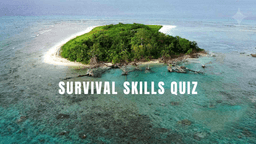
Will you survive?
Quiz by Anna Jones
Customize this quiz to suit your class
Instantly translate to 100+ languages
Tag the questions with any skills you have. Your dashboard will track each student's mastery of each skill.
Give this quiz to my class


How long can a person survive without food?

How long can a person survive without water?

Plants are one of the best sources of nutrition in a survival situation

You've been bitten by a snake, which may be venomous. Which of these should you NOT do?

When in the cold, it is important to always wear several layers of thick clothing at all times, even if you get overheated.

Where is it best to build a shelter?

What does vegetation and swarming insects often indicate?

Why should you try to avoid sleeping directly on the ground?
Drinking small amounts of salt water will keep you from dehydrating until fresh water can be found

 Will you survive in managing your own information?How to Stop Avalanchesnow with explosives, or by erecting snow fences. Explosives Explosives are primarily used to prevent avalanches, especially at ski resorts where other methods are often impractical. Maintenance staff from the ski resort travel to potential avalanche areas and areas with steep slopes. First, they measure the depth of the snow and its quality. They want to check for hard, loose, wet or icy snow layers. If an area is considered dangerous, small explosives are fired into the side of the steep terrain. The explosion loosens the top layer of snow, which tumbles harmlessly down the mountainside. But using explosives is costly and dangerous. Some researchers are currently experimenting with the cheaper and safer method of using ultrasonic sound waves that shock the snow into falling, averting an avalanche and saving lives. Snow Fences It is very common to put up snow nets or snow fences. These nylon nets or wooden and steel fences are placed at the top of slopes. They prevent the buildup of snow on the downwind side, thereby lessening the chance of a slab avalanche. Beacons and Radio Devices Fortunately, there are companies that specialize in making rescue beacons. These are small electronic devices that send out a radio signal to search and rescue crews. Most people who venture into the backcountry carry some sort of beacon or GPS device. They can help locate a buried victim up to 80 meters away. However, these beacons and GPS devices only send out a signal if the victim turns it on. Often, the victim is too injured to think clearly and press the 'on button.' If search and rescue crews do not quickly reach the victims, the skiers will not be discovered in time. Surviving an Avalanche If you are ever caught in an avalanche, the chances are slim that you will survive. If you are not killed instantly, you only have a short time (15~35 minutes) before your oxygen runs out. Take off your ski, boots and poles. Use a swimming motion to claw your way to the surface. Often people do not know which way is up or down. The effect of this is disorientation. It is not uncommon for avalanche victims to dig in the wrong direction. With proper precautions, both skiers and ski resorts can avoid the tragedy of an avalanche.How to Stop Avalanches ToB A major concern of ski resorts is avalanche control. Most avalanches occur outside the boundaries of the regular groomed ski runs. But each year, skiers and trekkers on snowshoes go into these remote areas where most avalanches occur. There are two primary ways to prevent avalanches-by blasting the snow with explosives, or by erecting snow fences. Explosives Explosives are primarily used to prevent avalanches, especially at ski resorts where other methods are often impractical. Maintenance staff from the ski resort travel to potential avalanche areas and areas with steep slopes. First, they measure the depth of the snow and its quality. They want to check for hard, loose, wet or icy snow layers. If an area is considered dangerous, small explosives are fired into the side of the steep terrain. The explosion loosens the top layer of snow, which tumbles harmlessly down the mountainside. But using explosives is costly and dangerous. Some researchers are currently experimenting with the cheaper and safer method of using ultrasonic sound waves that shock the snow into falling, averting an avalanche and saving lives. Snow Fences It is very common to put up snow nets or snow fences. These nylon nets or wooden and steel fences are placed at the top of slopes. They prevent the buildup of snow on the downwind side, thereby lessening the chance of a slab avalanche. Beacons and Radio Devices Fortunately, there are companies that specialize in making rescue beacons. These are small electronic devices that send out a radio signal to search and rescue crews. Most people who venture into the backcountry carry some sort of beacon or GPS device. They can help locate a buried victim up to 80 meters away. However, these beacons and GPS devices only send out a signal if the victim turns it on. Often, the victim is too injured to think clearly and press the 'on button.' If search and rescue crews do not quickly reach the victims, the skiers will not be discovered in time. Surviving an Avalanche If you are ever caught in an avalanche, the chances are slim that you will survive. If you are not killed instantly, you only have a short time (15~35 minutes) before your oxygen runs out. Take off your ski, boots and poles. Use a swimming motion to claw your way to the surface. Often people do not know which way is up or down. The effect of this is disorientation. It is not uncommon for avalanche victims to dig in the wrong direction. With proper precautions, both skiers and ski resorts can avoid the tragedy of an avalanche.Write questions based on the text: How long could you survive at sea? One day? Two? And when would you start to lose hope? When Robert Hewitt came to the surface, he realized straight away that something was wrong. He’d been diving for sea urchins and crayfish off the coast of New Zealand with a friend, and had decided to make the 200-metre swim back to shore alone. But instead, strong underwater currents had taken him more than half a kilometre out to sea. Lying on his back in the middle of the ocean, Robert told himself not to panic. He was a strong swimmer and he was wearing his thick wetsuit. 'I'm not going to die. Someone will come,' he told himself. But three hours passed and still no one had come for him. Robert would soon have to make a tough decision. He was now a long way from the coast and the tide was taking him further out, but he decided not to try to swim for shore. He felt it was better to save his energy and hold on to his brightly coloured equipment. But the decision was not an easy one. 'l just closed my eyes and said, "You've made the right decision. You've made the right decision" until that's all I heard,' he remembers. As night approached, Robert established a pattern to help him survive in the water. To stay warm, he kept himself moving and took short naps of less than a minute at a time. Every few hours, he called out to his loved ones: 'Just yelling out their names would pick me up and then I would keep going for the next hour and the next hour and the next.' When he woke the next morning, he couldn't believe he was still alive. Using his bright equipment, he tried to signal to planes that flew overhead. But as each plane turned away, his spirits dropped. He managed to drink water from his oxygen tank to keep himself alive, but as day turned to night again he started to imagine things. Robert woke on the third day to a beautiful blue sky. Now seven kilometres off the coast, Robert decided he had to swim for it. But the sun was so strong and Robert quickly ran out of strength. Hope turned to disappointment yet again: 'l felt disappointed in myself. I thought I was a lot fitter. I thought I would be able to do it.' Robert then started to think he might not survive. On the fourth day, the lack of food and water was really starting to affect him. Half unconscious, and with strange visions going through his head, he thought he saw a boat coming towards him with two of his friends in. Another vision, surely. But no - 'They put me in the boat and I said something like "Oh, how's it going, what are you guys doing here?"' Then he asked them the question that he'd asked in all his visions: 'Can I have some water?' As they handed him the water and he felt it touch his lips, he knew. This was not a vision. He'd been found! After four days and three nights alone at sea, Robert had been found! Sunburnt, hungry and exhausted, but alive.Make a multiple choice quiz for my year 8 science students based on the science in this transcript from a video: 3°C 0:04 It can be the difference between snow and sleet 0:08 Wearing a jacket or not 0:11 In your day-to-day life, it may not seem significant 0:15 But 3°C of global warming would be catastrophic 0:20 Heatwaves, droughts, extreme precipitation, even fire 0:25 3°C of warming is really disastrous 0:28 The scary thing is, the world is well on its way there 0:32 Since the industrial revolution, the Earth has warmed between 1.1°C and 1.3°C 0:40 This is a problem that babies you pass in the street will have to live with 0:46 Children born today... 0:47 ...are up to seven times more likely to face extreme weather than their grandparents 0:52 If global temperatures do rise by 3°C... 0:55 ...what would their world look like? Climate change is already having devastating effects 1:03 Rising sea levels 1:05 Desertification 1:07 Hollywood has always enjoyed imagining the end of the world 1:11 While blockbusters like this are clearly fiction... 1:14 ...this film will show the scenario we all face... 1:17 ...unless more drastic measures are taken to stop burning fossil fuels 1:30 In some parts of the world the effects of inaction are already clear 1:35 The slums of Bangladesh’s capital are filling up with climate migrants 1:41 Minara comes from Bhola District, an area in southern Bangladesh 1:46 There, like many other parts of the country... 1:49 ...rivers swollen by heavier rain and melting Himalayan glaciers... 1:53 ...are washing away people’s homes 1:56 Many, like her, have lost everything 2:00 Our home in Bhola had endless amounts of land 2:03 There was lots of space for farming, we had a spacious house 2:08 There were different types of fruits, vegetation and trees growing at home 2:12 We used to eat the fruit from our own trees 2:18 I can’t eat them now because they don't exist anymore 2:21 Since the river flooded for the third time, I had to flee to Dhaka 2:26 Life was much better back home 2:29 It was unbearable to live through, truly intolerable 2:33 We didn’t have the time to save anything at all 2:38 1.1°C to 1.3°C of global warming has already transformed Minara’s life 2:45 It’s one of the reasons why so many migrants like her... 2:47 ...are moving to the city each year... 2:50 ...nearly 400,000 according to the last estimate 2:53 And climate models show there could be much worse to come How climate modelling works 3:02 Climate scientist Joeri Rogelj... 3:04 ...has spent the last ten years modelling future climate scenarios... 3:08 ...for the United Nations 3:10 The models we use to carry out this exercise... 3:13 ...really represent the state of the art... 3:15 ...of our current knowledge of climate change and where we are heading 3:19 Joeri’s projections use data collected by hundreds of scientists around the world 3:26 Here this is the 3°C level... 3:28 ...and so there is at least a one-in-four chance that under current policies... 3:32 ...we would hit 3°C by the end of the century 3:36 This is just one of the scenarios Joeri looks at 3:40 Another one imagines that all policy promises are kept 3:44 The most optimistic assumes that all promises have been kept... 3:47 ...and net-zero targets are met 3:50 Where our best estimate ends up around 2°C at the end of the century... 3:54 ...there is still a one-in-20 chance that we end up with 3°C instead 3:59 One would not be entering a plane if there is a one-in-20 chance... 4:03 ...that the plane will crash Nowhere is safe from global warming 4:07 A rise of 3°C would affect everyone 4:10 Even wealthy cities in rich countries wouldn’t be immune to the consequences 4:15 European capitals like Paris and Berlin... 4:18 ...would bake under more extreme heatwaves 4:22 Frequent storm-surges in New York could turn parts of the city desolate 4:27 In many ways, cities magnify, intensify climate events 4:33 Cities are hotter than the places around them... 4:36 ...they tend to be more vulnerable to flooding 4:39 And you can get a really bad event in a city in a way that you can’t in the countryside 4:46 And because of their denser populations... 4:49 ...disasters in a city affect far more people 4:52 Some cities might be badly prepared for the changes coming 4:56 But they have the means to adapt 4:59 Cities tend to be wealthier than surrounding places 5:03 They have a lot of amenities 5:05 A city that has taken seriously the risks of a 3°C world... 5:08 …wouldn’t necessarily be a worse place to be in a 3°C world 5:12 But a city that hasn’t prepared for these sort of eventualities... 5:16 ...that might be a really nasty place The impact of prolonged droughts 5:20 So far, many developed cities have got off lightly... 5:24 ...but some rural parts of the world are suffering disproportionately 5:29 Smallholders—small-scale farmers—are particularly vulnerable to climate change 5:35 And there are over 600 million around the world 5:38 Smallholders with farms under two hectares... 5:40 ...produce around a third of the global food supply 5:46 Central America’s “Dry Corridor”... 5:48 ...supports a mix of smallholdings and medium-sized farms 5:53 Sandwiched between the Pacific Ocean and the Caribbean Sea... 5:56 ...the area is prone to droughts 6:08 Israel Ramírez Rivera is a smallholder in Guatemala 6:12 Here, climate change is making the dry seasons longer, and more severe 6:18 This is the biggest ear of maize that this plot could deliver 6:23 He depends on his crops of corn and beans 6:26 But they’re getting harder to grow 6:30 The surrounding mountains... 6:32 ...used to provide us with native food... 6:38 ...and now that isn’t an option anymore... 6:41 ...due to climate change and its effects 6:46 Nearly two-thirds of the smallholders in the Dry Corridor now live in poverty 6:52 The impact of all of this for us... 6:59 ...malnutrition among children 7:03 We’ve lost a few 7:07 For my crops especially, the midsummer heat is harder than before 7:16 The plant dries up and can’t provide us... 7:19 ...with the necessary food provision 7:24 Severe droughts in Central America... 7:26 ...are now four times more likely than they were last century 7:30 Many families from here have gone to the States 7:37 The economic despair and debts... 7:44 ...have pushed many people from this community to do this journey 7:53 Migration from Guatemala to the United States has quadrupled since 1990 7:59 Not all of this has been due to climate change 8:02 But longer droughts would force even more to move 8:05 In a 3°C world, annual rainfall in this region... 8:09 ...could drop by up to 14% 8:12 At 3°C, over a quarter of the world’s population... 8:16 ...could endure extreme droughts for at least a month of the year 8:19 Northern Africa could see droughts that last for years at a time Rising sea levels, storm surges and flooding 8:24 But for some, too much water will be the problem 8:29 10% of the world’s population lives on a coastline... 8:32 ...that’s less than 10 metres above sea level 8:35 For these coastal inhabitants, a 3°C world would spell disaster 8:40 By 2100, global sea levels could have climbed by half a metre from 2005 levels 8:46 Low-lying cities like Lagos would be especially vulnerable... 8:49 ...with up to up to a third of the population displaced 8:54 And in Fiji, rising waters are already upending lives 9:04 You can see the graveyard there, it’s all under water now... 9:08 ...due to this rising sea level and climate change 9:15 The village of Togoru in Fiji is being swallowed by the sea 9:19 Barney Dunn, the village headman, has seen over half the village disappear 9:24 Relatives’ houses have been abandoned, and family graves are now under water 9:29 We have been asked by the government to relocate... 9:32 ...but no one wants to relocate... 9:34 ...because we have our great-great-grandparents down there in the sea 9:39 This is the place we’ve been brought up in 9:41 ...it’s not easy to leave 9:44 Past attempts to build a seawall haven’t worked 9:48 But Barney sees building a new one as the village’s only hope 9:52 If they do that, maybe we can save whatever is left 9:56 But if we don’t have the seawall, then it will be keep eroding and time will come... 10:01 ...maybe in ten,15 years, Togoru will be all eroded 10:05 Rising seas also mean storms cause more floods 10:11 And many more countries could suffer 10:14 The Philippines and Myanmar are just two countries... 10:17 ...that will also see an increase in storm surges in a 3°C world 10:21 To escape, many will move… 10:24 …often, to urban areas Extreme heat and wet-bulb temperatures 10:27 Half the world’s population already lives in cities... 10:31 ...almost a third in slums 10:36 For them, a 3°C world could be deadly 10:40 Minara has moved to Dhaka to escape the impact of climate change 10:44 But life could get even worse for her 10:47 I’m struggling a lot nowadays 10:49 The heat during the day is unbearable 10:52 Even late at night it doesn’t cool down 10:57 The heat is getting more intense every day 10:59 I mean, it’s going to get much worse 11:03 I can barely survive it now, how will I live through it in the future? 11:08 Dhaka is getting hotter 11:11 In the last 20 years the average daytime temperature... 11:13 ...has crept up by nearly half a degree 11:17 Days that approach 40°C are now being reported 11:20 And high so-called wet-bulb temperatures are on the rise 11:26 A wet-bulb temperature is a measure of heat and humidity 11:30 Humans cool themselves by sweating… 11:32 But in these conditions, when relative humidity is near 100%... 11:36 ...sweat doesn’t evaporate well 11:38 So people can’t cool down… 11:41 ...even if given unlimited shade and water 11:45 At a high wet-bulb temperature, the body can’t lose heat... 11:49 ...and so it gets hotter and hotter... 11:51 ...and the body is designed to work at a given temperature 11:53 And if it gets too hot inside, you will die 11:58 The human limit for wet-bulb temperatures is 35°C... 12:02 ...around skin temperature 12:04 Dhaka will have a much higher chance... 12:05 ...of reaching dangerous wet-bulb temperatures... 12:07 ...if global warming reaches 3°C 12:12 You can’t really adapt to that 12:14 You have to get out. If the temperature is so high that you can’t work... 12:20 ...can’t do hard manual labour outside for significant parts of the year... 12:25 ...then many places will become functionally no longer part of the economy 12:33 Jacobabad in Pakistan, and Ras al Khaimah, in the United Arab Emirates... 12:37 ...have already recorded deadly wet-bulb temperatures 12:40 More of the tropics and the Persian Gulf... 12:43 ...as well as parts of Mexico and the south-eastern United States... 12:47 ...could all get to this threshold by the end of the century 12:50 Climate modelling might show us the weather Increased migration and conflict 12:52 But it doesn’t show us its other effects on society 12:56 Established migration patterns could change 12:59 Climate disasters may exacerbate reasons people cross borders 13:03 Within countries, more people will move to cities 13:07 In a 3°C world, tens of millions of people a year... 13:10 ...could be displaced by disasters made worse by climate change 13:15 When people are displaced by climate... 13:18 …they may well go to cities... 13:19 ...because cities are the places that attract people from the countryside already 13:25 A lot of people who can get to the developed world... 13:28 ...not least because the developed world tends to be less hot, will give that a go 13:35 As migration around the world increases... 13:38 ...there could be more competition for fewer resources 13:42 Water—already a highly contested resource—will be a focal point 13:47 Turkey’s new Ilisu dam has reduced the flow of water into Iraq 13:53 China lays claim to rivers vital to India and Pakistan 13:57 The prospect of a water-conflict makes people very uneasy 14:03 How national tensions would exacerbate those sorts of reactions... 14:08 ...in a 3°C world... 14:09 ...is the sort of thing that no one should really want to find out 14:14 I think you’d have to be incredibly sanguine... 14:16 ...not to think that the sort of climate extremes that we talk about... 14:19 ...in a 3°C world wouldn’t lead some places... 14:22 ...to the brink of societal collapse 14:25 Those lucky enough to escape unrest... Adaptation and mitigation are crucial 14:28 ...would still have to adapt to a radically different world 14:32 People can adapt to climate change in all sorts of ways, one of the most obvious ones... 14:37 ...is air conditioning 14:39 But other ways to adapt at a local or regional level... 14:42 ...I mean, one of the most obvious is diversifying agriculture 14:47 There are physical things you can do, like seawalls 14:52 The fact that people can adapt and that adaptation will reduce suffering... 14:57 ...doesn’t mean that it will eliminate suffering 15:00 Suffering is built into this whole process of heating up the planet 15:06 Adaptation will only get the world so far 15:09 The best way to deal with a 3°C world... 15:12 ...is not to go to a 3°C world 15:14 And that’s why increasing efforts on mitigation are important 15:17 It’s why working towards negative emissions... 15:20 ...that could bring down the temperature after it peaks are important 15:25 Once you get to a 3°C world, you are in real bad global trouble 15:33 The scale of change needed... 15:35 ...and the slow progress of governments so far... 15:38 ...means 3°C of warming is uncomfortably likely unless more is done 15:44 Despite existing pledges, greenhouse-gas emissions... 15:48 ...are still set to rise by 16% from 2010 levels by 2030 15:54 The need to act has never been clearer 15:57 There’s still time to reduce emissions, so that a 3°C world remains fiction... 16:02 ...rather than becoming factThe outdoor recreation industry represents a new economy. The leaders of this economy will need to have a deep understanding of our local natural resources and integrate the components of innovation, health, and wellness into a vision for what comes next. Everyone wins when you do the right things for the environment, the community, and the venture. We want to offer the young generation a chance to be part of the foundation we are building for adventure tourism in the emirates and the region. Adventure Tourism Is the Fastest-Growing Global Niche. What does this mean? It means that there’s plenty of room for young experts to enter the field. It’s not just the "guides" that the adventure tourism industry needs. It’s everything that goes with it, from adventure tourism accommodations to trip planners, event managers, marketing and finance directors, advertising, public relations, and communications. We want to highlight that adventure tourism requires more than just guides, and various careers within adventure tourism play a big role in attracting high-value customers, supporting local economies, and encouraging sustainable practices. The continued growth of this sector creates net positive impacts not only for tourism, but also for destination economies, their people, and their environment. 1) Understanding Tourism Tourism is one of the world’s fastest-growing industries and a major foreign exchange and employment generation for many countries. It is one of the most remarkable economic and social phenomena. 2) Understanding Adventure Tourism Adventure tourism is defined as the movement of the people from one to another place outside their comfort zone for exploration or travel to remote areas, exotic and possibly hostile areas. Adventure tourism is a type of tourism in which tourists engage in adventure activities such as trekking, climbing, rafting, scuba diving, or the likes. Adventure tourism gains much of its excitement by allowing the tourist to step outside their comfort zone. This may be from experiencing culture shock or through the performance of acts that required some degree of risk whether real or perceived. It is also about connecting with a new culture or a new landscape and being physically active at the same time. It is not only about being risky or pushing your boundaries. In fact, it is especially important to know and respect your limits while you are in an unfamiliar area. Adventure travel is a leisure activity that takes place in an unusual, exotic, remote, or wilderness destination. It tends to be associated with high levels of activity by the participant, most of it outdoors. Adventure tourists expect to experience various levels of risk, excitement, and tranquillity and be personally tested. In particular, they are explorers of unspoiled, exotic parts of the planet and also seek personal challenges. The main factor distinguishing adventure tourism from all other forms of tourism is the planning and preparation involved. 3) Definitions of Adventure Tourism Adventure tourism is a new concept in the tourism industry. The tourism industry adopted adventure tourism, but there is not any specific definition of adventure tourism. Most commentators concur that adventure tourism is a niche sector of the tourism industry, but there are many other niche sectors in tourism that have the same characteristics that overlap with adventure tourism such as ecotourism, activity tourism, or adventure travel. One of them can confuse. Adventure tourism is a complicated and ambiguous topic. Some important definitions of adventure tourism are as following: A) According to the Adventure Travel Trade Association (ATTA): “adventure tourism is a tourist activity that includes physical activity, cultural exchange, or activities in nature.” B) According to Muller and Cleaver: “Adventure tourism is characterized by its ability to provide the tourist with relatively high levels of sensory stimulation, usually achieved by including physically challenging experiential components with the tourist experience.” C) The Canadian Tourism Commission in 1995 defines adventure tourism as: “an outdoor leisure activity that takes place in an unusual, exotic, remote or wilderness destination, involves some form of unconventional means of transportation, and tends to be associated with low or high levels of activity.” D) According to Sung et al: “adventure tourism is the sum of the phenomena and relationships arising from the interactions of adventure touristic activities with the natural environment away from the participant’s usual place of residence area and containing elements of risk in which the outcome is influenced by the participation, setting, and the organizer of the tourist’s experience.” E) According to UNWTO: ” adventure tourism can be domestic or international, and like all travel, it must include an overnight stay, but not last longer than one year.” 4) Types of Adventure Tourism Adventure tourism has grown exponentially all over the world in recent years with tourists visiting destinations previously undiscovered. This allows for new destinations to market themselves as truly unique, appealing to those travellers looking for a rare, incomparable experience. Adventure tourism includes various activities like caving, hiking, sailing, trekking, etc. Adventure tourism is categorized into two categories: • Hard Adventure • Soft Adventure Hard Adventure Hard adventure refers to activities with high levels of risk, requiring intense commitment and advanced skills. Hard tourism includes the activities like climbing mountains/rock/ice, trekking, caving, etc. Hard adventure activities are highly risked in nature. Professional guides and advanced levels of skills are required to perform these activities. Many tourists died during climbing mountains, caving every day. Soft Adventure Soft adventure refers to activities with a perceived risk but low levels of risk, requiring minimal commitment and beginner skills; experienced guides lead most of these activities. Soft tourism includes the activities like backpacking, camping, hiking, kayaking, etc. Soft adventure activities are low-risk in nature. Professional guides lead these activities. Soft adventure is a popular category in adventure tourism as it caters to a wider audience. 5) Adventure Tourism Activities Adventure travellers are early adopters by nature, meaning they are generally more willing to try new destinations, activities, and travel products. Popular activities change rapidly, and it seems there is a new twist on an existing sport every year. Some activities have low risk and some have high. Adventure tourism activities are classified into two types: • Hard Adventure Activities • Soft Adventure Activities Hard Adventure Activities Hard adventure activities are highly risky and dangerous in nature. These activities are as the following: • Caving • Mountain Climbing • Rock Climbing • Ice Climbing • Trekking • Sky Diving Soft Adventure Activities These activities are less dangerous and risk as compared to hard adventure activities. These activities are mostly lead by professional guides. An example of these activities are: • Backpacking • Bird watching • Camping • Canoeing • Eco-tourism • Fishing • Hiking • Horseback riding • Hunting • Kayaking/sea/whitewater • Orienteering • Safaris • Scuba Diving • Snorkeling • Skiing • Snowboarding • Surfing Adventure tourism activities sit well with the environment because the natural world provides us with the resources for many of the activities that provide risk, challenge, sensory stimulus, novelty, discovery, and so on. 6) Characteristics and Features of Adventure Tourism The threefold combination of activity, nature, and culture marks adventure travel as an all-around challenge. Some unique characteristics and features of adventure tourism are as the following: • Physical activity, like involving physical exertion or psychomotor skills • Contact with nature, activities bringing contact with the natural world in general, or with specific wildlife • Contact with different cultures, i.e. people, faith, lifestyles • Journeys for example vehicle, animal, or human power • Uncertain outcomes • Danger and risk • Challenges • Anticipated rewards • Novelty • Stimulation and excitement • Exploration and discovery • Contrasting emotions 7) Adventure Tourism Supplier A tourism supply chain is the system of people, products, activities, and materials that get a product or service from its raw state through production and distribution to the consumer. As with any sector, volume discounts drive the mass price point, so major retailers primarily market select trips that sell in high volume. The supply chain for these mass tourism products is often very simple, comprising only transportation and accommodation elements. The adventure tourism supply chain is more complex. Niche products often require specializes in knowledge and operations. Adventure tourism’s supply chain linkages go very deep, and this is one of the key reasons that adventure tourism delivers greater benefits at the local level. Supply chains vary from destination to destination. Without a proper supply chain, the tourism sector cannot survive. Tourism suppliers are the backbone of the tourism industry. Adventure tourism suppliers work at a different, different level like as domestic as well international level. 8) Adventure Tourism Importance and Benefits Adventure tourism is one of the fastest-growing sectors of the tourism sector, attracting high-value customers, supporting local economies, and encouraging sustainable practices. The continued growth of this sector creates net positive impacts not only for tourism, but also for destination economies, their people, and their environment. Some importance and benefits of adventure tourism are: A) Employment Generation Adventure tourism generates jobs. Adventure tourism generates directs jobs to accommodation, transportation sector, and travel agencies or tour operators. Adventure tourism also provides indirect jobs to tourism suppliers. Adventure tourism plays an important role in the generation of employment in the economy. B) Foreign Exchange Adventure tourism attracts foreign tourists on a large scale, as a result, it helps in foreign exchange generation. When tourists travel to another country, they spend a large amount of money on accommodation, transportation, and shopping. Adventure tourism generates foreign exchange and supports the economy of the host country. C) Economy Development Adventure tourism helps in the development of the host country’s economy. Adventure tourism activities directly support the economy in various forms. The more tourists, the more economic growth. D) Support Local Communities Adventure tourism helps in the development of infrastructure and supports local communities. Adventure tourism activities directly contributed to the local economy of the communities and increase local people's living standards. E) Conservation of Natural Resources Adventure tourism activities are nature-based activities. Leaders in the adventure tourism industry are dedicated to making this tourism segment as sustainable as possible. They help in the conservation of natural resources as well as culture. F) Creating Business Opportunities Adventure tourism activities create new business opportunities. Several companies specialize in helping emerging adventure tourism operators market their products. Each new adventure tourism activity creates a new business opportunity. G) Local and Foreign Investment Adventure tourism creates business opportunities; as a result, it attracts local as well as international investors. Investors invest their money in accommodation, transportation, and travel trade organization. Adventure tourism plays an important role in the economy of the host country.Cohesion and Adhesion Water molecules stick to each other as a result of hydrogen bond- ing. An attractive force that holds molecules of a single substance together is known as cohesion. Cohesion due to hydrogen bonding between water molecules contributes to the upward movement of water from plant roots to their leaves. Related to cohesion is the surface tension of water. The cohe- sive forces in water resulting from hydrogen bonds cause the mol- ecules at the surface of water to be pulled downward into the liquid. As a result, water acts as if it has a thin “skin” on its sur- face. You can observe water’s surface tension by slightly overfill- ing a drinking glass with water. The water will appear to bulge above the rim of the glass. Surface tension also enables small crea- tures such as spiders and water-striders to run on water without breaking the surface. Adhesion is the attractive force between two particles of differ- ent substances, such as water molecules and glass molecules. A related property is capillarity (KAP-uh-LER-i-tee), which is the attrac- tion between molecules that results in the rise of the surface of a liquid when in contact with a solid. Together, the forces of adhe- sion, cohesion, and capillarity help water rise through narrow tubes against the force of gravity. Figure 2-11 shows cohesion and adhesion in the water-conducting tubes in the stem of a flower. Temperature Moderation Water has a high heat capacity, which means that water can absorb or release relatively large amounts of energy in the form of heat with only a slight change in temperature. This property of water is related to hydrogen bonding. Energy must be absorbed to break hydrogen bonds, and energy is released as heat when hydrogen bonds form. The energy that water initially absorbs breaks hydro- gen bonds between molecules. Only after these hydrogen bonds are broken does the energy begin to increase the motion of the water molecules, which raises the temperature of the water. When the temperature of water drops, hydrogen bonds reform, which releases a large amount of energy in the form of heat. Therefore, during a hot summer day, water can absorb a large quantity of energy from the sun and can cool the air without a large increase in the water’s temperature. At night, the gradually cooling water warms the air. In this way, the Earth’s oceans stabilize global temperatures enough to allow life to exist. Water’s high heat capac- ity also allows organisms to keep cells at an even temperature despite temperature changes in the environment. As a liquid evaporates, the surface of the liquid that remains behind cools down. A relatively large amount of energy is absorbed by water during evaporation, which significantly cools the surface of the remaining liquid. Evaporative cooling prevents organisms that live on land from overheating. For example, the evaporation of sweat from a person’s skin releases body heat and prevents over- heating on a hot day or during strenuous activity. Adhesion Cohesion Hydrogen bonds Cohesion, adhesion, and capillarity contribute to the upward movement of water from the roots of plants. FIGURE 2–11 www.scilinks.org Topic: Hydrogen Bonding Keyword: HM60777 mb06se_cols03.qxd 5/18/07 10:47 AM Page 41 42 CHAPTER 2 Density of Ice Unlike most solids, which are denser than their liquids, solid water is less dense than liquid water. This property is due to the shape of the water molecule and hydrogen bonding. The angle between the hydrogen atoms is quite wide. So, when water forms solid ice, the angles in the molecules cause ice crystals to have large amounts of open space, as shown in Figure 2-12. This open space lattice structure causes ice to have a low density. Because ice floats on water, bodies of water such as ponds and lakes freeze from the top down and not the bottom up. Ice insulates the water below from the cold air, which allows fish and other aquatic crea- tures to survive under the icy surface.LESSON 3 Characteristics of Living Things Learning Objectives • Describe each characteristic of life • Relate each characteristic of life with how first forms of life evolved What sets living things apart from nonliving things? Organisms are equipped with different characteristics that allow them to grow, adapt, survive, and perpetuate. These include the ability to metabolize, respond to stimuli, interact, and reproduce, among others What are the characteristics of life? Try to look at your surroundings and identify the living things that you see. You have probably identified a lot. Many scientists believe that there are more than 10 million kinds of living things that exist on Earth today. But the question is, how can something be considered living? There are certain characteristics that all living things exhibit: the characteristics of life. Living things are made up of cells. They metabolize, grow and develop, respond to stimulus, adapt to their environment, and reproduce. Living Things Are Made up of Cells All living things are made up of cells. Cells are the basic building blocks of all living things. Each cell contains materials that carry out basic life processes such as respiration. In the 1600s, an argument against the theory of spontaneous generation was made. Italian physician and biologist Francesco Redi disproved the theory that all living things come from nonliving things. Cells have different properties and characteristics. The cell theory describes the properties of all cells. There are three tenets of the cell theory: 1. The cell is the basic unit of life. 2. All living things are composed of one or more cells. 3. All cells arise from preexisting cells. The discovery of the cell is largely attributed to Robert Hooke. Upon examining a piece of cork using a microscope that he built, Hooke observed tiny compartments that he called "cells" (from the Latin word cella, meaning "little room"). Matthias Schleiden suggested that all structural parts of plants are made up of cells. In 1839, Theodore Schwann stated that along with plants, all animals were composed of cells. From these conclusions about plants and animals, advancement on the study of animal parts and functions began. In 1855, Rudolf Virchow included the idea that all cells came from preexisting cells. Some living things are made up of only single cells. Single-celled or unicellular organisms include bacteria, some protists, and some fungi. Even though composed of single cells, these organisms carry out all the functions necessary for life. Most living things such as animals and plants, are multicellular organisms. They are composed of many cells, which are grouped together and perform specific tasks in the body. In different organisms, cells also vary in sizes, shapes, parts, and functions. There are two kinds of organisms according to their cell structure, the prokaryotes and eukaryotes (figure 5-3). Prokaryotes are single-celled organisms that lack a membrane-bound nucleus, mitochondria, and all other organelles. Its name comes from the Greek words pro, which means "before," and karyon, which means "nut or kernel." Eukaryotes are organisms with cells that contain membrane-bound nucleus and other membrane-bound organelles. The nucleus of a eukaryotic cell contains the genetic material (DNA), enclosed by a nuclear envelope. Other membrane-bound organelles are mitochondria, Golgi apparatus, and chloroplast found in photosynthetic organisms such as algae and plants. There are also unicellular eukaryotes known as protozoa. All other eukaryotes are multicellular organisms, such as plants, animals, and fungi. Living Things Metabolize Essential chemical reactions in life can be best described as building up (anabolism) and breaking down (catabolism) processes. In anabolism, the substances needed by organisms to grow, store energy, and repair tissues are synthesized. In contrast in catabolism, some complex substances are broken down, releasing the energy stored in their molecules. This happens in food digestion. This chemical building up and breaking down processes are collectively called metabolism. Metabolism, from the Greek word metabole meaning "change," is the sum total of all the life-sustaining chemical reactions in living things. It allows living things to grow, maintain their structures and functions, and respond to stimuli. Living Things Grow and Develop Growth and development are not new concepts to many. In all living things, growth involves the increase in one's size or height. However, growth is not just an increase in physical structure. It also involves complex changes in an organism. Growth and development occur rapidly from younger stages of life to maturity. In humans, animals, and plants, distinct changes brought by growth and development can be dearly identified. Microorganisms such as bacteria also undergo growth and development until they reach their maximum size and maturity. A life span is the average length of time a aving thing can live. Living things have different life spans. Humans have average life spectancy of 60 to 70 years, while some plants, such as the narra trees, can live for more than 100. Living Things Respond to Stimuli All living things respond to stimuli the environment. This responsiveness Increases survivability. Stimulus (plural: uli) is any signal or change in he environment of an organism that produces a response or reaction from that organism. Responses to stimuli depend on an organism's need. Responding to stimuli also maintains homeostasis in living things. Homeostasis is the internal balance of a body system. This balance is needed for the proper function and regulation of the living thing's body. For example, when a person is in a warmer environment, the body sweats, keeping the body maintain a temperature suited for the normal function of the body. Living Things Interact No living thing can live alone. Interaction among organisms is simultaneously happening on Earth. From the smallest microorganisms to the biggest organism, and from the North Pole to the South Pole of Earth, all are connected in one living system. An ecosystem is formed when a community of organisms interacts with another community and with their environment. Many processes and interactions, such as in a feeding relationship, life cycle, and the exchange of gases between plants and animals, occur in the ecosystem. These are some of the important processes needed to maintain life on Earth. Living Things Reproduce The ability of living things to produce offspring of their kind is called reproduction. Reproduction is not an individual organism's need, rather, it is for the species' perpetuation. In some cases, animals become extinct because of their inability to reproduce their kind. Higher forms of plants and animals reproduce through sexual reproduction. Sexual reproduction involves the union of sex cells or gametes-the egg cell from a female organism and the sperm cell from a male organism. This union gives rise to a new individual with characteristics or traits from both parents. Other simple organisms, such as bacteria and plants, can reproduce asexually. These organisms give rise to a new individual from their body. A bacterial cell divided in two through asexual reproduction gives rise to new bacteria, as shown in figure 5-5. A yeast can form buds that later on become separate individual. Plants grow new plants using their stem, leaf, and roots. Both sexual and asexual reproductions have important functions. In both cases, the genetic material (DNA) is passed on from one generation to the next, ensuring the survival of the species on Earth. 1. Bacteria copy their DNA by starting at any point on the circular chromosomes. 2. The two copies of DNA attach to the inside wall of the bacterial cell. 3. The cell starts to divide, forming a new membrane and cell wall. 4. The bacterial cell splits into two separate cells, each with their own DNA. Living Things Adapt and Evolve All living things can adapt to their environment. This adaptation is necessary for rvival. Adaptation depends on the need of an individual. A polar bear, for example, would not be able to survive in an extremely cold environment without its capacity adapt. Adaptation is any response or reaction toward a stimulus that helps in the survival of an organism. A seed-eating bird will eventually eat a worm when there are seeds to be found. This change in food choice is therefore its adapting mechanism. Prolonged adaptation to certain environments may lead to the gradual evolution of the succeeding generations. Evolution is the gradual change in organisms over a long period in response to changing environment. Living Things Are Organized Life on Earth exhibits organization. The atom is the smallest unit of matter, lowed by molecules, which are combinations of atoms. When these molecules are grouped together, they form a cell. The cell is the basic unit of life. In multicellular organisms, such as plants and animals, cells are grouped as tissues to perform specific Functions. Different tissues can be grouped further and form organs. Organs in animals include the heart, brain, and lungs, among others. The organs form organ systems that makes the function of the body more complex and efficient. Organ systems form the whole organism. All living things exhibit organization, whether they are unicellular or multicellular organisms..