Loading...


Y7 Particle Theory and States of Matter
Quiz by Julia Reed [Staff]
Tag the questions with any skills you have. Your dashboard will track each student's mastery of each skill.
The particles move quickly in any direction from point A to point B in:
Particles are able to change position by sliding over each other in:
Theparticles are not held together in:
The particles are organised in a regular pattern in:
In gases the particles move more slowly than the particles in liquids.
The particles in gases and liquids can diffuse.
If a balloon is gently warmed the particles lose energy and begin to move more slowly.
Boiling can happen at any temperature.
Chlorine's melting point is: -101 and boiling point is: -35 degrees C.
What state of matter is chlorine at room temperature?
Bromine's melting point is: -7 and boiling point is: 59 degrees C.
What state of matter is bromine at room temperature?
Look at the diagram. Give the letter that describes evaporation.
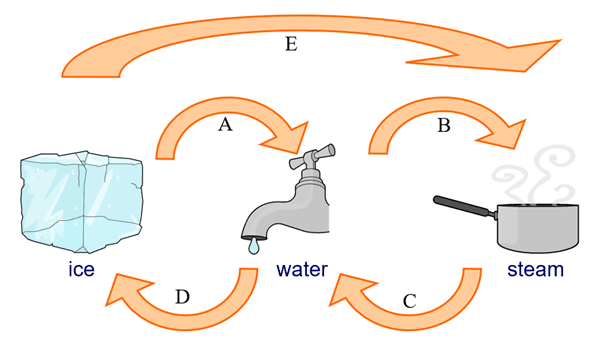
Look at the diagram. Which letter describes freezing?
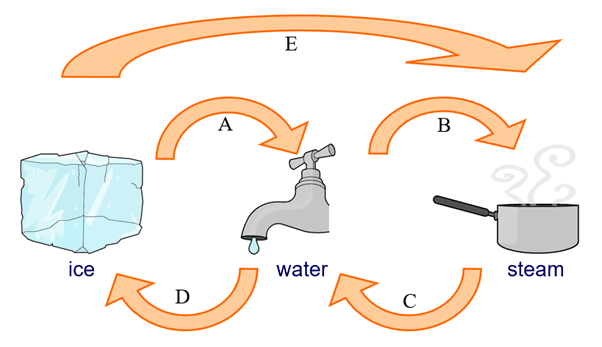
Look at the diagram. What is the change marked with letter E called?
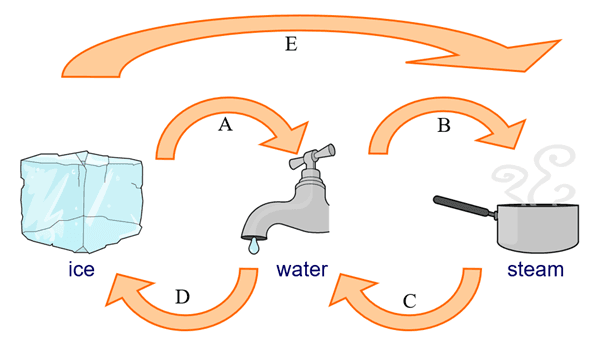
The melting point of ice is 0 degrees C. At what temperature does water freeze?
If 10g of ice melted, how many grams of liquid water are formed?