Loading...

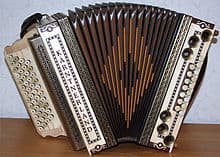
3/3 Test - What musical instrument it is? (description)
Quiz by Ivi Rausi
Customize this quiz to suit your class
Instantly translate to 100+ languages
Tag the questions with any skills you have. Your dashboard will track each student's mastery of each skill.
Give this quiz to my class
The musical instruments belongs to the woodwind section. It is usually made of metal and it is played in transverse position.
Name the musical instrument which is usually very big. It has pipes and it needs air to create the sound. People usually think if you can play the piano, you can play also that musical instrument, but it is not so similar.
Violin and double bass belong to the stringed instrument' section.
Saxophone is a brass instrument.
Electric guitar is an acoustic instrument.
Name the biggest string instrument which has many strings. The sound is created by the fingers: the strings are plucked with the fingers.
Connect the musical instrument with the correct group.
Put the musical instruments in order starting with the musical instrument with the highest sound.
Connect the musical instrument with the correct group.
 What is a rubric? A tool comprising a set of criteria (with possible levels of performance quality on the criteria) developed to assess learners’ work, from written to oral to visual. It is used tomeasureperformance,suchastheprocess of doing something (e.g.,playing a musical instrument, making a speech) or products of the learners’ work (e.g., concept map, laboratory report, bookshelf) (Brookhart, 2013). BENEFITS OF USING RUBRICS Support authentic assessment Reflects how well learners are able to apply knowledge inthe real-world context. Communicate expectations Gives learners an idea of what is expected of them. It is especially useful when the rubrics are communicated to the learners before they are assessed. Improve performance Explicit criteria and performance level descriptions allow learners to understand the desired performance. Learners are able to assess themselves by referring to the specific criteria and performance-level descriptions. Provide informative feedback Instructors are able to provide constructive feedback to learners on their weaknesses and strengths. Promote thinking andlearning 4 Provide informative feedback Instructors are able to provide constructive feedback to learners on their weaknesses and strengths. Learners are able to review and revise their work,thus reflecting on their learning experiences. Ensure fairness Learner performance assessed fairly given its objectivity. It helps avoid disputes between learners and instructors about the scores/grades achieved. TYPES OF RUBRIC ANALYTIC It consists of individual criterion with corresponding descriptor of performance. HOLISTIC It consists of performance descriptors that are placed together to refeclet to overalll performance. ANATOMY OF ANANALYTIC RUBRIC Rating scales with corresponding scores or weights The row represents the criteria for the desired performance, while the column represents the evaluation score. Under the rating scale (corresponding weights orscorescanbeassigned),theperformance descriptors are explicitly stated ANATOMYOF AHOLISTICRUBRIC Descriptions: It comprises the rating scale (corresponding weights or scores can be assigned) in the row while the combined desired performance descriptors are placed in the column. Description of the task The purpose of the assignment is to assess learner’s cognitive and analytic skills in applying knowledge gained and constructed throughout the course Diffusion of Innovation,bywatching the Surrogates movieand writing ananalytical review of the movie in the context of innovation diffusion.Iwant to provide learners with informative feedback on their cognitive and analytic skills such as the following: applying the concepts of innovation diffusion,making judgmentson the scenes related to innovation diffusion identified from the movie,selecting and critiquing theories of innovation diffusion and making connections between the theories,aswell asarguingand proposing necessary solutions to the problemss hown in the movie. ESTABLISHING ALTERNATIVEASSESSMENTINHIGHEREDUCATION VALIDITYAND RELIABILITYOF RUBRICS. Validity Measuring what is supossedto be measured. Reability Yielding consists results. Instruments that are used in the alternative assessment must be aligned to the learning outcomes and measure well what it intends to measure (valid) and produce consistent scores (reliable). The valid instrument will manifest the true ability (latent trait) of learners and permit appropriate inferences to be made about a specific group of people for specific purposes. TYPES OF VALIDITY FACE VALIDITY Simple form of validity thatapplies a superficial and subjective assessment whether the instrument measures what it is supposed to measure. CONTENT VALIDITY Refers to the extent to which the items on a measure assess the same content or how wellthe content material was sampled inthe measure. CONSTRUCT VALIDITY Refers to the extent to which the test may be said to measure a theoretical construct or trait. CONCURRENT VALIDITY Refers to the extent to which scores onanewmeasure are related to scores from a criterion measure administered at the same time. PREDICTIVE VALIDITY Refers to the uses of the scores from the new measure to predict performance on a criterion measure administered ata later time. STEPS TO CONSIDER WHEN ESTABLISHING CONTENT VALIDITY Calculate the level of expert agreeement for the content validity, get expert to verfy. Interview the expert ,make meta contentdata análisis from literatura. STEPS TO CONSIDER WHEN ESTABLISHING CONSTRUCCT VALIDITY Administer the instrument for alll learners, revise any item necccesay, run an apropriates statistical analiysis, administerthe instrument to learners as a pilot test . CONSTRUCTMAP Morepreciseconceptthan construct. Ranges from one extreme to another(fromhightolow,small tolarge,positivetonegative,or strongtoweak). Identifiesthepositionofthe respondentsinthisrange. Representativenessofsampling (questions and ability of respondents). EXAMPLEO FACONSTRUCTMAP:AFFECTIVE LEVELOF AFFECTIVE VARIABLES EXAMPLESOFITEMSIN MEASURINGTEAM WORKING SKILLS 5. Characterisation Learnersvolunteerstodothe groupworks. 4. Organisation Learners are willing to help others,althoughitisnottheir scopeoftask. 3. Valuing Learners respect other team members’opinionwhendoing thediscussion. 2. Responding Learnergivescooperationwhen neededingroupworks. 1. Receiving Learneracceptsthediversityof races and nationalities among groupmembers. EXAMPLEOFACONSTRUCTMAP:PSYCHOMOTOR LEVELOF PSYCHOMOTOR VARIABLES EXAMPLESOFITEMSIN MEASURING DIGITAL SKILLS 7.Origination Learnerscanmodifytheirowndevicesto performbetter. 6.Adaptation Learnerscansolveandtroubleshootthe problemwhileusingthecomputer. 5.ComplexOvertResponse Learnerscanusethecomputercompetently. 4.Mechanism Learners can use the computer independently,butstillmakeminorerrors. 3.GuidedResponses Learnerscanusethecomputer,butstill needguidance. 2.Set Learnersarereadytousethecomputer. 1.Perception Learnerscanobservehowtousecomputer. EXAMPLEOFACONSTRUCTMAP:COGNITIVE LEVELOF COGNITIV E VARIABLES EXAMPLESOFITEMS IN MEASURING THINKINGSKILLS 6. Creating Learners are able to suggest anewmodelorframeworkof learningdigitalcommunity. 5. Evaluating Learners are able to judge the impactofthescenariotowards educationperspective. 4. Analysing Learnerscandifferentiate the factsusingafew theories. 3. Applying Learnerscansolveproblems usingthefactsgiven. 2. Understanding Learnersareabletoexplainthe factsusingtheirownwords. 1. Remembering Learnersonlymemorisethe. Direction of Increasing “X” Learners Learners with high “X” Learners with mid range “X” Learners with low “X” Responses to Item Item response indicate highest level of X Item response indicate higher level of X Item response indicate lower level of X The construct map shows the lower ability students are in line with the lower level of items. This shows that when educators plan to develop an instrument, it Item response indicate lowest level of X Direction of Decreasing “X” is crucial to create an item difficulty thatrepresents learners’ ability. Learners’ ability Learners who engage in level characterisation Learners who engage in level organisation Learners who engage in level valuing Learners who engage in level responding Learners who engage in level receiving Direction of Decreasing“X” MEASURINGCONSTRUCTVALIDITY Unlike content validity, this construct validity can be analysed using statistical analysis. Use Exploratory FactorAnalysis [EFA], Confirmatory FactorAnalysis [CFA] or Unidimensionality to confirm all items are measuring the right construct and the raw variance explained for the latent variables is sufficient. Gap initem map also can show accuracy in construct validity. RELIABILITY The degree to which test scores are consistent over repeated administrations of the same/ equivalent test and therefore considered dependable and repeatable for an individual learner.A test thatproduces highly consistent and stable results (i.e. relative free from random error) is said to be highly reliable. TYPESOFRELIABILITY Test-retest demonstrates the stability of a measure over time 01 Internal consistency most of the items within a rating scale of a concept show consistency of scoring. Inter-rater the extent to which two or more independent raters are consistent in observing, recording and scoring data (should be 70% or higher agreement) 04 Intra-rater relies on one rater to rate an object or event twice (70% or higher of agreement) FACTORSAFFECTING VALIDITYANDHOWTO INCREASEVALIDITY? FACTORS AFFECTING VALIDITY HOWTO INCREASE VALIDITY? 1. Inaccuracy of items in measuringtheoutcomes 1. Vetting session to get reviewsfromtheexpert. 2. Pooritemsdevelopment 2. Followtheformatandtips indevelopinggooditems. 3. Unclearinstructions 3. Do pilot testing to measuretheusabilityof thetest. 4. Interveningevents 4. Controltheinternalthreats validityfactors. 5. Itemsdifficultyisnot suitableforthelearners 5. Create a construct map toensurethereisanitem thatrepresentslearners ability. FACTORS AFFECTING RELIABILIT Y HOWTOINCREASERELIABILITY? 1. TestLength 1. Thetestlengthshouldbeappropriate withtestdifficulty. 2. Test retest interval 2. Suggesteddurationisbetween3 weeksto2months. 3. Variability of scores 3. Doconstructmaptoensuretheitems aresuitablewithlearners’ability. 4. Guessing 4. Penalisetheguessinganswers.You alsocandetecteitherthelearnersare guessing or not using the statistical analysis named guessing analysis andpersonfitanalysis. 5. Inconsistency score from different raters 5. Appointtheratertomarkcertain questionsforalllearners(Thisalways happen when you have more than onesectionandhavemorethanone lecturer). CONCLUSION Coming back to the issue of validity and reliability in assessment, there is a need for educators to put an effort to ensurethattheitemsintheformofquestionsorinstructions arenotonlyclearbutalsoabletomeasurewhatitisintended tomeasurebasedontherelatedlearningoutcomes. Establishingvalidityandreliabilityofinstrumentscan provide educators with some indications of the quality of the measuring tools being used. Valid and reliable instruments enabletheeducatorstocontinuouslyusethemeasuringtools withoutreservation. Reliablenot valid Precisenot Accurate Reliableand valid Preciseand Accurate NotReliable butvalid NotPrecisebut Accurate NotReliable butNotvalid NotPrecisebut NotAccurate 94 We found you were making a quiz on the subject of "What is a rubric? A tool comprising a set of criteria (with possible levels of performance quality on the criteria) developed to assess learners’ work, from written to oral to visual. It is used tomeasureperformance,suchastheprocess of doing something (e.g.,playing a musical instrument, making a speech) or products of the learners’ work (e.g., concept map, laboratory report, bookshelf) (Brookhart, 2013). BENEFITS OF USING RUBRICS Support authentic assessment Reflects how well learners are able to apply knowledge inthe real-world context. Communicate expectations Gives learners an idea of what is expected of them. It is especially useful when the rubrics are communicated to the learners before they are assessed. Improve performance Explicit criteria and performance level descriptions allow learners to understand the desired performance. Learners are able to assess themselves by referring to the specific criteria and performance-level descriptions. Provide informative feedback Instructors are able to provide constructive feedback to learners on their weaknesses and strengths. Promote thinking andlearning 4 Provide informative feedback Instructors are able to provide constructive feedback to learners on their weaknesses and strengths. Learners are able to review and revise their work,thus reflecting on their learning experiences. Ensure fairness Learner performance assessed fairly given its objectivity. It helps avoid disputes between learners and instructors about the scores/grades achieved. TYPES OF RUBRIC ANALYTIC It consists of individual criterion with corresponding descriptor of performance. HOLISTIC It consists of performance descriptors that are placed together to refeclet to overalll performance. ANATOMY OF ANANALYTIC RUBRIC Rating scales with corresponding scores or weights The row represents the criteria for the desired performance, while the column represents the evaluation score. Under the rating scale (corresponding weights orscorescanbeassigned),theperformance descriptors are explicitly stated ANATOMYOF AHOLISTICRUBRIC Descriptions: It comprises the rating scale (corresponding weights or scores can be assigned) in the row while the combined desired performance descriptors are placed in the column. Description of the task The purpose of the assignment is to assess learner’s cognitive and analytic skills in applying knowledge gained and constructed throughout the course Diffusion of Innovation,bywatching the Surrogates movieand writing ananalytical review of the movie in the context of innovation diffusion.Iwant to provide learners with informative feedback on their cognitive and analytic skills such as the following: applying the concepts of innovation diffusion,making judgmentson the scenes related to innovation diffusion identified from the movie,selecting and critiquing theories of innovation diffusion and making connections between the theories,aswell asarguingand proposing necessary solutions to the problemss hown in the movie. ESTABLISHING ALTERNATIVEASSESSMENTINHIGHEREDUCATION VALIDITYAND RELIABILITYOF RUBRICS. Validity Measuring what is supossedto be measured. Reability Yielding consists results. Instruments that are used in the alternative assessment must be aligned to the learning outcomes and measure well what it intends to measure (valid) and produce consistent scores (reliable). The valid instrument will manifest the true ability (latent trait) of learners and permit appropriate inferences to be made about a specific group of people for specific purposes. TYPES OF VALIDITY FACE VALIDITY Simple form of validity thatapplies a superficial and subjective assessment whether the instrument measures what it is supposed to measure. CONTENT VALIDITY Refers to the extent to which the items on a measure assess the same content or how wellthe content material was sampled inthe measure. CONSTRUCT VALIDITY Refers to the extent to which the test may be said to measure a theoretical construct or trait. CONCURRENT VALIDITY Refers to the extent to which scores onanewmeasure are related to scores from a criterion measure administered at the same time. PREDICTIVE VALIDITY Refers to the uses of the scores from the new measure to predict performance on a criterion measure administered ata later time. STEPS TO CONSIDER WHEN ESTABLISHING CONTENT VALIDITY Calculate the level of expert agreeement for the content validity, get expert to verfy. Interview the expert ,make meta contentdata análisis from literatura. STEPS TO CONSIDER WHEN ESTABLISHING CONSTRUCCT VALIDITY Administer the instrument for alll learners, revise any item necccesay, run an apropriates statistical analiysis, administerthe instrument to learners as a pilot test . CONSTRUCTMAP Morepreciseconceptthan construct. Ranges from one extreme to another(fromhightolow,small tolarge,positivetonegative,or strongtoweak). Identifiesthepositionofthe respondentsinthisrange. Representativenessofsampling (questions and ability of respondents). EXAMPLEO FACONSTRUCTMAP:AFFECTIVE LEVELOF AFFECTIVE VARIABLES EXAMPLESOFITEMSIN MEASURINGTEAM WORKING SKILLS 5. Characterisation Learnersvolunteerstodothe groupworks. 4. Organisation Learners are willing to help others,althoughitisnottheir scopeoftask. 3. Valuing Learners respect other team members’opinionwhendoing thediscussion. 2. Responding Learnergivescooperationwhen neededingroupworks. 1. Receiving Learneracceptsthediversityof races and nationalities among groupmembers. EXAMPLEOFACONSTRUCTMAP:PSYCHOMOTOR LEVELOF PSYCHOMOTOR VARIABLES EXAMPLESOFITEMSIN MEASURING DIGITAL SKILLS 7.Origination Learnerscanmodifytheirowndevicesto performbetter. 6.Adaptation Learnerscansolveandtroubleshootthe problemwhileusingthecomputer. 5.ComplexOvertResponse Learnerscanusethecomputercompetently. 4.Mechanism Learners can use the computer independently,butstillmakeminorerrors. 3.GuidedResponses Learnerscanusethecomputer,butstill needguidance. 2.Set Learnersarereadytousethecomputer. 1.Perception Learnerscanobservehowtousecomputer. EXAMPLEOFACONSTRUCTMAP:COGNITIVE LEVELOF COGNITIV E VARIABLES EXAMPLESOFITEMS IN MEASURING THINKINGSKILLS 6. Creating Learners are able to suggest anewmodelorframeworkof learningdigitalcommunity. 5. Evaluating Learners are able to judge the impactofthescenariotowards educationperspective. 4. Analysing Learnerscandifferentiate the factsusingafew theories. 3. Applying Learnerscansolveproblems usingthefactsgiven. 2. Understanding Learnersareabletoexplainthe factsusingtheirownwords. 1. Remembering Learnersonlymemorisethe. Direction of Increasing “X” Learners Learners with high “X” Learners with mid range “X” Learners with low “X” Responses to Item Item response indicate highest level of X Item response indicate higher level of X Item response indicate lower level of X The construct map shows the lower ability students are in line with the lower level of items. This shows that when educators plan to develop an instrument, it Item response indicate lowest level of X Direction of Decreasing “X” is crucial to create an item difficulty thatrepresents learners’ ability. Learners’ ability Learners who engage in level characterisation Learners who engage in level organisation Learners who engage in level valuing Learners who engage in level responding Learners who engage in level receiving Direction of Decreasing“X” MEASURINGCONSTRUCTVALIDITY Unlike content validity, this construct validity can be analysed using statistical analysis. Use Exploratory FactorAnalysis [EFA], Confirmatory FactorAnalysis [CFA] or Unidimensionality to confirm all items are measuring the right construct and the raw variance explained for the latent variables is sufficient. Gap initem map also can show accuracy in construct validity. RELIABILITY The degree to which test scores are consistent over repeated administrations of the same/ equivalent test and therefore considered dependable and repeatable for an individual learner.A test thatproduces highly consistent and stable results (i.e. relative free from random error) is said to be highly reliable. TYPESOFRELIABILITY Test-retest demonstrates the stability of a measure over time 01 Internal consistency most of the items within a rating scale of a concept show consistency of scoring. Inter-rater the extent to which two or more independent raters are consistent in observing, recording and scoring data (should be 70% or higher agreement) 04 Intra-rater relies on one rater to rate an object or event twice (70% or higher of agreement) FACTORSAFFECTING VALIDITYANDHOWTO INCREASEVALIDITY? FACTORS AFFECTING VALIDITY HOWTO INCREASE VALIDITY? 1. Inaccuracy of items in measuringtheoutcomes 1. Vetting session to get reviewsfromtheexpert. 2. Pooritemsdevelopment 2. Followtheformatandtips indevelopinggooditems. 3. Unclearinstructions 3. Do pilot testing to measuretheusabilityof thetest. 4. Interveningevents 4. Controltheinternalthreats validityfactors. 5. Itemsdifficultyisnot suitableforthelearners 5. Create a construct map toensurethereisanitem thatrepresentslearners ability. FACTORS AFFECTING RELIABILIT Y HOWTOINCREASERELIABILITY? 1. TestLength 1. Thetestlengthshouldbeappropriate withtestdifficulty. 2. Test retest interval 2. Suggesteddurationisbetween3 weeksto2months. 3. Variability of scores 3. Doconstructmaptoensuretheitems aresuitablewithlearners’ability. 4. Guessing 4. Penalisetheguessinganswers.You alsocandetecteitherthelearnersare guessing or not using the statistical analysis named guessing analysis andpersonfitanalysis. 5. Inconsistency score from different raters 5. Appointtheratertomarkcertain questionsforalllearners(Thisalways happen when you have more than onesectionandhavemorethanone lecturer). CONCLUSION Coming back to the issue of validity and reliability in assessment, there is a need for educators to put an effort to ensurethattheitemsintheformofquestionsorinstructions arenotonlyclearbutalsoabletomeasurewhatitisintended tomeasurebasedontherelatedlearningoutcomes. Establishingvalidityandreliabilityofinstrumentscan provide educators with some indications of the quality of the measuring tools being used. Valid and reliable instruments enabletheeducatorstocontinuouslyusethemeasuringtools withoutreservation. Reliablenot valid Precisenot Accurate Reliableand valid Preciseand Accurate NotReliable butvalid NotPrecisebut Accurate NotReliable butNotvalid NotPrecisebut NotAccurate 94 ". Would you like to continue making it or start afresh?E2 WHAT ARE YOU DOING TEST 33/25/20 Ch 15 Pre-test ( lets gauge what you know) Question,Correct Answer,Option 2,Option 3,Option 4 You just saw your crush trip, but you imagine it in slow‑motion as if in a movie. What are you doing?,Visualizing,Ignoring,Running away,Screaming Your best friend says your outfit is “trash” but you think it’s ICONIC! This shows —,Perception,Precision,Symmetry,Association A butterfly’s wings are perfectly matching on both sides. They are —,Symmetrical,Random,Loud,Vague You always think of pizza when you hear “Friday night.” This is a(n) —,Association,Obsession,Illustration,Symmetry You carefully measure 10 candies for lunch. This shows —,Precision,Obsession,Symmetry,Association A teacher draws a big volcano on the board to explain it. She is —,Illustrating,Guessing,Visualizing,Ignoring Two students react differently to the same horror movie. This shows —,Perception,Symmetry,Precision,Obsession You measure your eyeliner perfectly on both eyes. This is —,Symmetry,Visualizing,Association,Individualized A student redoes ONE sentence 17 times all night. She is —,Obsessive,Relaxed,Careless,Confused A loud, clear knock on the door is —,Distinct,Vague,Random,Individualized You picture your future life as a superhero saving the world. You are —,Visualizing,Associating,Obsessing,Measuring A quiz made just for ONE student is —,Individualized,General,Random,Symmetrical Two students get the same task but react differently. This shows differences in —,Perception,Symmetry,Association,Obsession Your friend always folds napkins perfectly before dinner. That is —,Obsessive,Relaxed,Visualizing,Association A student triple‑checks a ruler, erases tiny mistakes, and won’t submit. Which TWO describe her? (Choose best single answer),Obsessive and Precise,Relaxed and Calm,Confused and Random,Symmetrical and Vague Which shows BOTH perception AND association?,Thinking rain is sad because you cried in it,Measuring carefully,Folding paper,Drawing a volcano The **funniest way to show symmetry** in class would be —,Balancing a pencil on your nose randomly,Throwing paper randomly,Screaming at the board,Balancing a pencil perfectly on your nose You hear a scary clear knock and spill your water. That knock is —,Distinct,Vague,Individualized,Symmetry Which is NOT individualized?,Standard school uniform,Custom shoes,Test for one student,Personalized notebook Two students measure carefully. One is calm and exact, the other keeps freaking out. The calm student shows —,Precision,Obsession,Association,Illustration The same scenario: The freaking‑out student shows —,Obsession,Symmetry,Visualizing,PrecisionQuestion 1: What is a rubric used for in assessment? A. To provide random scores B. To make tests harder C. To establish clear performance criteria D. To replace lesson plans Question 2: Which of the following is an essential part of a rubric? A. Randomized scoring B. Learning outcomes C. Student names D. Test format Question 3: What are the three main components of a rubric? A. Goals, instructions, and timing B. Criteria, levels of performance, and descriptors C. Subjects, grades, and age D. Test format, feedback, and score Question 4: Why are descriptors important in a rubric? A. They describe the student's background B. They allow subjectivity C. They explain each performance level D. They list test dates Question 5: A well-designed rubric helps to: A. Confuse students B. Ensure subjective evaluation C. Promote consistency and transparency in grading D. Replace teacher feedback Question 6: What does "validity" in assessment refer to? A. The number of questions B. The consistency of results C. The degree to which an instrument measures what it claims to measure D. The length of the rubric Question 7: Reliability refers to: A. The time taken to grade B. How fair the test is C. The consistency and stability of the assessment results D. The number of rubrics used Question 8: Which factor can negatively affect reliability? A. Clear criteria B. Multiple evaluators C. Subjective grading D. Use of rubrics Question 9: Why is it important for alternative assessments to be valid and reliable? A. To shorten evaluation time B. To improve rubric length C. To ensure fair, accurate, and meaningful results D. To impress stakeholders Question 10: How can a teacher improve the reliability of an assessment? A. Use vague instructions B. Avoid training graders C. Use standardized rubrics and provide scorer training D. Change criteria frequentlyInstructions: Please answer the following questions to test your understanding of aptitudes and interests. 1. What are Core Drivers (Talents) in the context of aptitudes and interests? a) Abilities that are developed through education b) Natural gifts that predict job effectiveness and contentment c) Interests that change over time d) Personality traits 2. Determine how effective and satisfied you'll be doing a particular kind of work. a) Visual Comparison Speed b) Numerical Reasoning c) Spatial Visualization d) Sequential Reasoning 3. Which Core Driver is associated with the knack for organizing things in a sequential and systematic manner? a) Visual Comparison Speed b) Numerical Reasoning c) Spatial Visualization d) Sequential Reasoning 4. What is the primary role of Space Planners in careers? a) They are responsible for interior design b) They read maps and blueprints c) They generate creative ideas d) They manage financial accounts 5. Which Core Driver relates to the ability to mentally translate two-dimensional images into three-dimensions? a) Visual Comparison Speed b) Numerical Reasoning c) Spatial Visualization d) Sequential Reasoning 6. What type of individuals are known as 3D Visualizers? a) Those who excel in visual art b) People who can quickly process numerical data c) Individuals who can mentally create 3D models from 2D representations d) Creative writers 7. How do Brainstormers differ from Concentrated & Focused individuals in terms of generating ideas? a) Brainstormers generate more ideas b) Concentrated & Focused individuals generate more ideas c) They generate ideas at the same rate d) Both groups struggle to generate ideas 8. What is the primary advantage of having high Visual Comparison Speed? a) It helps in artistic endeavors b) It is useful in complex mathematical problems c) It aids in tasks requiring clerical detail and accuracy d) It enhances spatial visualization 9. Which career is NOT associated with the Core Driver: Visual Comparison Speed? a) Fire Inspector b) Astronomer c) Creative Writer d) Orthoptist 10. What is the main focus of Numerical Reasoning? a) Identifying numerical patterns and trends b) Analyzing historical data c) Solving abstract problems d) Communicating effectively 11. Which Core Driver involves the ability to rapidly draw conclusions from seemingly unrelated pieces of information? a) Numerical Reasoning b) Idea Generation c) Spatial Visualization d) Inductive Reasoning 12. What is the primary characteristic of Diagnostic Problem Solvers? a) They follow a logical step-by-step method of problem-solving b) They rely on specific information and observed experience c) They intuitively leap to conclusions based on limited information d) They are meticulous and deliberate in decision-making 13. What is the role of Fact Checkers in the problem-solving process? a) They intuitively provide solutions b) They rely on specific information and observed experience c) They enjoy acquiring new information and learning d) They make conclusions based on limited facts 14. In what type of role are Abstract Thinkers most comfortable? a) Counseling b) Law c) Marketing d) Construction 15. How can understanding your Core Drivers benefit collaborative work? a) It allows individuals with similar aptitudes to work together more effectively b) It creates conflicts within the team c) It doesn't affect collaborative work d) It makes collaboration more challenging 16. Which Core Driver is associated with processing complex mathematical problems logically? a) Visual Comparison Speed b) Numerical Reasoning c) Sequential Reasoning d) Idea Generation 17. What are Collaborative Planners more likely to do in a team project? a) Lead the team b) Create individual pieces of a project c) Solve abstract problems d) Generate creative ideas 18. How can understanding your aptitudes and interests help you make informed career choices? a) It guarantees job satisfaction b) It allows you to align your career with your strengths c) It helps you choose any career at random d) It has no impact on career decisions 19. Which Core Driver affects whether your thoughts go in several directions at once or follow single ideas more readily? a) Visual Comparison Speed b) Numerical Reasoning c) Idea Generation d) Inductive Reasoning 20. What is the primary characteristic of Idea Contributors? a) They generate creative ideas b) They discuss the big picture and next steps c) They are highly focused and detailed d) They follow a logical step-by-step approach 21. What is the role of Space Planners in the problem-solving process? a) They intuitively provide solutions b) They rely on specific information and observed experience c) They quickly organize information d) They create abstract plans 22. Which Core Driver is linked to the ability to see relationships in seemingly unrelated pieces of information? a) Spatial Visualization b) Inductive Reasoning c) Idea Generation d) Visual Comparison Speed 23. Which career is NOT associated with the Core Driver: Numerical Reasoning? a) Statistician b) Survey Researcher c) Chef d) Actuary 24. What are Core Drivers, and why are they important in the context of aptitudes and interests? a) They are educational qualifications b) They are interests that change over time c) They are natural gifts that predict job effectiveness and contentment d) They are personality traits 25. How can understanding your Core Drivers benefit collaborative work? a) It allows individuals with similar aptitudes to work together more effectively b) It creates conflicts within the team c) It doesn't affect collaborative work d) It makes collaboration more challenging Answers: b) Natural gifts that predict job effectiveness and contentment a) Visual Comparison Speed d) Sequential Reasoning b) They read maps and blueprints c) Spatial Visualization c) Individuals who can mentally create 3D models from 2D representations a) Brainstormers generate more ideas c) It aids in tasks requiring clerical detail and accuracy c) Creative Writer a) Identifying numerical patterns and trends d) Inductive Reasoning c) They intuitively leap to conclusions based on limited information b) They rely on specific information and observed experience b) Law a) It allows individuals with similar aptitudes to work together more effectively b) Numerical Reasoning b) Create individual pieces of a project b) It allows you to align your career with your strengths c) Idea Generation b) They discuss the big picture and next steps c) They quickly organize information b) Inductive Reasoning c) Chef c) They are natural gifts that predict job effectiveness and contentment a) It allows individuals with similar aptitudes to work together more effectively 1. What is the main purpose of including theme and main idea questions in a text? a) To test your reading comprehension skills b) To understand the overall message or lesson of the text c) To practice identifying specific details in the text d) To improve your vocabulary and word knowledge 2. What is the purpose of finding the theme in a text? a) To summarize the main idea of the text in a few words b) To identify the specific details and examples in the text c) To understand the order of events in the text d) To analyze the author's writing style and techniques 3. Which of the following represents the theme of a text? a) A long sentence that describes the setting of the story b) A single word or short phrase that captures the main idea of the text c) A list of characters and their traits d) A detailed description of the plot and conflict in the story 4. How does identifying the main idea of a paragraph help you understand the text? a) It allows you to make connections between different parts of the text b) It helps you identify the author's purpose for writing the text c) It enables you to predict what will happen next in the story d) It helps you remember the specific details and examples in the paragraph 5. Which of the following best describes the main idea of a paragraph? a) The specific details and examples that support the theme of the text b) The order of events and actions in the paragraph c) The overall message or lesson conveyed by the paragraph d) The vocabulary words and their definitions in the paragraph 6. In a short paragraph about dogs, what could be a possible theme? a) Running and playing in the park b) Different breeds of dogs and their characteristics c) The loyalty and companionship dogs provide d) How to train a dog to do tricks 7. What might be the main idea of a paragraph about the importance of recycling? a) Recycling reduces pollution and conserves natural resources b) The process of recycling and how it works c) The different types of materials that can be recycled d) The history of recycling and its impact on society 8. Which of the following could be the theme of a paragraph about the benefits of reading? a) The importance of reading for academic success b) How to choose the right book to read c) The different genres of literature and their characteristics d) The role of libraries in promoting reading 9. If a paragraph discusses the life cycle of a butterfly, what would be the most likely main idea? a) The different colors and patterns of butterfly wings b) The stages of a butterfly's life from egg to adult c) The habitats and environments where butterflies live d) The types of plants that attract butterflies for feeding 10. What is the purpose of including vocabulary words and their meanings in context in a text? a) To test your knowledge of different words and their definitions b) To understand the specific details and examples in the text c) To improve your reading comprehension skills d) To practice using new words in your own writing