Tag the questions with any skills you have. Your dashboard will track each student's mastery of each skill.
Give this quiz to my class
Q 1/17
Score 0
What physical property defines the ability of matter to transfer both heat and electricity?
30
conductivity
luster
ductility
malleability
Q 2/17
Score 0
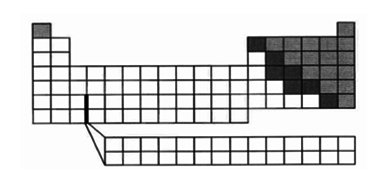
Which of the following matches the white squares?
30
Lithium, Potassium, Sodium, Metalloids
Lithium, Potassium, Sodium, Metals
Lithium, Potassium, Sodium, Gases
Lithium, Potassium, Sodium, Non-metals
17 questions
Q.
What physical property defines the ability of matter to transfer both heat and electricity?
1
30 sec
Q.
Which of the following matches the white squares?
2
30 sec
Q.
The picture shows a sample of an element that is shiny, conducts electricity, and is magnetic. How is this element classified?
3
30 sec
Q.
Which of the following correctly fills in the blanks below?
4
30 sec
Q.
Which of the following physical properties would you use to tell a metal from a non-metal?
5
30 sec
Q.
What does section A represent on the Periodic Table above?
6
30 sec
Q.
What does section C represent on the Periodic Table above?
7
30 sec
Q.
A student is asked to identify an element that is pale, brittle, yellow, solid, and does not conduct electricity. At which location on the periodic table would the element most likely be found?
8
30 sec
Q.
Based on the data in the table, which of the elements should be classified as metals?
9
30 sec
Q.
Which of the following statements is supported by the evidence in the table?
10
30 sec
Q.
Based on these observations, which one is a nonmetal?
11
30 sec
Q.
If an element is lustrous and malleable, what is it MOST likely to be?
12
30 sec
Q.
Substance W is best classified as a
13
30 sec
Q.
Substance X is what substances?
14
30 sec
Q.
Copper is mostly used in electrical wiring because of its conductivity. How would copper be classified?
15
30 sec
Q.
Unlike metals, many nonmetals are
16
30 sec
Q.
Using the illustration above, what physical property is being tested?