Loading...


8.11A- Interdependence, 7.5B- Flow of energy, 7.10B- Biodiversity
Quiz by BYRONESIA HAROLD
Track each student's skills and progress in your Mastery dashboards
Is climate abiotic or biotic?
Is sunlight abiotic or biotic?
Is air abiotic or biotic?
Are organisms abiotic or biotic?
Is a decaying tree abiotic or biotic?
Answer the question below.

How would a reduction in the snail population affect this ecosystem?

There are three species of birds on an island. Bird A has a pointed bill for eating insects. Bird B has a heavy bill for eating seeds. Bird C has a sharp bill for eating seeds and insects. If the insect populations suddenly disappeared one season, which bird would probably be the least affected that season?

Some scientists studying aquatic plants notice that flooding often leads to a decrease in the rate of photosynthesis among aquatic plants. Flooding causes more sediment to be suspended in the water. The increased sediment concentration decreases the amount of light that reaches the plants. Why does a decreased rate of photosynthesis lead to a decrease in a plant population?
The Guam rail is a flightless bird found on the island of Guam. It builds a shallow nest on the ground and lays eggs throughout the year. There are no native species of snakes on Guam, so the Guam rail had no experience with snake predators until the brown tree snake was accidentally introduced sometime between 1944 and 1952. These snakes, which eat a wide variety of animal species, quickly established a large population on Guam. How was the Guam rail most likely affected by the introduction of the brown tree snake?
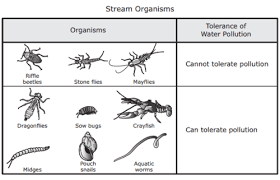
The types of small organisms that live on the bottom of streams can be good indicators of water pollution. The table below groups some organisms by their tolerance of pollution. A certain stream that was historically clear and clean has become increasingly polluted with fertilizer waste over the years. Which of these describes a likely result of this pollution?
Identify the following as a short-term change or long-term change.
An earthquake caused landslides and shifts in ground level, which changed the course of rivers or flooded large areas. Earthquakes that occur in ocean areas can cause underwater landslides that create tsunamis. The large waves can destroy coastal ecosystems.
Identify the following as a short-term change or long-term change.
Tectonic plate movement has caused large changes in climate across the Earth, leading to the extinction or growth of many species.
Droughts, smog, flooding, volcanic eruptions, blizzards, and pollution are all examples of ________ changes.
Four students categorized several different environmental changes as short-term or long-term changes. Which table correctly categorizes short- and long-term changes?

Artificial reefs, such as old ships placed in the ocean by humans, affect the ecosystems of the ocean. How can these artificial reefs change the ecosystem?
Match each example (left) with the correct description (right) that explains how humans have modified ocean systems by writing the letter of your answer in the blank.
Which of the following is most likely to have a positive effect on biodiversity?
Look closely at the table that shows the dominant flora at various stages of ecological succession. Which stage represents the climax community?

Look closely at the table that shows the dominant flora at various stages of ecological succession. Which stage represents the establishment of the pioneer organisms?
Which of these correctly sequences the diagrams to show the process of ecological succession happening in an ecosystem?

During ecological succession, why do grasses appear before shrubs?