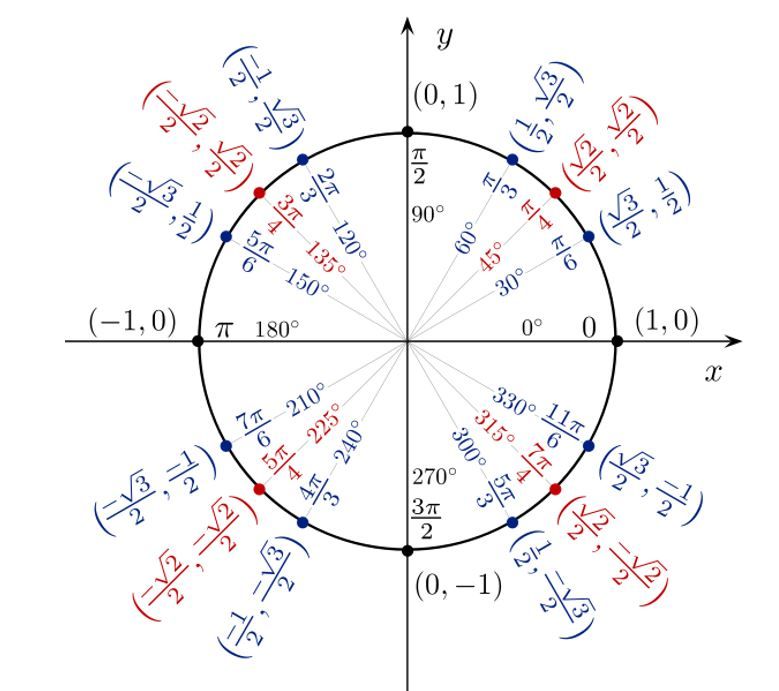
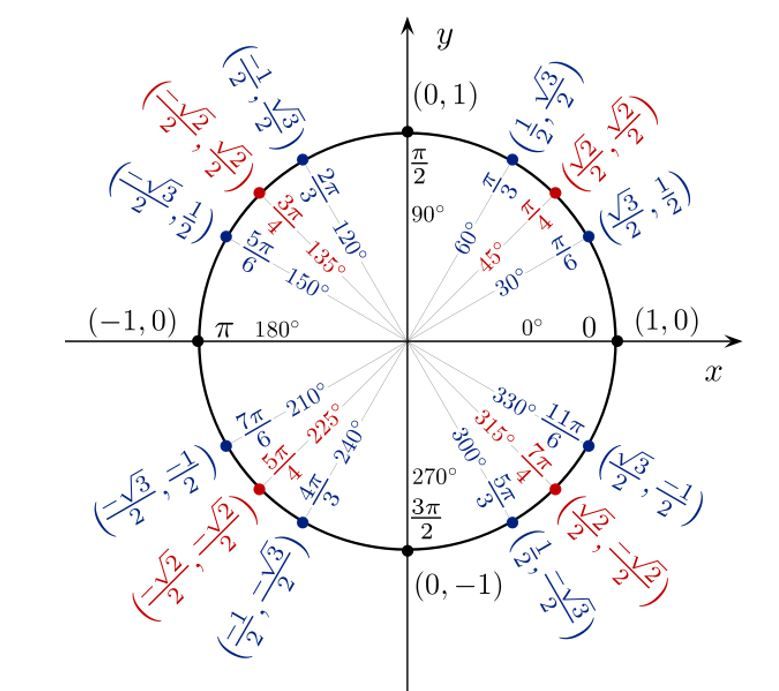
Understand radian measure of an angle as the length of the arc on the unit circle subtended by the angle.
Explain how the unit circle in the coordinate plane enables the extension of trigonometric functions to all real numbers, interpreted as radian measures of angles traversed counterclockwise around the unit circle.
Use special triangles to determine geometrically the values of sine, cosine, tangent for π/3, π/4 and π/6, and use the unit circle to express the values of sine, cosine, and tangent for x, π + x, and 2π - x in terms of their values for x, where x is any real number.
Use the unit circle to explain symmetry (odd and even) and periodicity of trigonometric functions.
Solve linear equations and inequalities in one variable, including equations with coefficients represented by letters.
Understand the inverse relationship between exponents and logarithms and use this relationship to solve problems involving logarithms and exponents.
For a function that models a relationship between two quantities, interpret key features of graphs and tables in terms of the quantities, and sketch graphs showing key features given a verbal description of the relationship.
Understand that rational expressions form a system analogous to the rational numbers, closed under addition, subtraction, multiplication, and division by a nonzero rational expression; add, subtract, multiply, and divide rational expressions.
Graph polynomial functions, identifying zeros when suitable factorizations are available, and showing end behavior.
Use the method of completing the square to transform any quadratic equation in x into an equation of the form (x - p)^2 = q that has the same solutions. Derive the quadratic formula from this form
Track each student's skills and progress in your Mastery dashboards