Tag the questions with any skills you have. Your dashboard will track each student's mastery of each skill.
Give this quiz to my class
Q 1/60
Score 0
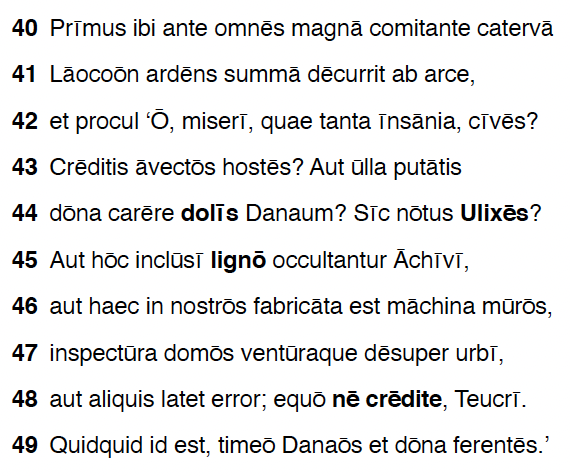
Which is the best translation of "magnā comitante catervā" on line 40?
45
accompanying in a large crowd
with a great crowd accompanying
having accompanied a great crowd
in a large accompanying crowd
Q 2/60
Score 0
"magnā comitante catervā" is an example of
45
a purpose clause
a gerund of obligation
an ablative absolute
an indirect statement
60 questions
Q.
Which is the best translation of "magnā comitante catervā" on line 40?
1
45 sec
Q.
"magnā comitante catervā" is an example of
2
45 sec
Q.
Which of the following words from lines 40-42 describes Laocoon's emotional status as he approaches the Trojans?
3
45 sec
Q.
Where was Laocoon before he approached the crowd?
4
45 sec
Q.
In lines 42, Laocoon addresses someone/something as being "miserī." Who/What is he addressing?
5
45 sec
Q.
Which Latin word does "miserī" on line 42 modify?
6
45 sec
Q.
Which verb form is missing from the question on line 42 due to the process of ellipsis?
7
45 sec
Q.
Lines 43-44 contain examples of
8
45 sec
Q.
On line 43, Laocoon asks if
9
45 sec
Q.
Who is the "hostēs" mentioned on line 43?
10
45 sec
Q.
On lines 43-44, Laocoon characterizes the Greeks as being
11
45 sec
Q.
The word "Danaum" on line 44 refers to
12
45 sec
Q.
"carēre dōlīs" on line 44 is an example of the ablative of
13
45 sec
Q.
What Greek hero is known to the Romans as "Ulixēs"?
14
45 sec
Q.
Why does Laocoon mention 'Ulixēs" on line 44?
15
45 sec
Q.
"Sīc nōtus Ūlixēs" is an example of
16
45 sec
Q.
"lignō" on line 45 is metonymy for
17
45 sec
Q.
To what proposed action does "insania" on line 42 refer?
18
45 sec
Q.
Who are the "Achīvī" mentioned on line 45?
19
45 sec
Q.
Which is the most appropriate translation of "inclusī" on line 45?
20
45 sec
Q.
"haec machina" on line 46 refers to
21
45 sec
Q.
When referencing violence or aggression, "in" has a particular translation. What is the translation of "in" on line 46?
22
45 sec
Q.
What is the TENSE and VOICE of the verb "fabricāta est" on line 46?
23
45 sec
Q.
The "murōs" on line 46 refer to
24
45 sec
Q.
"inspectūra" and "ventūra" on line 47 refer to the noun
25
45 sec
Q.
"inspectūra" and "ventūra" are examples of ______________ participles.
26
45 sec
Q.
Which two letters identify the tense of the participles "inspectūra" and "ventūra"? Do not use macrons. Only enter in the two letters, no extra characters.
27
45 sec
Q.
"equō nē crēdite" on line 48 is an example of
28
45 sec
Q.
What is the case of "Teucrī" on line 48?
29
45 sec
Q.
On line 49, Laocoon states that he does not trust Greeks, but especially those Greeks who
30
45 sec
Q.
Which is the most appropriate translation of the word "ferentēs" on line 49?
31
45 sec
Q.
The most appropriate translation of the word "fatus" on line 50 is
32
45 sec
Q.
The phrase "validīs ingentem vīribus hastam" on line 50 is an example of
33
45 sec
Q.
"vīribus" on line 50 means
34
45 sec
Q.
"validīs vīribus" on line 50 is an example of the ablative of
35
45 sec
Q.
"hastam" on line 50 is the direct object of
36
45 sec
Q.
What is the best translation of the preposition "in" on line 51?
37
45 sec
Q.
"ferī" on line 51 is
38
45 sec
Q.
"ferī curvam....alvum" on line 51 refers to
39
45 sec
Q.
"compāgibus" on line 51 is an example of the ablative of
40
45 sec
Q.
The subject of "contorsit" on line 52 is.....
41
45 sec
Q.
To what does "illa" on line 52 refer?
42
45 sec
Q.
"tremēns" on line 52 indicates
43
45 sec
Q.
What is the TENSE, VOICE, and TRANSLATION of the participle "tremēns" on line 52?
44
45 sec
Q.
The phrase "uterōque recussō" is an example of
45
45 sec
Q.
Which of the following words from lines 50-52 is a synonym of the word "uterō"?
46
45 sec
Q.
"insonuēre" on line 53 is an example of
47
45 sec
Q.
What is the true form of the verb "insonuēre" on line 53?
48
45 sec
Q.
What is the subject of the verbs "insonūere" and "dedēre"?
49
45 sec
Q.
Lines 54-56 present a conditional sentence (if....then...). Which of the following is true about the sentence here?
50
60 sec
Q.
Which of the following is a pluperfect subjunctive?
51
60 sec
Q.
On line 55, Aeneas is referring to
52
60 sec
Q.
Identify an infinitive from lines 54-56. Write out the Latin only for the word. Do not use macrons.
53
60 sec
Q.
Who is speaking line 56?
54
60 sec
Q.
What emotion is meant to be evoked on line 56?
55
60 sec
Q.
What is the case of "Priamī" on line 56?
56
60 sec
Q.
What is the most accurate translation for the word "staret" on line 56
57
60 sec
Q.
What is the most accurate translation of the verb "manērēs" on line 56?