Loading...


Chapter 2, Part III - Chemistry the Central Science
Quiz by Andre McBean
Tag the questions with any skills you have. Your dashboard will track each student's mastery of each skill.
If __________ is removed from or added to an atom, a charged particle called an ion is formed.
Consider the sodium atom, which has 11 protons and 11 electrons, if this atom loses one electron how many protons, electrons, and neutrons does this ion have, and what is the net charge?
Match the following to the group:
In a given element with 22 protons, 26 neutrons and 19 electrons, what is the chemical symbol?
In a given element with 22 protons, 26 neutrons and 19 electrons, what is the mass number?
In a given element with 22 protons, 26 neutrons and 19 electrons, what is the net charge?
The ion of sulfur has 16 neutrons and 18 electrons, how many protons does it have?
The ion of sulfur has 16 neutrons and 18 electrons, how many protons does it have?
The ion of sulfur has 16 neutrons and 18 electrons, what is the net charge?
In which of the following species is the difference between the number of protons and the number of electrons largest? (a) Ti2+ (b) P3- (c) Mn (d) Se2- (e) Ce4+
Ions, such as NH+4 (ammonium ion) and SO42- (sulfate ion), which consist of atoms joined as a molecule, but carrying a net positive or negative charge are called what?
Does the atom have the same chemical properties as the ions?
Noble gases are chemically reactive?
Predict the charge expected for the most stable ion of barium.
Predict the charge expected for the most stable ion of oxygen.
The periodic table is very useful for remembering ionic charges, what is the suspected ionic charge for group 1 elements?
The periodic table is very useful for remembering ionic charges, what is the suspected ionic charge for group 2 elements?
The periodic table is very useful for remembering ionic charges, what is the suspected ionic charge for group 17 elements?
The most common ionic charges for transition metals are +2 and +3/
An electron transfers from a sodium atom to a chlorine atom, forming a Na+ ion and a Cl- ion because objects of opposite charges attract.
A compound made up of ions (cations or anions) is known as a _________ compound.
The transfer of electrons from a chlorine atom results in a chlorine ________.
Ionic compounds are generally combinations of metals and nonmetals.
Cations are nonmetal ions and anions are metal ions.
Which of these compounds would you expect to be ionic: N2O, Na2O, CaCl2, SF4?
Because chemical compounds are always electrically neutral, the ions in an ionic compound always occur in such a ratio that the total positive charge equals the total negative charge.
In the chemical bonding of two ions, the superscript/the charge of one ion will become the _______ of the other ion and vice-versa.
The smallest possible whole-number ratio of the two elements.
I will pay attention to the formula being asked in the questions. I will remember the significant difference between the molecular formula and the empirical formula. These are fundamentally important for chemistry. I understand that the empirical formula for the ionic compound formed between Ti4+ and O2- is TiO2 rather than Ti2O4.
Write the empirical formula of the compound formed by (a) Al3+ and Cl- ions.
Write the empirical formula of the compound formed by (b) Al3+ and O2 - ions.
Write the empirical formula of the compound formed by (c) Mg2+ and NO3- ions.
Which of the following nonmetals will form an ionic compound with Sc3+ that has a 1:1 ratio of cations to anions?
Which group in the periodic table contains elements that form a 2- anion?
Predict whether each of the following compounds is molecular or ionic: (a) HClO4
Predict whether each of the following compounds is molecular or ionic: (b) CH3OCH3
Predict whether each of the following compounds is molecular or ionic: (c) Mg(NO3)2
Predict whether each of the following compounds is molecular or ionic: (d) H2S
Predict whether each of the following compounds is molecular or ionic: (e) TiCl4
Predict whether each of the following compounds is molecular or ionic: (f) K2O2
Predict whether each of the following compounds is molecular or ionic: (g) PCl5.
Predict whether each of the following compounds is molecular or ionic: (h) P(OH)3.
What is the vocabulary used to describe the naming of compounds?
Even though there are over 50 million substances in existence, some are so common that they are aptly given traditional names, which are referred to as the "common name." These include substances such as water (H2O) and ammonia (NH3).
What are the two categories of substances in order to name them?
"A" contain carbon and hydrogen, often in combination with oxygen, nitrogen, or other elements. All others are "B". Early chemists associated "C" compounds with plants and animals and "D" compounds with the nonliving portion of our world, for example minerals and water.
Metals bonding with nonmetals are classified as _________ compounds.
Some metals can form more than one type of ion. These metals are in the transitional metals of the periodic table. Since there are more than one variation of these elements bonding, they are differentiated using roman numerals.
Name the following ion: Na+
Name the following ion: Zn2+
Name the following ion: Al3+
Name the following ion: Fe2+
Name the following ion: Fe3+
Ions of the same element that have different charges have different phyical and chemical properties.
Which two transitional metals do not form more than one type of ion, and therefore will never use roman numerals?
Positively charged ions (cations) composed of purely nonmetals end in ______
Monatomic (mono-one, atomic-atom) anions (negatively charged ions), end in/with ______. Examples include H-, O2-, and N3-.
Polyatomic ions containing oxygen, are known as oxyanions. They end in one of two suffixes:
Name the following polyatomic ions:
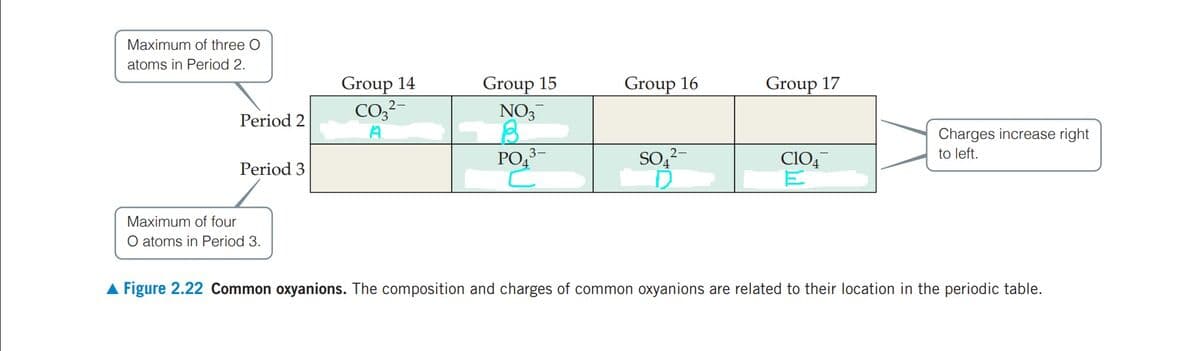
What is the formula for the sulphate ion? Enter the charge next to the ion in parentheses. Ex: ClO4(1-).
Write the formula for the selenate ion (selenium).
Match the following:
Name the following polyatomic ion: ClO3-
Name the following polyatomic ion if an additional oxygen were present: ClO3- + O
What prefix is added to the naming of an ion when an additional oxygen is added/bonded:
Which of the following is the predominant oxyanion (contains oxygen and a negative charge):
Name the following oxyanions: ClO4-
Name the following oxyanions: ClO3-
Name the following oxyanions: ClO2-
Name the following oxyanions: ClO-
Name the following ion: Cl-
Name the following ion: O2-
Name the following ion: CN-
Name the following ion: H-
Name the following ion: OH-
Anions derived by adding H+ to an oxyanion are named by adding as a prefix the word hydrogen or dihydrogen. For example: H2PO4- would be dihydrogen phosphate ion.
Name the following polyatomic anion which has a hydrogen added to it: HCO3-
This ion is unusually named because the compound was first discovered before chemical nomenclature was standardized: CH3COO- (or C2H3O2-).
Name the following ion: MnO4-.
The anion name comes before the cation name.
Name the following ionic compound, Cu(ClO4)2. Hint: Copper is a transitional metal.
Name the following ionic compounds: K2SO4.
Name the following ionic compounds: Ba(OH)2.
Name the following ionic compounds: FeCl3.
Acids are compounds that all contain hydrogen as their defining ion.
Identify whether the following acids have simple anions or polyatomic anions:
Why is it important to take note if it is simple anion or polyatomic anion when naming an acid? Because acids that have simple anions are named using the hydro prefix and -ic suffix. Whereas polyatomic anion acids do not use the hydro prefix. They only use a -ic or -ous suffix.
Name the following acids: HCN.
Name the following acids: HNO3..
Name the following acids: H2SO4.
Name the following acids: H2SO3.
Binary molecular compounds are compounds that contain two nonmetal elements. The nonmetal closest to the metals gets preference in being written first.
Which of the following is an ionic compound?
Which of the following is a binary molecular compound?
Which of the following is an acid?
Which of the following is a binary molecular compound?
Which of the following is an ionic compound?
Which of the following is an acid?
Indicate which of the following is false:
Match the following prefixes for the number of atoms:
Which are the only compounds that are given prefixes that dictate the number of each element?
Binary molecular compounds are compounds that have a covalent bond and are therefore nonmetal, nonmetal bonding.
Name the following compound: Cl2O.
Name the following compound: NF3.
Name the following compound: N2O4.
Name the following compound: P4S10.
The study of compounds that contain carbon is called?
Compounds that contain carbon are called?
All living things contain carbon.
Compounds that contain only carbon and hydrogen are called?
Which is an example of a hydrocarbon (organic compound containing hydrogen and carbon)?
In the simplest class (category/type) of hydrocarbons, ___________, each carbon is bonded to four other atoms.

Name the following compounds: C8H18. Hint: contains carbon, and hydrogen.
Alcohols are a derivative of alkanes which only have carbons and hydrogens since they replace one side of the alkane structure with a hydroxide group.
Label the following molecular structures:
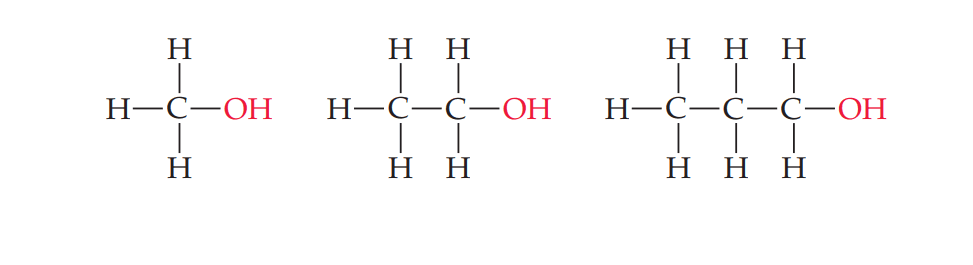
The alcohols have similar chemical properties as the alkanes they are derived from.
If 2 is added as a prefix for a derivative organic compound such as alcohol 2 propanol, that means that the replacement hydrogen was replaced at the center. Whereas, if there is a 1 prefix such as 1-propanol, the ending hydrogen of the alkane (the right H) was replaced.
Compounds with the same molecular formula but different arrangements of atoms are called ______________.
1-propanol and 2-propanol are structural isomers.
Name the following organic compound:
