Loading...


Chapter 6 - Chemistry the Central Science
Quiz by Andre McBean
Tag the questions with any skills you have. Your dashboard will track each student's mastery of each skill.
The behavior of electrons on the sub atomic level are explained by the __________ theory.
Quantum theory does not include particles of light.
The arrangement of electrons is part of quantum theory.
The quantum theory used to describe the arrangement of electrons is known as:
Visible light is a type of _______________ radiation.
The wavelength is the distance between two adjacent peaks or two adjacent troughs.
If we counted the number of wavelengths that occur in a one second time frame, this would be known as its ______________.
All electromagnetic radiation moves at the same speed, namely, the speed of light: radio waves, infrared (heat), x-rays.
Match the following:
What is represented by the letter A in the image:
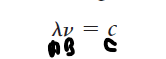
What is represented by the letter B in the image:
What is represented by the letter C in the image:
Why do different types of electromagnetic radiation [visible light, x-ray, radio waves, infrared (heat)] have different properties?
A table that catalogues the different electromagnetic radiation by their wavelength. Hint: Two words
Frequency is the measure of how many cycles of a wavelength fit into 1 second. What is the unit of measurement?
One peak (top) and one trough (bottom) of a wavelength is considered to be one cycle. This peak and trough is also called Hertz. In other words, one hertz is one cycle (peak + trough).
One hundred megahertz represents 100 cycles.
Label the electromagnetic spectrum based on their frequency (number of cycles per second):
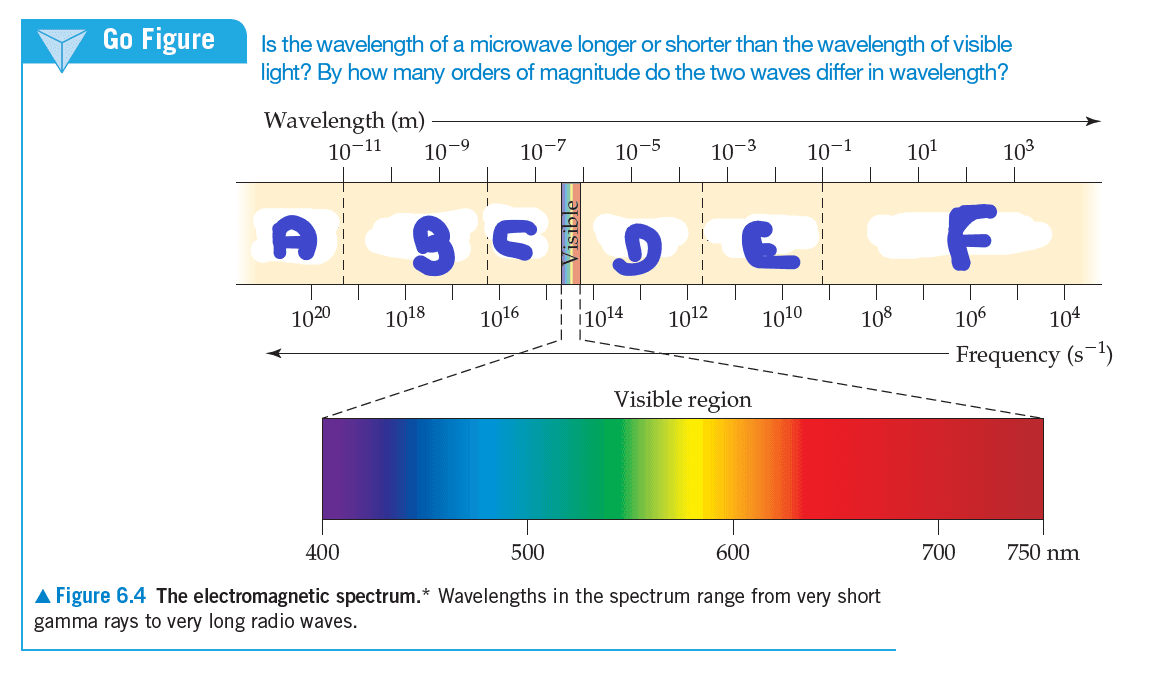
An electromagnetic ray is found to have a wavelength of 10-4 m. Which electromagnetic ray is this?
An electromagnetic ray is found to have a wavelength in the millimeter spectrum. Which electromagnetic ray is this?
An electromagnetic ray is found to have a wavelength in the micrometer spectrum. Which electromagnetic ray is this?
An electromagnetic ray is found to have a wavelength in the meter spectrum. Which electromagnetic ray is this?
An electromagnetic ray is found to have a wavelength in the nanometer spectrum. Which electromagnetic ray is this?
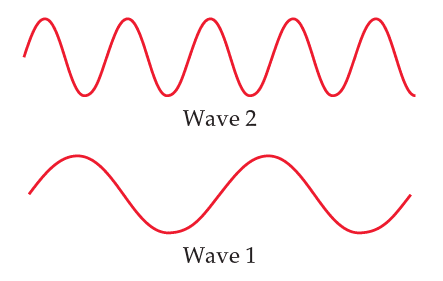
Two electromagnetic waves are represented in the margin. (a) Which wave has the higher frequency?
Angstrom is the electromagnetic spectrum unit of measurement for:
The longer the wavelength the longer the frequency
The yellow light given off by a sodium vapor lamp used for public lighting has a wavelength of 589 nm. What is the frequency of this radiation?
A laser used in orthopedic spine surgery produces radiation with a wavelength of 2.10 mm. Calculate the frequency of this radiation.
The smallest quantity of energy that can be emitted is called:
Frequencies are a study of quantum theory. And therefore the energy of frequencies are called quantum energy. Technically speaking, it is said to be a quantized energy. Quantum is equivalent to saying "a tiny amount of." Quantum of energy, whereas the energy is quantized (its tiniest amount). Quantized energy of a frequency is the tiniest energies of a frequency.
Planck gave the name quantum (meaning “fixed amount”) to the smallest quantity of energy that can be emitted or absorbed as electromagnetic radiation. He proposed that the energy, E, of a single quantum equals a constant times the frequency of the radiation: E = hv. Where h is Planck's constant which assumes the smallest amount of energy that can ever be released is 6.626 x 10⁻³⁴ joule-second (J-s). v is wavelength as in previous calculations. What this means is that v is a multiplication of the energy of h and cannot ever be smaller than Planck's constant.
In 1905, Albert Einstein (1879– 1955) used Planck’s theory to explain the photoelectric effect. This effect is described to be the observed effect when light is shined onto a clean metal surface and electrons and displaced which emits light. This is known as the emission of electrons.
A particle of light emission is known as a ___________.
The energy of a photon is the same as the quantized energy of a frequency. Therefore the energy of a photon = E = hv.
The amount of energy needed to overcome like charges of electrons to move is known as the work function. Therefore if the amount of light that is beamed onto a surface of clean/clear metal does not have enough work function, it can still cause electron emission.
The intensity/brightness of light is directly related to the amount of photons being emitted.
Increasing the amount of photons being emitted (brightness) increases the frequency of each photon. In other words, it changes its wavelengths.
Each atom of different metals have their own work function (energy required to displace one electron).
Electrons are emitted when the frequency of the photons is greater than the work function of the metal.
Excess energy of a photon that is greater than the work function is converted to:
Calculate the energy of one photon of yellow light that has a wavelength of 589 nm (Measured in J/mol). Hint: There is 1 photon per atom therefore 6.02e23 photons in 1 mol.
Which of the following expressions correctly gives the energy of a mole of photons with wavelength l?
Which photon of light has the higher energy?
Radiation (light) can be composed of more than one wavelength.
What is the name of radiation composing of only one wavelength?
Most radiation is monochromatic (single wavelength).
Most common radiation sources, including incandescent light bulbs and stars, produce radiation containing many different wavelengths. This is called ___________ radiation.
A spectrum is produced when the different wavelengths of a polychromatic radiation source are separated.
The rainbow of colors, containing light of all wavelengths, is called a continuous spectrum.
All radiation sources produce a continuous spectrum.
A spectrum containing radiation of only specific wavelengths is called a _____________ spectrum.
Visible light exists on a continuous spectrum.
Hydrogen has a line spectrum (very few wavelengths that have similar colors). This line spectra was observed and the distance between wavelength calculated. It was found that for hydrogen, it is possible to predict and define this line spectra lines using an equation.
What is the name of the equation that is used to find the line spectra of hydrogen?
Rydberg's equation is used to find the line spectra of:
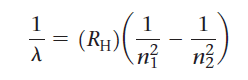
Rydberg's equation is used to find the line spectra of:
What does the RH stand for in Rydberg's equation?
What is the value of Rydberg's constant?
In Rydberg's equation, which value is always the larger
Rutherford, the New Zealand scientist who discovered the nucleus, proposed that the atom is like a mini solar system where the electrons orbit around the nucleus similar to the planets orbiting the sun.
The laws of physics proposed that object in motion (circular) lose energy and therefore if the electrons were to be orbiting the nucleus, they would continuously lose energy until they collapsed into the nucleus since the protons would reach a point where they have more attraction energy than the balancing electron.
Rutherford challenged the laws of physics by proposing an exception for electron saying that the quantized energies of electrons negate the effects of energy loss at the quantum level.
Rutherford proposed three of the following, which is incorrect:
Who discovered the following equation which describes the energies of the orbits themselves?

What does h stand for in Bohr's equation?
What does c stand for in Bohr's equation?
What does RH stand for in Bohr's equation?
What does RH stand for in Bohr's equation?
Each allowed orbit corresponds to a different value of n in Bohr's equation. Thus, the first allowed orbit (the one closest to the nucleus) has n = 1, the next allowed orbit (the one second closest to the nucleus) has n = 2, and so forth.
Bohr's equation will not tell us how much energy an electron has in each allowed orbit.
The lower (more negative) the energy is, the more stable the atom is. In other words, the lowest energy is orbit 1 and therefore the closest to the nucleus. Energy orbits closest to the nucleus are the most stable, creating the most stable atoms.
As n (the orbit number) gets larger, the energy becomes more negative and therefore increases.
Higher energy = Greater negative energy
When the electron is in a higher-energy state (n = 2 or greater), the atom is said to be in a _________ state.
The lowest energy state (n=1) is also called the _____________ state.
What does the following equation represent?

It is said that when an electron absorbs enough energy (such as radiation), it is excited (n>1) into another orbital (jumps orbit) emitting radiant energy in the form of a ___________.
An electron must absorb energy in order to be excited (move into a higher).
Radiant energy is emitted when an electron jumps to a lower-energy state (lower n).
n is also referred to as:
The following equation can be used to find the difference between two energy states (n).

What is the point of finding the difference between energy states?
Since we know that this equation is used to calculate the energy of a photon release from the jump of the electron, what does it mean when the energy is positive?
Since we know that this equation is used to calculate the energy of a photon release from the jump of the electron, what does it mean when the energy is negative?
Positive photon value means it is emitted.
ni represents the value of the final jump of the electron -- where the electron jump to.
nf represents the value of the final jump of the electron -- where the electron jumps to.
The energy of a photon is also equal to hv. Ephoton = hv.
If you have the energy of a photon, can you calculate its wavelength
The photon with the longest wavelength will have the largest energy.
The photon with the smallest wavelength will have the largest energy. Since the energy of a photon is equal to hv then if the v (frequency) is swapped out to include the wavelength then the energy of a proton = hc/lambda (wavelength). Meaning that through simply match inversion, this would make wavelength = hc/Eproton. In other words, the higher the energy of a proton the smaller the wavelength since the hc is being divided by an increasingly larger and larger number.
Although the Bohr model explains the line spectrum of the hydrogen atom, it can not explain the spectra of other atoms.
Louis de Broglie proposed that since photons as a form of energy can exhibit wave (hence having wavelength) patters, then why is it not the case that electrons which also move and is energy do the same.
Louis de Broglie proposed that the wave pattern of an electron is based and varies by its ________.
matter (electrons) having a wave pattern is known as __________ waves.
What is the wavelength of an electron moving with a speed of 5.97 x 10⁶ m/s? The mass of the electron is 9.11 x 10- 31 kg.
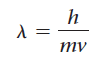
A few years after de Broglie published his theory, the wave properties of the electron were demonstrated experimentally. When X rays pass through a crystal, an interference pattern results that is characteristic of the wave-like properties of electromagnetic radiation, a phenomenon called X-ray ______________.
Werner Heisenberg proposed that since we know the mass and the speed of an electron and we now know that it moves in wave patters, we can predict and calculate the distance the electron travels with some levels of uncertainty. What is the name of the formula that combines all of these principles.
The uncertainty principle does not apply to larger objects beyond the atomic level since objects such as a tennis ball are so large, that measurements have less uncertainty than at the subatomic level. Therefore, there is no uncertainty and thus the uncertainty principle is inconsequential.
The discoveries related to knowing the position and space of an electron lead to the discovery of which important tool.
When considering a small fast moving object such as an electron, we can never measure both its position and velocity with great accuracy?
The wave-particle duality becomes significant with objects the size of an electron?
Neutron diffraction is an important technique for determining the structures of molecules. Calculate the velocity of a neutron needed to achieve a wavelength of 125 pm. The mass of a neutron is 1.67 x 10⁻²⁷
The wave-particle duality prescribes that quantum entities are both waves and particles, and can be described as either. Therefore, a photon is both a particle, and a wave.
The wave-particle duality lead to the theory that combining both formulas into one would better explain subatomic particles. The name of that equation is the Schrodinger wave equation. Today, the study of subatomic particles uses this duality equation in a field of study known as __________________.
The higher the principal quantum number, the more nodes that exist in the quantum particle's wavelength/frequency.
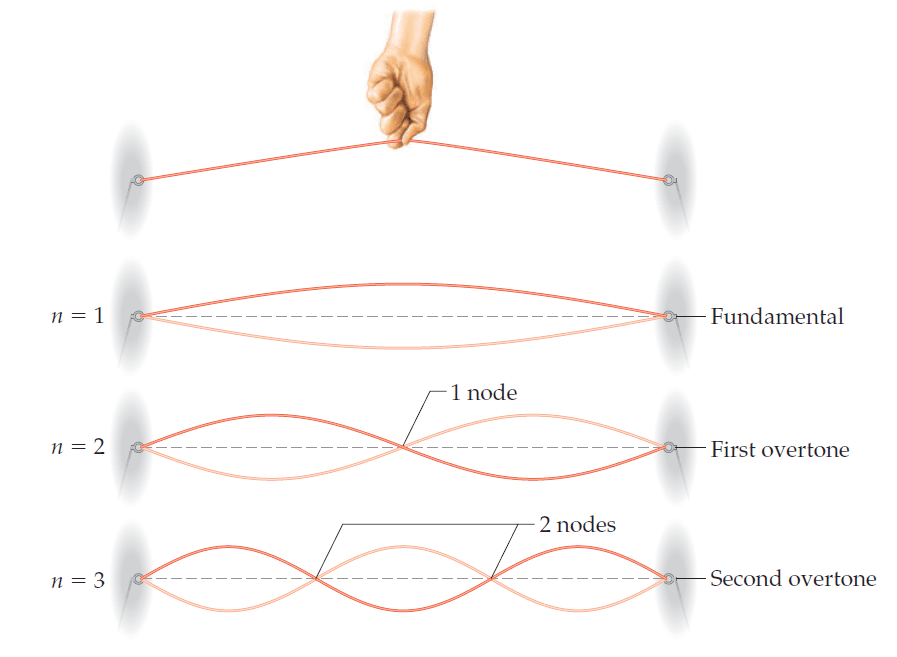
The probability that an electron is at a particular location is known as the probability density.
The probability that an electron is at a particular location is known as the electron density.
Solving Schrodinger's wave equation results in a wave function. This wave function when put to the second power (squared) is the same as the electron density/probability density that an electron is at a particular location.
A wave function is the solution to a Schrodinger equation.
The wave function is represented by which greek symbol.
Schrodinger's equation came to a solution which resulted in the discovery of:
Each orbital has a characteristic (unique) shape and energy
An orbital and an orbit are the same.
An orbital is a quantum mechanical model that takes deeper scientific understandings and combines them such as Schrodinger's particle-wave principle as well as equation and uncertainty, as well as advance calculus to position each individual electron relative to the nucleus and to draw out an accurate understanding of the relationship. Whereas an orbit is the basic understanding that was explained by Bohr's model comparing electrons to a planetary system circling the nucleus. A layman way of describing the two is that an orbital is 3-dimentional positioning of electrons whereas an orbit is 2-dimentional.
Each n, such as n=1, n=2, etc., is referred to as the individual electron ____________ of the atom. This means that for any collection of electrons that have the same n value, are in the same electron ________.
Each electron shell contains compartments called subshells.
Arrange the following subshells from smallest to largest.
Electron shells are designated with n, whereas their subshells are designated with l.
Match the following subshell values of l.
Match the names of the following:
Match the quantum number letter with what it describes about an electron in orbital:
Which letter would be used in describing a thickly shaped orbital:
Which letter would be used in describing an orbital that is close to the nucleus:
What is the orbital number if n=3, and l=2
What is the subshell number if n=3, and l=1
The maximum allowed subshell orbitals per subshell is represented by ml as 2l +1. So, in the case where the l is the s orbital, the value would be 0 since s is 0, p is 1, d is 2, and f is 3. Therefore, using the formula, 2(0)+1 = 1. S has 1 orbital in the subshell.
The total number of orbitals in a shell is n2, where n is the principal quantum number of the shell.
When an electron occupies the lowest energy orbital (1s), this is known as the ground state. Whereas other orbitals being occupied are described as excited.
There are 2 subshells within n=4.
The ml values are based on the l values going from positive l vale to negative l value. For example, l=2, would be 2, 1, 0, -1, -2.
What is the designation for the subshell with n = 5 and l = 1?
For the subshell with n = 5 and l = 1, how many orbitals are in this subshell?
For the subshell with n = 5 and l = 1, indicate the values of ml for each of these orbitals.
Which set of quantum numbers is a valid description of an orbital?
Describe the orbitals' image below:
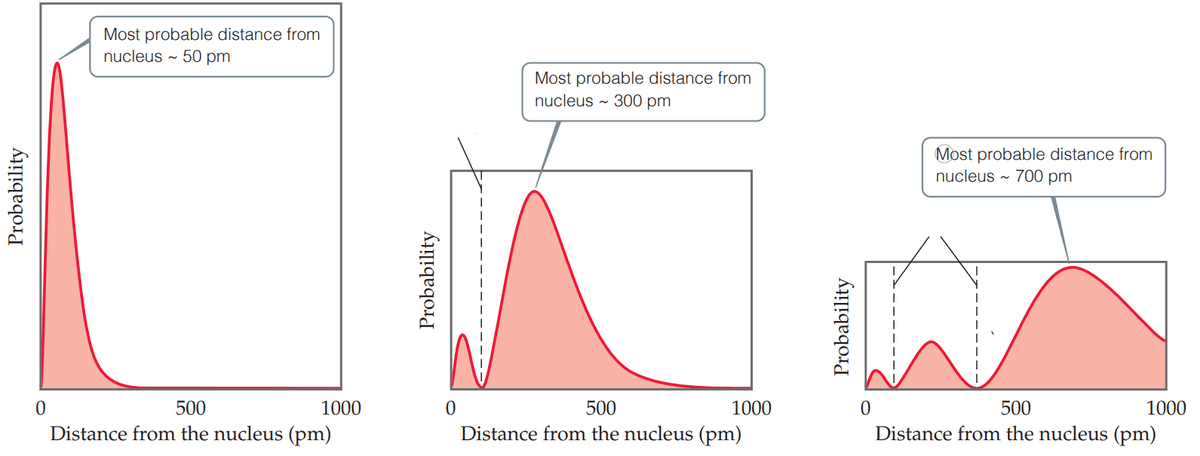
What are the perforated lines below in the orbitals' image:
The number of nodes in an ns orbital is:
As n increases, the electron density becomes more spread out; that is, there is a greater probability of finding the electron further from the nucleus.
Which of the following is true:
Drawing out the shape of the orbitals is drawing out the distribution of electrons around and away from the nucleus.
Which of the following has a four-leaf clover shape?
The Pauli exclusion principle states that no two electrons can have the same electron orbital set of quantum values for positions: n, l, ml, and ms. ms was introduced as a principle to explain that only a maximum of two electrons can fit into an orbital and they must have opposite spins. In other words, all electrons are unique.
What is the maximum number of electrons that can occupy a 3d subshell?