Loading...


Class XII Computer Science Quiz No 1
Quiz by Tamil selvi
Tag the questions with any skills you have. Your dashboard will track each student's mastery of each skill.
Convert A.B + B.C’ to its canonical SOP form using Boolean Algebra and choose the answer from the following:
Simplify y=AB’+(A’+B)C
DeMorgan’s theorem states that _______________
If (~P => Q) then choose the inverse from the following.
Reduce the given Boolean function F(A,B,C,D)=€( 0, 3, 4, 7, 8, 11, 12, 15) by using 4-variable Karnaugh map and answer the following questions: a. What will be the least number of groups and their types formed for reduction?
The reduced expression of the Boolean function given above is:
Reduce the given Boolean function F(A,B,C,D)=π(1, 2, 5, 6, 9, 11, 13, 15) a. What will be the least number of groups and their types formed for reduction?
The reduced expression of the Boolean function given above is:
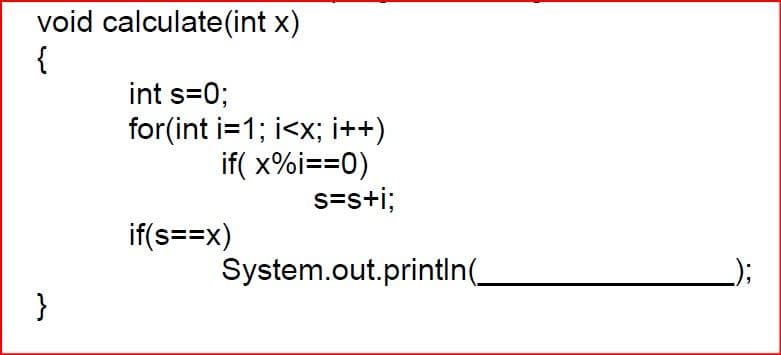
With reference to the program code given below, answer the questions that follow:
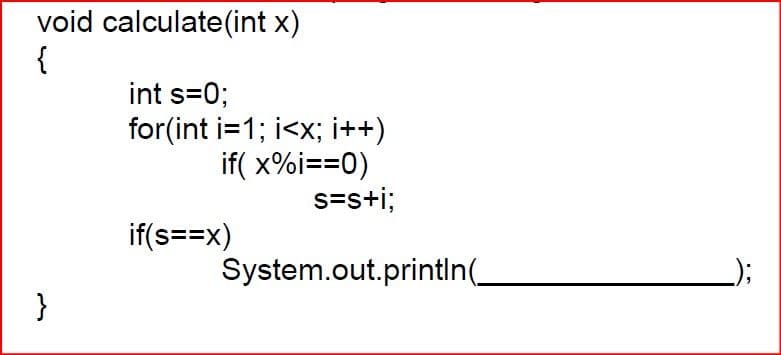
What is the output of the method calculate() when x=4?
Simplify the given expression and choose the answer from the following: (A.B’ + AB) (A+B)
Choose the dual of F=(p+1).(q’+0)
Predict the output from the given code snippet, when value of n=567.

Choose the answer after Converting X + Y to minterms.
Which of the following for loop declaration is not valid?
Find the value of value[i] for the above code

What is the output of function show(24,2) ?

When x=5 and y=2 before calculation then predict the output of the following expression: System.out.println(x++/--x%++y * 2);
When x=5 and y=2 before calculation then predict the output of the following expression: System.out.println(x+ ++y);
What is the output of the statements given below? System.out.print('D'+'9'+'9'+'Z');
What is the output of the statements given below?System.out.print(‘z’+’Z’);
When a full adder is using 3-variables X,Y,Z then find the SUM expression.
When a full adder is using 3-variables X,Y,Z then find the CARRY expression.
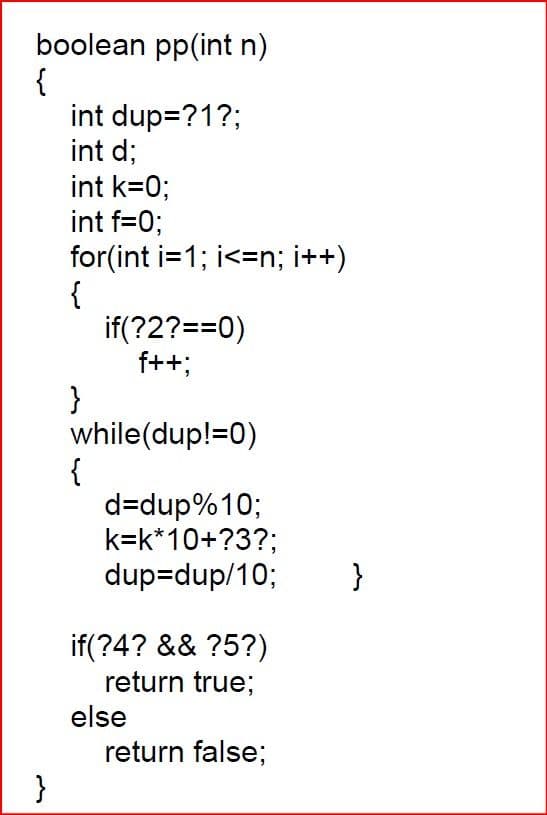
The following function is a part of some class to compute that the number is a Pal-prime number or not. If the number is prime and palindrome both then the number is called Pal-prime number. The function returns true if Pal-prime otherwise returns false. There are five places in the code marked by ?1?, ?2?, ?3?, ?4?, ?5? which must be replaced by statement or expression so that the function runs correctly. What is the expression or statement at ?1?
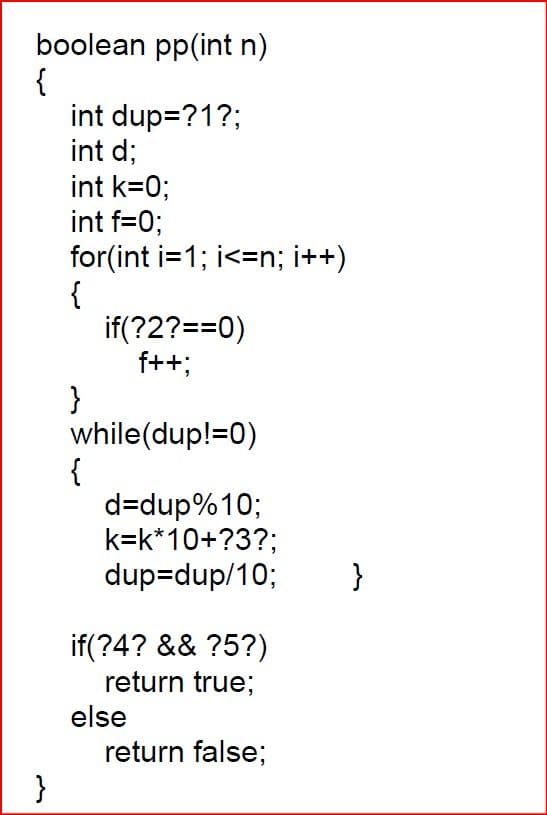
The following function is a part of some class to compute that the number is Pal-prime number or not. If the number is prime and palindrome both then the number is called Pal-prime number. The function returns true if Pal-prime otherwise returns false. There are five places in the code marked by ?1?, ?2?, ?3?, ?4?, ?5? which must be replaced by statement or expression so that the function runs correctly.What is the expression or statement at ?2?
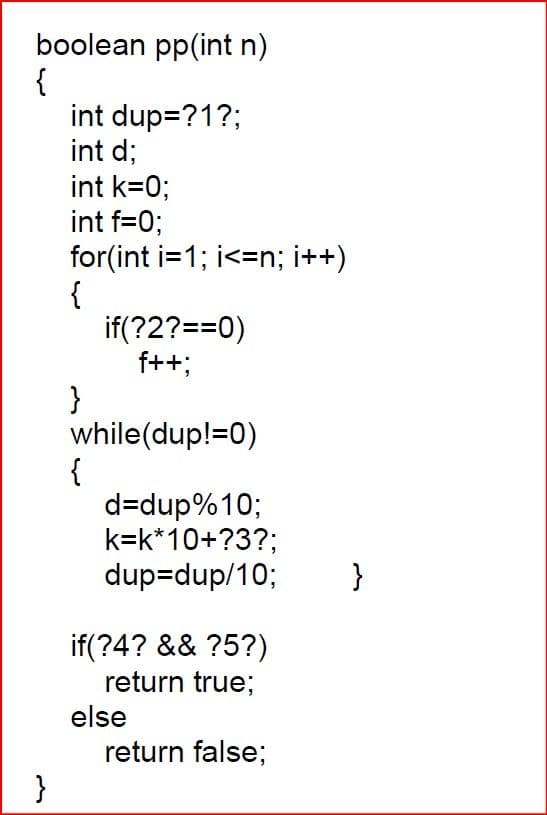
The following function is a part of some class to compute that the number is Pal-prime number or not. If the number is prime and palindrome both then the number is called Pal-prime number. The function returns true if Pal-prime otherwise returns false. There are five places in the code marked by ?1?, ?2?, ?3?, ?4?, ?5? which must be replaced by statement or expression so that the function runs correctly.What is the expression or statement at ?3?
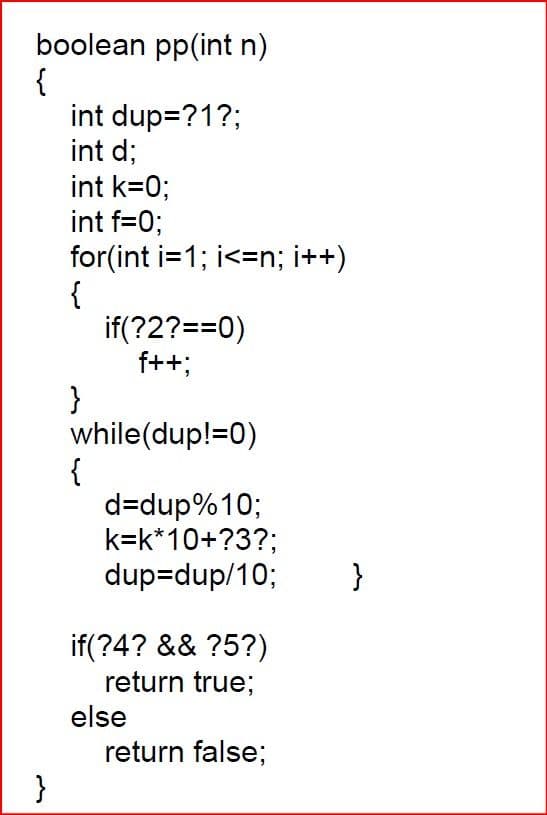
The following function is a part of some class to compute that the number is Pal-prime number or not. If the number is prime and palindrome both then the number is called Pal-prime number. The function returns true if Pal-prime otherwise returns false. There are five places in the code marked by ?1?, ?2?, ?3?, ?4?, ?5? which must be replaced by statement or expression so that the function runs correctly. What is the expression or statement at ?4?

The following function is a part of some class to compute that the number is Pal-prime number or not. If the number is prime and palindrome both then the number is called Pal-prime number. The function returns true if Pal-prime otherwise returns false. There are five places in the code marked by ?1?, ?2?, ?3?, ?4?, ?5? which must be replaced by statement or expression so that the function runs correctly. What is the expression or statement at ?5?
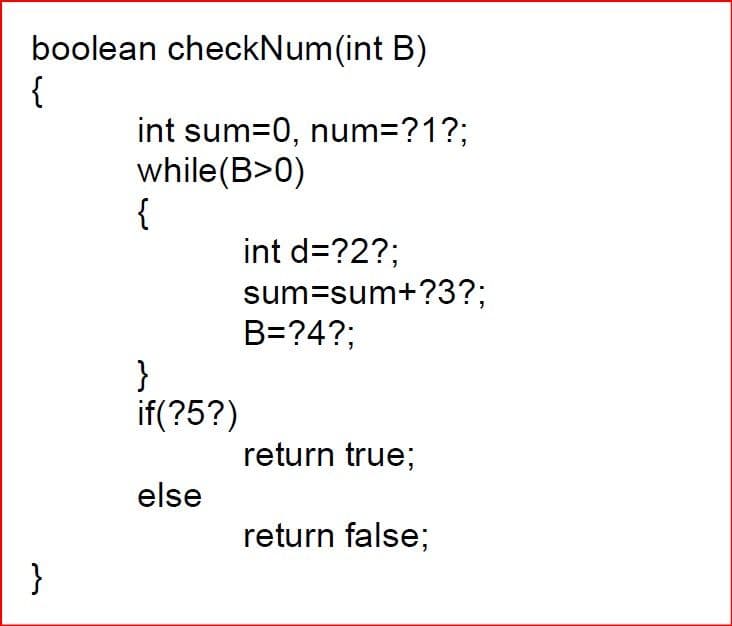
The following function is a part of some class to compute that the number is Armstrong or not. If sum of cube of all the digits of a number is equal to the number, then it is Armstrong. The function returns true if B is Armstrong otherwise returns false. There are five places in the code marked by ?1?, ?2?, ?3?, ?4?, ?5? which must be replaced by statement or expression so that the function runs correctly.What is the expression or statement at ?1?
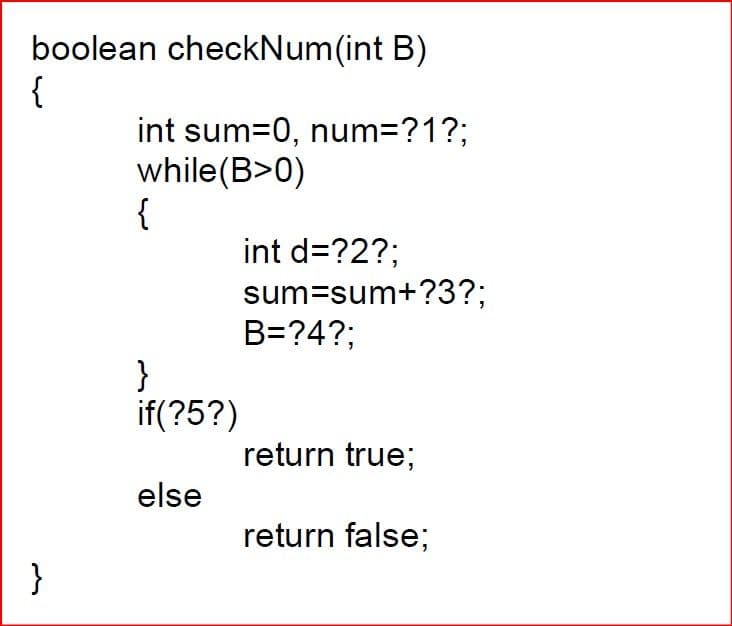
The following function is a part of some class to compute that the number is Armstrong or not. If sum of cube of all the digits of a number is equal to the number, then it is Armstrong. The function returns true if B is Armstrong otherwise returns false. There are five places in the code marked by ?1?, ?2?, ?3?, ?4?, ?5? which must be replaced by statement or expression so that the function runs correctly.What is the expression or statement at ?2?

The following function is a part of some class to compute that the number is Armstrong or not. If sum of cube of all the digits of a number is equal to the number, then it is Armstrong. The function returns true if B is Armstrong otherwise returns false. There are five places in the code marked by ?1?, ?2?, ?3?, ?4?, ?5? which must be replaced by statement or expression so that the function runs correctly. What is the expression or statement at ?3?
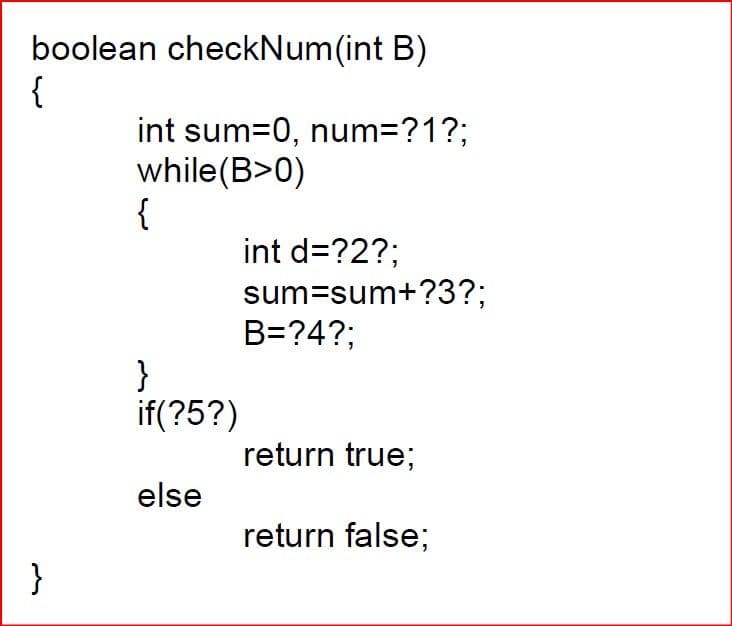
The following function is a part of some class to compute that the number is Armstrong or not. If sum of cube of all the digits of a number is equal to the number, then it is Armstrong. The function returns true if B is Armstrong otherwise returns false. There are five places in the code marked by ?1?, ?2?, ?3?, ?4?, ?5? which must be replaced by statement or expression so that the function runs correctly. What is the expression or statement at ?4?
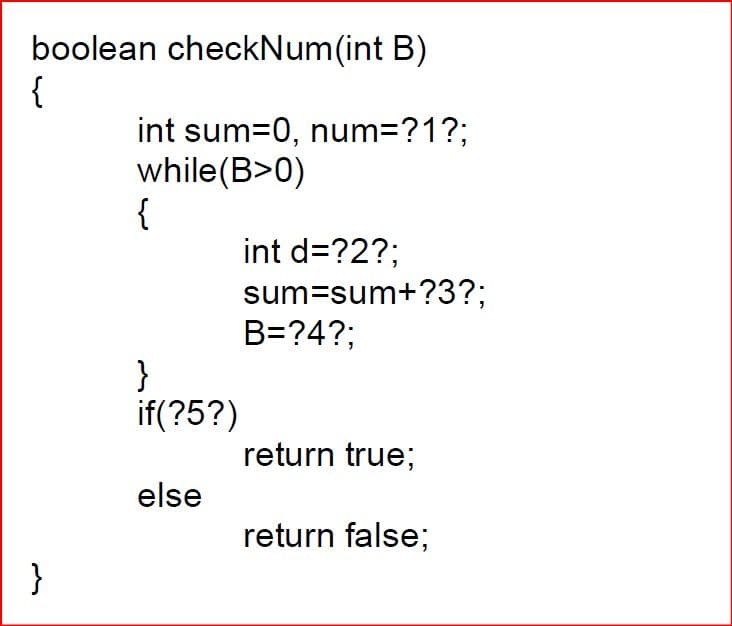
The following function is a part of some class to compute that the number is Armstrong or not. If sum of cube of all the digits of a number is equal to the number, then it is Armstrong. The function returns true if B is Armstrong otherwise returns false. There are five places in the code marked by ?1?, ?2?, ?3?, ?4?, ?5? which must be replaced by statement or expression so that the function runs correctly. What is the expression or statement at ?5?
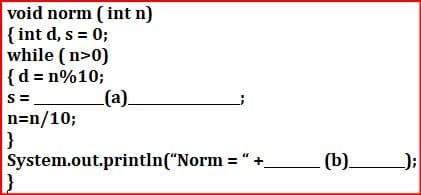
The following program segment calculates the norm of a number, norm of a number is square root of sum of squares of all digits of the number. Example: The norm of 68 is 10 6×6 + 8×8 = 36+64 = 100 square root of 100 is 10. Fill in the blanks with appropriate java statements.
1.(a)?

The following program segment calculates the norm of a number, norm of a number is square root of sum of squares of all digits of the number. Example: The norm of 68 is 10 6×6 + 8×8 = 36+64 = 100 square root of 100 is 10. Fill in the blanks with appropriate java statements.
1.(b)?