Loading...


earth sci
Quiz by wxyz
Tag the questions with any skills you have. Your dashboard will track each student's mastery of each skill.
Which factor influences the speed of movement in atoms and molecules and is related to the reaction speed in proteins, DNA, and other biomolecules?
Which of the following is considered as the importance of water in a habitable planet?
The absence or presence of this factor greatly affects the planet’s ability to maintain its surface temperature and protect it from cosmic rays. Which factor is described?
Which factor provides organisms with a power source for their biological processes, that too little and too much of this result in cell death?
Which factor is the source of all building blocks of cells and serves as the source ingredient they need to maintain metabolic processes inside them?
A small, hot planet will most likely have which of the following characteristic?
Which of the following characteristics relates to a planet’s energy?
Which of the following theories is considered to be the most accepted theory of the origin of the universe?
Which of the following planets has a global magnetic field?
Photosynthesis shows the interaction between the biosphere and what subsystem?
Which of the following is true about Earth’s four subsystems?
About 70% of Earth’s surface is covered with liquid water and much of it is in the form of ocean water. 3% of Earth's water is fresh; 2/3 is in the form of ice, and the remaining 1/3 is in streams, lakes, and groundwater
There are two types of crust: oceanic crust and continental crust. Continental crust is denser that oceanic crust.
The combined part of the crust and uppermost solid part of the mantle form the brittle upper layers of the Earth's interior called the lithosphere. The upper mantle is also called the asthenosphere - the highly viscous, mechanically weak, and ductile region of the upper mantle of the earth.
The core is basically made up of iron, with a small amount of copper. The liquid iron in the outer core is especially important in that it is the primary source of the Earth's magnetic field.
Which of the following best describes Earth’s water?
What does “geo” in geosphere mean?
What does “hydro” in hydrosphere mean?
Photosynthesis shows the interaction between the biosphere and what subsystem?
What is Earth’s largest system?
What is Earth’s outermost system?
Approximately what percentage of Earth’s water is available for human use?
What do you call the water that falls from the atmosphere to the earth in solid or liquid form?
Why is freshwater important for life on Earth?
Which of the following defines what geosphere is?
To what subsystems do all living things belong?
Where is Earth’s largest fresh water resource found?
What does the term “atmo” mean?
What the term “bio” means?
Which of the following atmospheric gas is found in the atmosphere of Venus, Earth, and Mars?
Which of the following events created Earth’s moon?
Which of the following theories is accepted as the current theory explaining the origin of our solar system?
What often occurs in amorphous or fine-grained minerals such as flint, opal, or obsidian, but may also occur in crystalline minerals such as quartz?
Which refers to the quality and intensity of reflected light exhibited by the mineral?
Which refers to the measure of the resistance of a mineral (not specifically surface) to abrasion?
Which of the following are minerals that form as individual elements?
Which of the following is inherent to every mineral?
Which property within the crystal structure results in the formation of different colors and varieties of quartz?
Which scale is highly relevant for field geologists to roughly identify minerals using scratch kits?
Which of the following is the natural shape of the mineral before the development of any cleavage or fracture?
What do you call the weak plane that is developed after the crystal is formed?
Which of the following is the measure used to express the density (mass per unit volume) of a mineral?
Identify the chemical group of the following minerals based on the given choices.
PbS (Galena)
Ca2Al3Si3O12(OH) (Tanzanite)
Au (Gold)
BaSO4 (Barite)
CaSO42H20 (Selenite)
Which of the following can change rocks into sediments?
Which characteristic is common among metamorphic rocks?
Which of the following is a result of weathering and erosion?
From the diagram, what is formed when the metamorphic rocks are heated and pressed in the mantle?
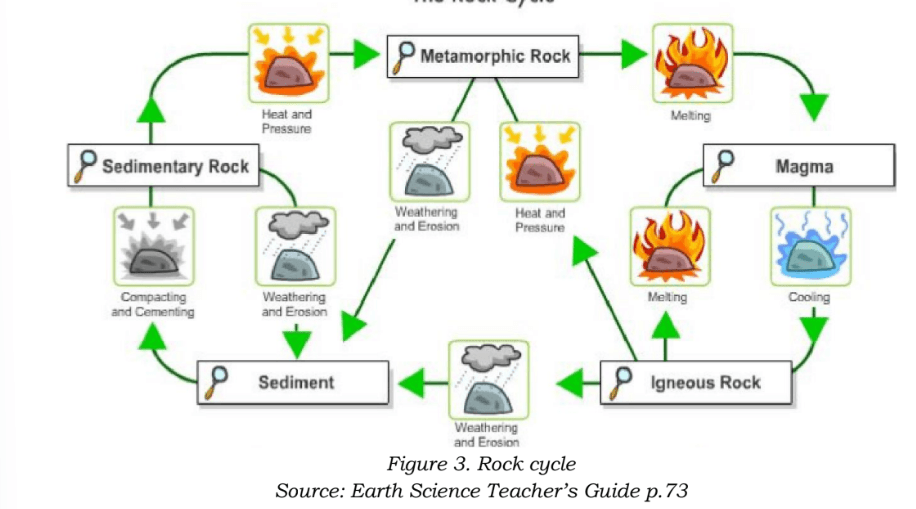
Shale, a sedimentary rock, can change into slat, a metamorphic rock, by what geologic process?
Which of the following rocks formed from magma that slowly cooled beneath the earth’s surface?
Which is a characteristic of sedimentary rocks?
What process changed sediments to rocks from this diagram of the rock cycle?
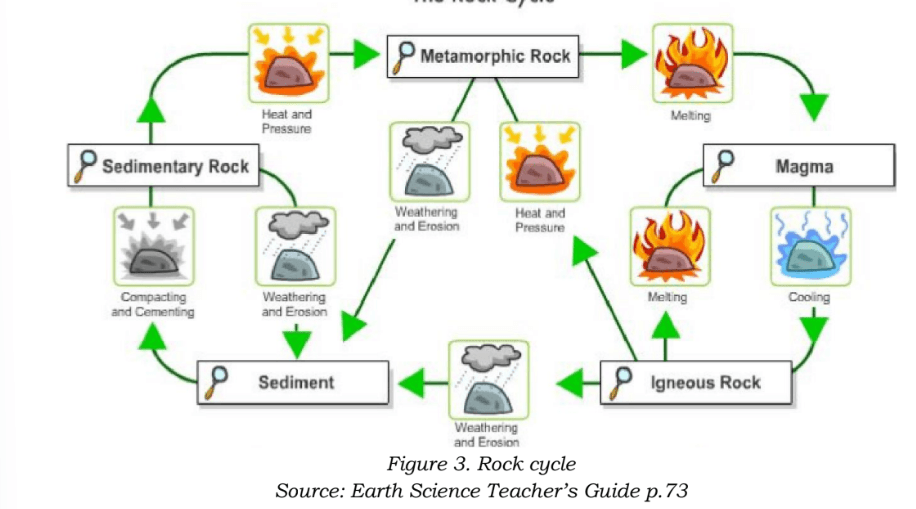
Which is the correct sequence of geologic processes that change magma into granite, granite into the sand, and sand into sandstone?
What type of rock are dolomite and sandstone?
Which series of geologic processes can transform sediments into shale, shale into slate, and slate into magma?
Which is the correct sequence of geologic processes that transform granite into gneiss, gneiss into magma, and magma into rhyolite?
What is a naturally occurring, inorganic solid with a fixed chemical formula and specific atomic arrangement?
How are magmatic ore deposits formed?
Which of the following is an example of a hydrothermal ore deposit?
What is the key difference between an ore deposit and a mineral deposit?
What type of deposit forms when hot fluids dissolve metals and minerals as they circulate through rock fractures?
In which type of deposit do valuable minerals accumulate through gravity separation in streams?
What is an "aggregate" in the context of mineral resources?
What is the primary characteristic of magmatic ore deposits?
What is a common characteristic of hydrothermal vein-type deposits?