Loading...

Earth & Space
Quiz by Tyisha Smith
Tag the questions with any skills you have. Your dashboard will track each student's mastery of each skill.
Which statement is true when Earth is in the position shown?
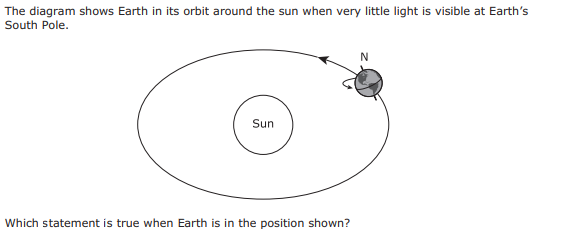
The number of hours of daylight is greater in the Southern Hemisphere than in the Northern Hemisphere
Spring begins earlier in the year in the Southern Hemisphere than it does in the NorthernHemisphere.
It is summer in the Northern Hemisphere. It is winter in the Southern Hemisphere.
It is August in the Northern Hemisphere. It is April in the Southern Hemisphere.
Based on the topographic map, if a park ranger hiked due west from the radio tower, the ranger’s path would —
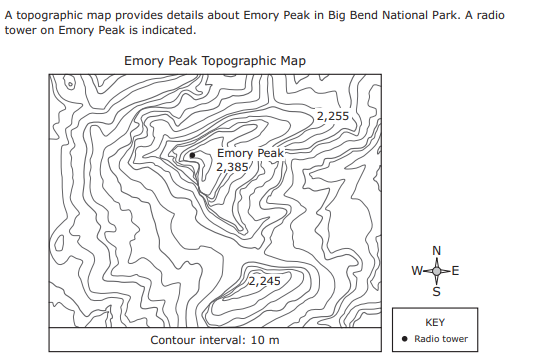
cross another peak in the park
go down a steep slope and then become flatter
cross a canyon with a river running through it
be flat and then go up a steep slope
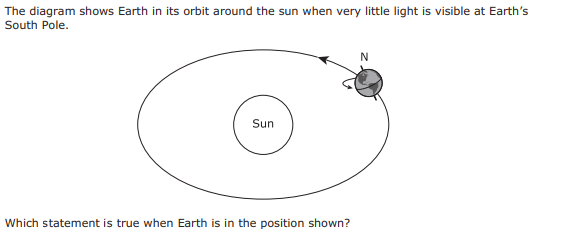
Which statement is true when Earth is in the position shown?
Based on the topographic map, if a park ranger hiked due west from the radio tower, the ranger’s path would —

Ocean currents affect weather patterns by —

On which date will they most likely be able to observe a new moon?

The moon remains in orbit around Earth because of the force of —

Stars with the highest temperatures will emit most of their light at wavelengths that are near —

Which section of the diagram includes the coolest, brightest stars?

During which lunar phase is the tide highest?

Glacial striations in the bedrock of South Africa indicate that glaciers once moved across the African continent. The presence of glaciers on the surface of Africa is evidence that —

Which answer choice best explains the change from daytime to nighttime on Earth?

As the glacier melts, water travels toward the ocean along the geological feature labeled X. When water erodes soil along this feature, the feature will most likely become —

Which location around Green Peak is likely to experience the most erosion over time?

Farmers can best reduce negative effects on the water quality ofnearby streams and lakes by planting crops that —
A star that has a luminosity of 10-2 and a temperature of 20,000 K is most likely a —

Which answer choice best describes the weather at location X on Day 1 and Day 2?

