Loading...


Eastern Africa
Quiz by John Hagenmaier
Customize this quiz to suit your class
Instantly translate to 100+ languages
Tag the questions with any skills you have. Your dashboard will track each student's mastery of each skill.
Give this quiz to my class
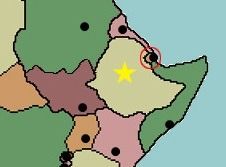
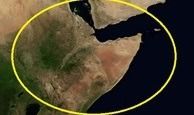






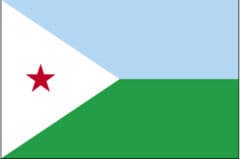


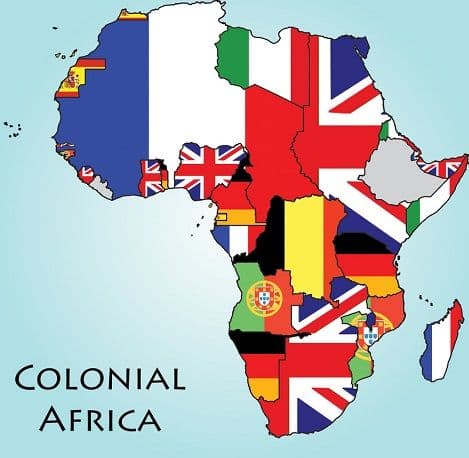


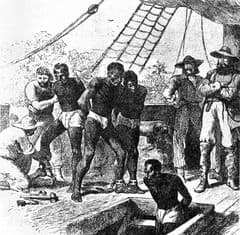
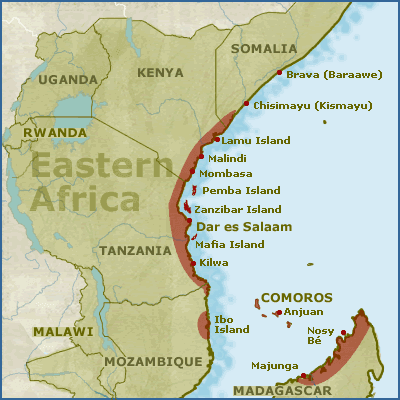
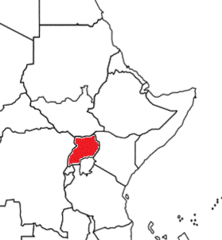 Eastern Africa Sec 1-2 Facts MapEastern Africa: Map & FlagsNorth and Eastern Africa Countries Lesson 2: Plate Tectonics There are a few handfuls of major plates and dozens of smaller, or minor, plates. Six of the majors are named for the continents embedded within them, such as the North American, African, and Antarctic plates. Though smaller in size, the minors are no less important when it comes to shaping the Earth. The tiny Juan de Fuca plate is largely responsible for the volcanoes that dot the Pacific Northwest of the United States. The plates make up Earth's outer shell, called the lithosphere. (This includes the crust and uppermost part of the mantle.) Churning currents in the molten rocks below propel them along like a jumble of conveyor belts in disrepair. Most geologic activity stems from the interplay where the plates meet or divide. The movement of the plates creates three types of tectonic boundaries: convergent, where plates move into one another; divergent, where plates move apart; and transform, where plates move sideways in relation to each other. They move at a rate of one to two inches (three to five centimeters) per year. Convergent BoundariesWhere plates serving landmasses collide, the crust crumples and buckles into mountain ranges. India and Asia crashed about 55 million years ago, slowly giving rise to the Himalaya, the highest mountain system on Earth. As the mash-up continues, the mountains get higher. Mount Everest, the highest point on Earth, may be a tiny bit taller tomorrow than it is today. These convergent boundaries also occur where a plate of ocean dives, in a process called subduction, under a landmass. As the overlying plate lifts up, it also forms mountain ranges. In addition, the diving plate melts and is often spewed out in volcanic eruptions such as those that formed some of the mountains in the Andes of South America. At ocean-ocean convergences, one plate usually dives beneath the other, forming deep trenches like the Mariana Trench in the North Pacific Ocean, the deepest point on Earth. These types of collisions can also lead to underwater volcanoes that eventually build up into island arcs like Japan. Divergent Boundaries At divergent boundaries in the oceans, magma from deep in the Earth's mantle rises toward the surface and pushes apart two or more plates. Mountains and volcanoes rise along the seam. The process renews the ocean floor and widens the giant basins. A single mid-ocean ridge system connects the world's oceans, making the ridge the longest mountain range in the world. On land, giant troughs such as the Great Rift Valley in Africa form where plates are tugged apart. If the plates there continue to diverge, millions of years from now eastern Africa will split from the continent to form a new landmass. A mid-ocean ridge would then mark the boundary between the plates. Transform Boundaries The San Andreas Fault in California is an example of a transform boundary, where two plates grind past each other along what are called strike-slip faults. These boundaries don't produce spectacular features like mountains or oceans, but the halting motion often triggers large earthquakes, such as the 1906 one that devastated San Francisco.Swahili Arabic Influenced Bantu language that is used in eastern and central AfricaWHI.10-Eastern Hemisphere (Japan and Africa)Contact with the Americas In 1001, Viking sailors led by Leif Erikson reached the eastern tip of North America. Archaeologists have found evidence of the Viking settlement of Vinland in present-day Newfoundland, Canada. The Vikings did not stay in Vinland long and no one is sure why they left. However, Viking stories describe fierce battles with Skraelings, the Viking name for the Inuit. Evidence suggests that Asians continued to cross the Bering Sea into North America after the last ice age ended. Some scholars believe that ancient seafarers from Polynesia may have traveled to the Americas using their knowledge of the stars and winds. Modern Polynesians have sailed canoes thousands of miles in this way. Still others think that fishing boats from China and Japan blew off course and landed on the western coast of North or South America. Perhaps such voyages occurred. If so, they were long forgotten. Before 1492, the peoples of Asia and Europe had no knowledge of the Americas and their remarkable civilizations. The Voyages of Columbus Portuguese sailors had pioneered new routes around Africa toward Asia in the late 1400s. Spain, too, wanted a share of the riches. King Ferdinand and Queen Isabella hoped to keep their rival, Portugal, from controlling trade with India, China, and Japan. They agreed to finance a voyage of exploration by Christopher Columbus. Columbus, an Italian sea captain, planned to reach the East Indies by sailing west across the Atlantic. Finding a sea route straight to Asia would give the Spanish direct access to the silks, spices, and precious metals of Asia. The spice trade was a major cause for European exploration and a reason the Spanish rulers supported Columbus’s voyage. They also wanted wealth from any source. “Get gold,” King Ferdinand said to Columbus. “Humanely if possible, but at all hazards—get gold.” Crossing the Atlantic In August 1492, Columbus set out with three ships and about 90 sailors. As captain, he commanded the largest vessel, the Santa María. The other ships were the Niña and the Pinta. After a brief stop at the Canary Islands, the little fleet continued west into unknown seas. Fair winds sped them along, but a month passed without the sight of land. Some sailors began to grumble. They had never been away from land for so long and feared being lost at sea. Still, Columbus sailed on. On October 7, sailors saw flocks of birds flying southwest. Columbus changed course to follow the birds. A few days later, crew members spotted tree branches and flowers floating in the water. At 2 a.m. on October 12, the lookout on the Pinta spotted white cliffs shining in the moonlight. “Tierra! Tierra!” he shouted. “Land! Land!” At dawn, Columbus rowed ashore and planted the banner of Spain. He was convinced that he had reached the East Indies in Asia. He called the people he found there “Indians.” In fact, he had reached islands off the coasts of North America and South America in the Caribbean Sea. These islands later became known as the West Indies. For three months, Columbus explored the West Indies. To his delight, he found signs of gold on the islands. Eager to report his success, he returned to Spain. Columbus Claims Lands for Spain In Spain, Columbus presented Queen Isabella and King Ferdinand with gifts of pink pearls and brilliantly colored parrots. Columbus brought with him many things that Europeans had never seen before: tobacco, pineapples, and hammocks used for sleeping. Columbus also described the “Indians” he had met, the Taino (ty noh). The Taino, he promised, could easily be converted to Christianity and could also be used as slaves. The Spanish monarchs were impressed. They gave Columbus the title Admiral of the Ocean Sea. They also agreed to finance future voyages. The promise of great wealth, and the chance to spread Christianity, gave them a reason to explore further. Columbus made three more voyages across the Atlantic. In 1493, he founded the first Spanish colony in the Americas, Santo Domingo, on an island he called Hispaniola (present-day Haiti and the Dominican Republic). A colony is an area settled and ruled by the government of a distant land. Columbus also explored present-day Cuba and Jamaica. He sailed along the coasts of Central America and northern South America. He claimed all of these lands for Queen Isabella of Spain. Columbus proved to be a better explorer than governor. During his third expedition, settlers on Hispaniola complained of his harsh rule. Queen Isabella appointed an investigator, who sent Columbus back to Spain in chains. In the end, the queen pardoned Columbus, but he never regained the honors he had won earlier. He died in 1506, still convinced that he had reached Asia. The Impact of Columbus’s Voyages Columbus has long been honored as the bold sea captain who “discovered America.” Today, we recognize that American Indians had discovered and settled these lands long before 1492. We also recognize that Columbus and the Europeans who followed him treated the ancient inhabitants of the Americas brutally. Still, Columbus’s voyages did change history. They marked the beginning of lasting contact among the peoples of Europe, Africa, and the Americas. For a great many American Indians, contact had tragic results. Columbus and those who followed were convinced that European culture was superior to that of the Indians. The Spanish claimed Taino lands and forced the Taino to work in gold mines, on ranches, or in Spanish households. Many Taino died from harsh conditions or European diseases. The Taino population was wiped out. Still, the voyages of Columbus signaled a turning point for the Americas. A turning point is a moment in history that marks a decisive change. Curious Europeans saw the new lands as a place where they could settle, trade, and grow rich. Spanish Exploration Continues After the voyages of Columbus, the Spanish explored and settled other Caribbean islands that Columbus had found. They sought gold, land for crops, people to enslave, and converts to Christianity for the Spanish crown. By 1511, they had conquered Puerto Rico, Jamaica, and Cuba. They also explored the eastern coasts of North America and South America in search of a western route to Asia. In 1513, Vasco Núñez de Balboa (bal boh uh) crossed the Isthmus of Panama. American Indians had told him that a large body of water lay to the west. With a party of Spanish soldiers and Indians, Balboa reached the Pacific Ocean and claimed the ocean for Spain. The Spanish had no idea how wide the Pacific was until a sea captain named Ferdinand Magellan (muh jel un) sailed across it. The expedition—made up of five ships and about 250 crew members—left Spain in 1519. Fifteen months later, it cut through the stormy southern tip of South America by way of what is now known as the Strait of Magellan and entered the Pacific Ocean. Crossing the vast Pacific, the sailors ran out of food: Primary Source “We remained 3 months and 20 days without taking in provisions or other refreshments and ate only old biscuit reduced to powder, full of grubs and stinking from the dirt which rats had made on it. We drank water that was yellow and stinking.” —Antonio Pigafetta, The Diary of Antonio Pigafetta Magellan himself was killed in a battle with the local people of the Philippine Islands off the coast of Asia. In 1522, only one ship and 18 sailors returned to Spain. They were the first people to circumnavigate, or sail completely around, the world. In doing so, they had found an all-water western route to Asia. Europeans became aware of the true size of the Earth. How Did the Columbian Exchange Affect the Rest of the World? The encounter between the peoples of the Eastern and Western Hemispheres sparked a global exchange of goods and ideas. Because it started with the voyages of Columbus, this transfer is known as the Columbian Exchange. The Columbian Exchange refers to a biological and cultural exchange of animals, plants, human populations, diseases, food, government, technology, the arts, and languages. The exchange went in both directions. Europeans learned much from American Indians. At the same time, Europeans contributed in many ways to the culture of the Americas. This exchange also brought about many modifications, or changes, to the physical environment of the Americas, with both positive and negative results. Changing Environments Europeans introduced domestic animals such as chickens from Europe and Africa. European pigs, cattle, and horses often escaped into the wild and multiplied rapidly. Forests and grasslands were converted to pastures. As horses spread through what would become the United States, Indians learned to ride them and used them to carry heavy loads. Plants from Europe and Africa changed the way American Indians lived. The first bananas came from the Canary Islands. By 1520, one Spaniard reported that banana trees had spread “so greatly that it is marvelous to see the great abundance of them.” Oranges, lemons, and figs were also new to the Americas. In North America, explorers also brought such plants as bluegrass, the daisy, and the dandelion. These plants spread quickly in American soil and modified American grasslands. Tragically, Europeans also brought new diseases, such as smallpox and influenza. American Indians had no resistance to these diseases. Historians estimate that within 75 years, diseases from Europe had killed almost 90 percent of the people in the Caribbean Islands and in Mexico. American Indian Influences on Europe, Africa and Asia American Indians introduced Europeans to valuable food crops such as corn, potatoes, sweet potatoes, beans, tomatoes, manioc, squash, peanuts, pineapples, and blueberries. Today, almost half the world’s food crops come from plants that were first grown in the Americas. Europeans carried the new foods with them as they sailed around the world. Everywhere, people’s diets changed and populations increased. In South Asia, people used American hot peppers and chilies to spice stews. Chinese peasants began growing corn and sweet potatoes. Italians made sauces from tomatoes. People in West Africa grew manioc and corn. European settlers often adopted American Indian skills. In the North, Indians showed Europeans how to use snowshoes and trap beavers and other fur-bearing animals. European explorers learned how to paddle Indian canoes. Some leaders studied American Indian political structures. In the 1700s, Benjamin Franklin admired the Iroquois League and urged American colonists to unite in a similar way. Positive and Negative Consequences Through the Columbian Exchange, Europeans and American Indians modified their environments and gained new resources and skills. At the same time, warfare and disease killed many on both sides. Europeans viewed expansion positively. They gained great wealth, explored trade routes, and spread Christianity. Yet their farming, mining, and diseases took a toll on the physical environment and left many American Indians dead. Despite these negatives, the Columbian Exchange shaped the modern world, including what would become the United States.Pray also for me, that whenever I open my mouth, words may be given me so that I will fearlessly make known the mystery of the gospel, for which I am an ambassador in chains. Pray that I may declare it fearlessly, as I should. Ephesians 6:19,20 What sacrifices have you made because of your faith in Jesus Christ? Have you encountered opposition for reading or carrying your Bible? On August 5, 2008, eight high school students from a small African country were imprisoned in a metal shipping container after they objected to authorities confiscating and burning 1,500 Bibles. That same month, in a prominent Middle Eastern country, a young woman had her tongue cut out and she was then burned to death by her own father because of her con- version to Christianity. These are just a couple of countless stories from around the globe about the persecution Christians face today. While we regularly enjoy the freedom to worship God openly without fear of death or imprisonment, millions of our broth- ers and sisters through the world face unimagi- nable persecution for their faith. This type of treatment is nothing new to the followers of Jesus Christ. Jesus himself warned His followers that they would face persecution for following Him, even going so far to say that “Men will hate you because of me.” (Matthew 10:22) Throughout church history, Christians have been imprisoned, beaten, stoned, thrown to the lions, burned at the stake, and much more because of their faith in Jesus. And in the verses you read earlier, Paul referred to his chains, or imprisonment, because of the gospel. Can you recall any other individuals from the Bible or history who faced opposition because of their faith? As men of God, we have a responsibility to our fellow believers around the world who regu- larly face persecution because of their faith. We need to support them in any way possible. In Ephesians and throughout his writings, Paul asked the believers to pray for him that he would have boldness to continue to preach the gospel even while he was locked in chains. Prayer is a very powerful weapon in your arse- nal. With prayer, a man of God can literally be a part of delivering strength, speaking encour- agement, and doing battle all without leaving his room. Through prayer, you can stand beside a missionary as he preaches to the people of South America. Through prayer, you can be part of delivering peace to the Asian pastor locked in prison because of his faith. How is that possible? It’s possible because your prayers have direct access to God. The most