Loading...


Economics - Paper 2 - MCQ
Quiz by Gulzhan Markabayeva
Customize this quiz to suit your class
Instantly translate to 100+ languages
Tag the questions with any skills you have. Your dashboard will track each student's mastery of each skill.
Give this quiz to my class
The increased integration and interdependence of economies is known as
globalisation
privatisation
specialisation
protectionism
What is the main cause of frictional unemployment?
People having the wrong skills
People choosing not to work
People employed at certain times of the year
People changing jobs
The increased integration and interdependence of economies is known as
What is the main cause of frictional unemployment?
The price of a basket of goods and services used to calculate the Consumer Price Index (CPI) in an economy, rose from €1 250 to €1 300 in one year. (a) What is the rate of inflation?
What is the name of the term used to describe tax on income, wealth and profit?
What is the name given to a country’s exports and imports of physical goods?
What term refers to a firm or country selling an export below the cost of production?
In a recovery, a country’s Gross Domestic Product (GDP)
A trade bloc is a group of countries that have
GDP per capita is a measure of a country’s economic output that accounts for population. If Sweden has a population of 10 million and a GDP of $511 bn (1bn = 1 000 000 000), then its GDP per capita is
What is the name of the policy that focuses on interest rate changes?
Kenyans who holiday in South Africa would be shown on the Kenyan current account as
Which one of the following is an example of an indirect tax?
International trade that takes place with no restrictions is known as
What is the name given to a country’s exports and imports of services?
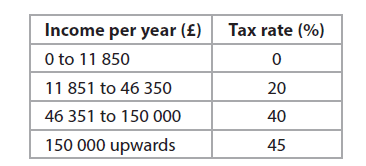
Figure 2 shows the rates of taxation in the UK in 2018. This is an example of what type of taxation system?
To improve the standard of living, which one of the following is a government likely to reduce?
A fiscal surplus occurs when
In an exchange rate system without government intervention, a rise in the exchange rate is known as
What is calculated by using the consumer price index (CPI)?
The sale or transfer of public sector assets to the private sector is known as
Which one of the following is likely to result from an increase in free trade?
Which one of the following policies is most likely to reduce the rate of inflation?
In an exchange rate system with no government intervention, a decrease in the exchange rate is known as
The International Labour Organisation (ILO) measures
Which method of protection is used to reduce the price of exports?
Which one of the following is likely to be a trade-off as a result of increased economic growth?
Which type of taxation has a higher proportion of income paid as income rises?
What type of unemployment is likely to be caused by generous welfare benefits?
What name is given to the phase in the economic cycle when consumers start to regain confidence and economic activity is on the increase?
Which of the following is used as a measure of economic growth?
Cost‑push inflation is most likely to result from an increase in
Monetary policy would involve changes in which one of the following?
Which type of unemployment occurs when the demand for a product is only at certain times of the year?
Which one of the following terms refers to a tax on imported goods?
Which one of the following is likely to result in poverty?
Member countries of a trading bloc agree to
Which one of the following terms refers to a physical limit on the quantity of imported products allowed into a country?
Which one of the following names is given to the government policy that aims to increase the productive capacity of the economy?
Which one of the following terms may refer to someone having a lower standard of living in comparison to the average person in society?
A firm is described as a multinational corporation (MNC) if it
An increase in which one of the following would be most likely to encourage saving?
Globalisation results in increasing
Which one of the following is a possible impact of economic growth?
Which one of the following is an example of cyclical unemployment?
A decrease in the exchange rate caused by government intervention is known as
Which one of the following means having more of one thing but less of another thing?
MYTH The British helped the Jews displace the native Arab population of Palestine. FACT Herbert Samuel, a British Jew who served as the first High Commissioner of Palestine, placed restrictions on Jewish immigration “in the ‘interests of the present population’ and the ‘absorptive capacity’ of the country.”1 The influx of Jewish settlers was said to force the Arab fellahin (native peasants) from their land. This was when less than a million people lived in an area that now supports more than nine million. The British limited the absorptive capacity of Palestine when, in 1921, Colonial Secretary Winston Churchill severed nearly four-fifths of Palestine—some thirty-five thousand square miles—to create a new Arab entity, Transjordan. As a consolation prize for the Hejaz and Arabia (which are both now Saudi Arabia) going to the Saud family, Churchill rewarded Sharif Hussein’s son Abdullah for his contribution to the war against Turkey by installing him as Transjordan’s emir. The British went further and placed restrictions on Jewish land purchases in what remained of Palestine. By 1949, the British had allotted 87,500 acres of the 187,500 acres of cultivable land to Arabs and only 4,250 acres to Jews. This contradicted Article 6 of the Mandate which stated that “the Administration of Palestine…shall encourage, in cooperation with the Jewish Agency…close settlement by Jews on the land, including State lands and waste lands not acquired for public purposes.”2 Ultimately, the British admitted that the argument about the country’s absorptive capacity was specious. The Peel Commission said, “The heavy immigration in the years 1933–36 would seem to show that the Jews have been able to enlarge the absorptive capacity of the country for Jews.”3 MYTH The British allowed Jews to flood Palestine while Arab immigration was tightly controlled. FACT The British response to Jewish immigration set a precedent of appeasing the Arabs, which was followed for the duration of the Mandate. The British restricted Jewish immigration while allowing Arabs to enter the country freely. Apparently, London did not feel that a flood of Arab immigrants would affect the country’s “absorptive capacity.” During World War I, the Jewish population in Palestine declined because of the war, famine, disease, and expulsion by the Turks. In 1915, approximately 83,000 Jews lived in Palestine among 590,000 Muslim and Christian Arabs. According to the 1922 census, the Jewish population was 83,000, while the Arabs numbered 643,000.4 Thus, the Arab population grew exponentially while that of the Jews stagnated. In the mid-1920s, Jewish immigration to Palestine increased primarily because of anti-Jewish economic legislation in Poland and Washington’s imposition of restrictive quotas.5 The record number of immigrants in 1935 (see table) was a response to the growing persecution of Jews in Nazi Germany. The British administration considered this number too large, however, so the Jewish Agency was informed that less than one-third of the quota it asked for would be approved in 1936.6 The British gave in further to Arab demands by announcing in the 1939 White Paper that an independent Arab state would be created within ten years and that Jewish immigration was to be limited to 75,000 for the next five years, after which it was to cease altogether. It also forbade land sales to Jews in 95% of the territory of Palestine. The Arabs, nevertheless, rejected the proposal. Jewish Immigration to Palestine7 1919 1,806 1931 4,075 1920 8,223 1932 12,533 1921 8,294 1933 37,337 1922 8,685 1934 45,267 1923 8,175 1935 66,472 1924 13,892 1936 29,595 1925 34,386 1937 10,629 1926 13,855 1938 14,675 1927 3,034 1939 31,195 1928 2,178 1940 10,643 1929 5,249 1941 4,592 1930 4,944 By contrast, throughout the Mandatory period, Arab immigration was unrestricted. In 1930, the Hope Simpson Commission, sent from London to investigate the 1929 Arab riots, said the British practice of ignoring the uncontrolled illegal Arab immigration from Egypt, Transjordan, and Syria had the effect of displacing the prospective Jewish immigrants.8 The British governor of the Sinai from 1922 to 1936 observed, “This illegal immigration was not only going on from the Sinai, but also from Transjordan and Syria, and it is very difficult to make a case out for the misery of the Arabs if at the same time their compatriots from adjoining states could not be kept from going in to share that misery.”9 The Peel Commission reported in 1937 that the “shortfall of land is…due less to the amount of land acquired by Jews than to the increase in the Arab population.”10 MYTH The British changed their policy to allow Holocaust survivors to settle in Palestine. FACT The gates of Palestine remained closed for the duration of the war, stranding hundreds of thousands of Jews in Europe, many of whom became victims of Hitler’s “Final Solution.” After the war, the British refused to allow the survivors of the Nazi nightmare to find sanctuary in Palestine. On June 6, 1946, President Truman urged the British government to relieve the suffering of the Jews confined to displaced persons camps in Europe by immediately accepting 100,000 Jewish immigrants. Britain’s foreign minister Ernest Bevin replied sarcastically that the United States wanted displaced Jews to immigrate to Palestine “because they did not want too many of them in New York.”11 Some Jews reached Palestine, many smuggled in on dilapidated ships organized by the Haganah. Between August 1945 and the establishment of the State of Israel in May 1948, sixty-five “illegal” immigrant ships, carrying 69,878 people, arrived from European shores. In August 1946, however, the British began to intern those they caught in camps on Cyprus. Approximately 50,000 people were detained in the camps, and 28,000 remained imprisoned when Israel declared independence.12 MYTH As the Jewish population grew, the plight of the Palestinian Arabs worsened. FACT In July 1921, Hasan Shukri, the mayor of Haifa and president of the Muslim National Associations, sent a telegram to the British government in reaction to a delegation of Palestinians that went to London to try to stop the implementation of the Balfour Declaration. Shukri wrote: We are certain that without Jewish immigration and financial assistance there will be no future development of our country as may be judged from the fact that the towns inhabited in part by Jews such as Jerusalem, Jaffa, Haifa, and Tiberias are making steady progress while Nablus, Acre, and Nazareth where no Jews reside are steadily declining.13 The Jewish population increased by 470,000 between World War I and World War II, while the non-Jewish population rose by 588,000.14 The permanent Arab population increased by 120% between 1922 and 1947.15 This rapid growth of the Arab population was a result of several factors. One was immigration from neighboring states—constituting 37% of the total immigration to pre-state Israel—by Arabs who wanted to take advantage of the higher standard of living the Jews had made possible.16 The Arab population also grew because of the improved living conditions created by the Jews as they drained malarial swamps and brought improved sanitation and health care to the region. Thus, for example, the Muslim infant mortality rate fell from 201 per thousand in 1925 to 94 per thousand in 1945, and life expectancy rose from 37 years in 1926 to 49 in 1943.17 The Arab population increased the most in cities where large Jewish populations had created new economic opportunities. From 1922–1947, the non-Jewish population increased by 290% in Haifa, 131% in Jerusalem, and 158% in Jaffa. The growth in Arab towns was more modest: 42% in Nablus, 78% in Jenin, and 37% in Bethlehem.18 MYTH Jews stole Arab land. FACT Despite the growth in their population, the Arabs continued to assert they were being displaced. From the beginning of World War I, however, part of Palestine’s land was owned by absentee landlords who lived in Cairo, Damascus, and Beirut. About 80% of the Palestinian Arabs were debt-ridden peasants, semi-nomads, and Bedouins.19 Jews went out of their way to avoid purchasing land in areas where Arabs might be displaced. They sought land that was largely uncultivated, swampy, cheap, and—most important—without tenants. In 1920, Labor Zionist leader David Ben-Gurion expressed his concern about the Arab fellahin, whom he viewed as “the most important asset of the native population.” He insisted that “under no circumstances must we touch land belonging to fellahs or worked by them.” Instead, he advocated helping liberate them from their oppressors. “Only if a fellah leaves his place of settlement,” Ben-Gurion added, “should we offer to buy his land, at an appropriate price.”20 Jews only began to purchase cultivated land after buying all the uncultivated territory. Many Arabs were willing to sell because of the migration to coastal towns and because they needed money to invest in the citrus industry.21 When John Hope Simpson arrived in Palestine in May 1930, he observed, “They [the Jews] paid high prices for the land and, in addition, they paid to certain of the occupants of those lands a considerable amount of money which they were not legally bound to pay.”22 In 1931, Lewis French conducted a survey of landlessness for the British government and offered new plots to any Arabs who had been “dispossessed.” British officials received more than 3,000 applications, of which 80% were ruled invalid by the government’s legal adviser because the applicants were not landless Arabs. This left only about 600 landless Arabs, 100 of whom accepted the government land offer.23 In April 1936, a new outbreak of Arab attacks on Jews was instigated by local Palestinian leaders who were later joined by Arab volunteers led by a Syrian guerrilla named Fawzi al-Qawuqji, the commander of the Arab Liberation Army. By November, when the British finally sent a new commission headed by Lord Peel to investigate, 89 Jews had been killed and more than 300 wounded.24 The Peel Commission’s report found that Arab complaints about Jewish land acquisition were baseless. It pointed out that “much of the land now carrying orange groves was sand dunes or swamp and uncultivated when it was purchased…There was at the time of the earlier sales little evidence that the owners possessed either the resources or training needed to develop the land.”25 Moreover, the Commission found the shortage was “due less to the amount of land acquired by Jews than to the increase in the Arab population.” The report concluded that the presence of Jews in Palestine, along with the work of the British administration, had resulted in higher wages, an improved standard of living, and ample employment opportunities.26 It is made quite clear to all, both by the map drawn up by the Simpson Commission and by another compiled by the Peel Commission, that the Arabs are as prodigal in selling their land as they are in useless wailing and weeping (emphasis in the original). —Transjordan’s king Abdullah27 Even at the height of the Arab revolt in 1938 (which began in April 1936 with the murder of two Jews by Arabs and the subsequent murder of two Arab workers by members of the Jewish underground28), the British high commissioner to Palestine believed the Arab landowners were complaining about sales to Jews to drive up prices for lands they wished to sell. Many Arab landowners had been so terrorized by Arab rebels they decided to leave Palestine and sell their property to the Jews.29 The Jews paid exorbitant prices to wealthy landowners for small tracts of arid land. “In 1944, Jews paid between $1,000 and $1,100 per acre in Palestine, mostly for arid or semiarid land; in the same year, rich black soil in Iowa was selling for about $110 per acre.”30 By 1947, Jewish holdings in Palestine amounted to about 463,000 acres. Approximately 45,000 were acquired from the mandatory government, 30,000 were bought from various churches, and 387,500 were purchased from Arabs. Analyses of land purchases from 1880 to 1948 show that 73% of Jewish plots were purchased from large landowners, not poor fellahin.31 Many leaders of the Arab nationalist movement, including members of the Muslim Supreme Council, and the mayors of Gaza, Jerusalem, and s sold land to the Jews. As’ad el-Shuqeiri, a Muslim religious scholar and father of Palestine Liberation Organization chairman Ahmed Shuqeiri, took Jewish money for his land. Even King Abdullah leased land to the Jews.32 MYTH The British helped the Palestinians to live peacefully with the Jews. FACT In 1921, Haj Amin el-Husseini first began to organize fedayeen (“one who sacrifices himself”) to terrorize Jews. El-Husseini hoped to duplicate the success of Kemal Atatürk in Turkey by driving the Jews out of Palestine just as Kemal had driven the invading Greeks from his country.33 Arab radicals gained influence because the British administration was unwilling to take effective action against them until they began a revolt against British rule. Colonel Richard Meinertzhagen, former head of British military intelligence in Cairo, and later chief political officer for Palestine and Syria, wrote in his diary that British officials “incline towards the exclusion of Zionism in Palestine.” The British encouraged the Palestinians to attack the Jews. According to Meinertzhagen, Col. Bertie Harry Waters-Taylor (financial adviser to the military administration in Palestine 1919–23) met with el-Husseini in 1920, a few days before Easter, and told him that “he had a great opportunity at Easter to show the world…that Zionism was unpopular not only with the Palestine administration but in Whitehall.” He added that “if disturbances of sufficient violence occurred in Jerusalem at Easter, both General [Louis] Bols [chief administrator in Palestine, 1919–20] and General [Edmund] Allenby [commander of the Egyptian force, 1917–19, then high commissioner of Egypt] would advocate the abandonment of the Jewish Home. Waters-Taylor explained that freedom could only be attained through violence.”34 El-Husseini took the colonel’s advice and instigated a riot. The British withdrew their troops and the Jewish police from Jerusalem, allowing the Arab mob to attack Jews and loot their shops. Because of el-Husseini’s overt role in instigating the pogrom, the British decided to arrest him. He escaped, however, and was sentenced to ten years in absentia. A year later, some British Arabists convinced High Commissioner Herbert Samuel to pardon el-Husseini and to appoint him Mufti (a cleric in charge of Jerusalem’s Islamic holy places). By contrast, Vladimir Jabotinsky and several followers, who had formed a Jewish defense organization during the unrest, were sentenced to 15 years. They were released a few months later.35 Samuel met with el-Husseini on April 11, 1921, and was assured “that the influences of his family and himself would be devoted to tranquility.” Three weeks later, riots in Jaffa and elsewhere left forty-three Jews dead.36 El-Husseini consolidated his power and took control of all Muslim religious funds in Palestine. He used his authority to gain control over the mosques, the schools, and the courts. No Arab could reach an influential position without being loyal to the Mufti. His power was so absolute that “no Muslim in Palestine could be born or die without being beholden to Haj Amin.”37 The Mufti’s henchmen also ensured he would have no opposition by systematically killing Palestinians who discussed cooperation with the Jews from rival clans. As the spokesman for Palestinian Arabs, el-Husseini did not ask that Britain grant them independence. On the contrary, in a letter to Churchill in 1921, he demanded that Palestine be reunited with Syria and Transjordan.38 The Arabs found rioting an effective political tool because of the lax British response toward violence against Jews. In handling each riot, the British prevented Jews from protecting themselves but made little effort to prevent the Arabs from attacking them. After each outbreak, a British commission of inquiry would try to establish the cause of the violence. The conclusion was always the same: The Arabs feared being displaced by the Jews. To stop the rioting, the commissions would recommend that restrictions be placed on Jewish immigration. Thus, the Arabs learned they could always stop the influx of Jews by staging riots. This cycle began after a series of riots in May 1921. After failing to protect the Jewish community from Arab mobs, the British appointed the Haycraft Commission to investigate the cause of the violence. Although the panel concluded the Arabs had been the aggressors, it rationalized the cause of the attack: “The fundamental cause of the riots was a feeling among the Arabs of discontent with, and hostility to, the Jews, due to political and economic causes, and connected with Jewish immigration, and with their conception of Zionist policy.”39 One consequence of the violence was the institution of a temporary ban on Jewish immigration. The Arab fear of being “displaced” or “dominated” was an excuse for their attacks on Jewish settlers. Note, too, that these riots were not inspired by nationalistic fervor—nationalists would have rebelled against their British overlords—they were motivated by economics, the radical Islamic views of the Mufti, and misunderstanding. In 1929, Arab provocateurs convinced the masses that the Jews had designs on the Temple Mount (a tactic still used today to incite violence). A Jewish religious observance at the Western Wall, which forms a part of the Temple Mount, served as a pretext for rioting by Arabs against Jews, which spilled out of Jerusalem into other villages and towns, including Safed and Hebron. Again, the British administration made no effort to prevent the violence, and, after it began, the British did nothing to protect the Jewish population. After six days of mayhem, the British finally brought troops in to quell the disturbance. By this time, most of Hebron’s Jews had fled or been killed. In all, 133 Jews were killed and 399 wounded in the pogroms.40 After the riots, the British ordered an investigation, resulting in the Passfield White Paper. It said the “immigration, land purchase and settlement policies of the Zionist Organization were already or were likely to become, prejudicial to Arab interests. It understood the mandatory government’s obligation to the non-Jewish community to mean that Palestine’s resources must be primarily reserved for the growing Arab economy.”41 This meant it was necessary to restrict Jewish immigration and land purchases. MYTH The Mufti was not a Nazi collaborator. FACT In 1941, Haj Amin al-Husseini, the Mufti of Jerusalem, fled to Germany and met with Adolf Hitler, Heinrich Himmler, Joachim Von Ribbentrop, and other Nazi leaders. He wanted to persuade them to extend the Nazis’ anti-Jewish program to the Arab world. The Mufti sent Hitler fifteen drafts of declarations he wanted Germany and Italy to make concerning the Middle East. One called on the two countries to declare the illegality of the Jewish home in Palestine. He also asked the Axis powers to “accord to Palestine and to other Arab countries the right to solve the problem of the Jewish elements in Palestine and other Arab countries in accordance with the interest of the Arabs, and by the same method that the question is now being settled in the Axis countries.”42 In November 1941, the Mufti met with Hitler, who told him the Jews were his foremost enemy. The Nazi dictator rebuffed the Mufti’s requests for a declaration in support of the Arabs, however, telling him the time was not right. The Mufti offered Hitler his “thanks for the sympathy which he had always shown for the Arab and especially Palestinian cause, and to which he had given clear expression in his public speeches.” He added, “The Arabs were Germany’s natural friends because they had the same enemies as had Germany, namely…the Jews.” Hitler told the Mufti he opposed the creation of a Jewish state and that Germany’s objective was destroying the Jewish element in the Arab sphere.43 In 1945, Yugoslavia sought to indict the Mufti as a war criminal for his role in recruiting twenty thousand Muslim volunteers for the SS, who participated in the killing of Jews in Croatia and Hungary. He escaped French detention in 1946, however, and continued his fight against the Jews from Cairo and later Beirut where he died in 1974. MYTH The bombing of the King David Hotel was part of a deliberate terror campaign against civilians. FACT British troops seized the Jewish Agency compound on June 29, 1946, and confiscated large quantities of documents. At about the same time, more than 2,500 Jews from all over Palestine were arrested. A week later, news of a massacre of 40 Jews in a pogrom in Poland reminded the Jews of Palestine how Britain’s restrictive immigration policy had condemned thousands to death. In response to the British provocations, and a desire to demonstrate that the Jews’ spirit could not be broken, the United Resistance Movement planned to bomb the King David Hotel, which housed the British military command and the Criminal Investigation Division in addition to hotel guests. The Haganah pulled out of the plot and left it up to the Irgun. Irgun leader Menachem Begin stressed his desire to avoid civilian casualties and the plan was to warn the British so they would evacuate the building before it was blown up. Three telephone calls were placed on July 22, 1946, one to the hotel, another to the French Consulate, and a third to the Palestine Post warning that explosives in the King David Hotel would soon be detonated. The call to the hotel was received and ignored. Begin quotes one British official who supposedly refused to evacuate the building, saying, “We don’t take orders from the Jews.”44 As a result, when the bombs exploded, the casualty toll was high: 91 killed and 45 injured. Among the casualties were 15 Jews. Few people in the main part of the hotel were injured.45 For decades, the British denied they had been warned. In 1979, however, a member of the British Parliament provided the testimony of a British officer who heard other officers in the King David Hotel bar joking about a Zionist threat to the headquarters. The officer who overheard the conversation immediately left the hotel and survived.46 In contrast to Arab attacks against Jews, which Arab leaders hailed as heroic actions, the Jewish National Council denounced the bombing of the King David.47 1 Aharon Cohen, Israel and the Arab World, (NY: Funk and Wagnalls, 1970), p. 1721.1945-1949: The immediate years after the Second World War ● At the end of 1945, Mao Zedong had come to see the USA as the greatest threat to his aspirations. a. He understood that East Asians were looking to the USA as the true liberator from Japanese imperialism. b. The USA’s support for the Kuomintang(KMT) and the restoration of U.S. authority in formerly Japanese Manchuria clashed with the CCP’s plans to use the region for its own needs in the impending civil war between the CCP and the GMD. ■ To compound matters, while the KMT was recognised internationally as the official government in China, Mao and the CCP saw the party as a puppet of U.S. imperialism. ● While Mao saw the USA as the greater threat to the CCP’s plans, Soviet actions also frustrated him. a. The USSR provided minimal and incoherent support for the Chinese Communists in Yan’an and Manchuria. b. Stalin also attempted to extract territorial and economic concessions from the Guomindang government in the Friendship and Alliance Treaty China signed in August 1945 under American and Soviet pressure in exchange for Soviet entry into the Second World War against Japan. ● The emerging superpower conflict over Europe and over American intervention in the impending civil war in China led to Mao’s ideological perception of the 8838/01 H1 History Paper 1 Theme II: The Cold War and East Asia (1945-1991) \ Page | 8 USA as an aggressive imperialist power that was hostile towards other countries, especially the USSR and China. ● In 1946, Mao promoted the theory of the intermediate zone, which envisioned a global united front against American imperialism. a. Mao saw the emerging superpower conflict as an American-Soviet contest for the intermediate zones, the capitalist, colonial and semi- colonial countries of West Europe, Africa, and Asia. b. Mao believed that the USSR was the defender of world peace. c. The intermediate zone, which included China, would not be part of the socialist camp. d. Despite the tremendous potential that U.S. aid held for China’s reconstruction, Mao’s ideological worldview and the impending civil war against the Guomindang prevented him from seeking normalised relations with the USA. In 1949, Mao decided to lean towards the side of the USSR despite two decades of unreliable support from them. e. Mao saw the anti-bourgeois campaigns in East Europe as evidence that China should isolate capitalist-bourgeois forces within it.2 f. Stalin had expelled Yugoslavia from the socialist camp as its leader, Tito was seen to have directly challenged Stalin’s authority. ■ Mao thus saw it as imperative to stress close unity to the USSR lest he was seen as a second Josip Broz Tito. At the same time, Mao sought a loose partnership with the USSR because Mao believed that China should preserve a high measure of self- reliance and zili gengsheng (自力更生) (regeneration through one’s own efforts). ● When the People’s Republic of China was formed on 1 October, 1949, relations between China’s and the USSR’s communists had improved substantially. a. However, the Chinese Communist Party (CCP) was also aware that the USSR never treated Chinese interests as a priority. What the CCP failed to fully understand was that Stalin ruled East Europe much like it was his empire and how this would have implications for China. b. In Mao’s first visit to the USSR in December 1949, Stalin was non- committal regarding the interests raised by the Chinese, and treated Mao as an underling as he feared that closer relations with the PRC would cause the USSR to lose privileges gained from the KMT. _________________________ 2 What Mao did not realise at that point was that the anti-bourgeois campaigns in East European countries were part of Stalin’s intentional design to consolidate the power of communists in them. 8838/01 H1 History Paper 1 Theme II: The Cold War and East Asia (1945-1991) \ Page | 9 A note on Sino-American relations 2. Early 1950: The USA’s hands-off policy towards Taiwan begins to change ● By early 1950, the Truman administration had written off Taiwan and believed it was only a matter of time before the island fell to the PLA. ● Two events in early 1950 changed the USA’s position on East Asia. ○ The formation of the USSR-PRC alliance in February 1950 ○ The North Korean invasion of South Korea in June 1950 3. 1950: The Sino-Soviet Friendship, Alliance and Mutual Assistance Treaty ● Signed on 14 February, 1950. 3.1Implications for Sino-Soviet relations ● Stalin saw it as a means to get concessions that he had failed to get from the Kuomintang (KMT) government in 1945. ● For Mao and the newly founded People’s Republic of China (PRC), the alliance would provide security against U.S. imperialism and allow the PRC to get economic aid for reconstruction from the USSR. ● The Chinese realised soon after the 1950 treaty had been signed that the Soviet Union was intent on exploiting the agreement in its own favour. 8838/01 H1 History Paper 1 Theme II: The Cold War and East Asia (1945-1991) \ Page | 10 ● The Sino-Soviet alliance was officially directed against Japanese militarism and its allies, especially the USA. ● The Sino-Soviet alliance comprised three elements: party, military and economic relations. ○ Party: The Chinese Communist Party (CCP) was included in the customs of communist party internationalism, such as regular exchange of party delegations to congresses of the fraternal parties in Stalin’s socialist camp. ■ This move was meant to bring the PRC’s ideological beliefs about communism into greater alignment with the USSR’s. ○ Military: The alliance was supposed to provide the newly formed and weak PRC with a strategic deterrent and military aid against the USA on three fronts: Guomindang-held Taiwan, divided Korea, and Vietnam where France attempted to reestablish its colonial control. ■ Convinced that the USA would aggressively seek ways to undermine the CCP-led PRC through Taiwan, Korea and Vietnam, Mao sought an active defence. ● While in Moscow, Mao unsuccessfully asked Stalin to provide military assistance for the liberation of Taiwan. ● At the beginning of 1950, the PRC delivered large-scale military aid to Hanoi. The PRC was the first country to grant the communist-led Democratic Republic of Vietnam diplomatic recognition on 18 January 1950; Mao persuaded Stalin to do so on 30 January 1950. ● The PRC committed itself to North Korea, where Mao saw the commitment to North Korea both as a defence against U.S. imperialism and as support for a fellow communist country. ○ Economic: During Mao’s first stay in Moscow, Stalin had personally promised the delivery of fifty projects for primary industrialisation. ■ The agreement also led to a series of supplementary ones, such as a US$ 300 million loan that the PRC would repay with a mixture of strategic materials, rubber, agricultural products, goods for daily use and hard currency. ■ Significantly, Stalin used Soviet military and economic aid to extract concessions similar to those he failed to get from the Guomindang government in 1945. ■ The USSR and PRC would disagree on the pace and extent of the PRC’s planned development. ● In the last five weeks of Stalin’s life in early 1953, he attempted to pressure the PRC to reduce the planned 8838/01 H1 History Paper 1 Theme II: The Cold War and East Asia (1945-1991) \ Page | 11 development speed to a mere annual growth of 13-14 percent, and to plan individual projects in detail beforehand. These moves would potentially result in the PRC’s economy growing at a slower rate than initially projected. ● However, after Stalin’s death on 5 March 1953, the PRC’s Zhou Enlai decided to use his visit of condolence to the USSR to press forward negotiations. ○ When talks resumed in 1 April 1953, Beijing pressed for 150 Soviet industrial projects, but Moscow reduced them to 91 on the basis of insufficient data provided by the Chinese. ■ The economic disarray after China’s civil war and the economic pressures that came with the Korean War influenced recovery and reconstruction in the early years of the PRC. ● Despite the PRC being unable to tap into Soviet economic assistance immediately, mutual trade between China and the USSR nevertheless increased 6.5 times from 1950 to 1956. ● Together with the 50 projects promised by Stalin in 1950, the final version of the First FYP for the PRC included 141 Soviet and 68 East European projects in a total of 649 planned. Three thousand Soviet advisers sent to China in subsequent years were directly linked to the First FYP. ● By 1955, over 60 percent of China’s goods exchange was with the USSR. ● Soviet economic assistance to China added up to the largest foreign development venture in the socialist camp ever. ○ The total number of planned projects amounted to between 300 and 360 projects. ○ However, the number of total finished projects ranged between 134 and 150. ● Transfers of knowledge and expertise were important to China’s economic development. ○ A study on Soviet experts counts 1,445 political advisers and 9,313 technical specialists sent to China until their sudden withdrawal in mid-1960. ■ For political reasons, the gradual withdrawal of advisers began after late 1956.“There’s No Such Thing as Sound Science” by By Christie Aschwanden was a lead science writer for FiveThirtyEight. FiveThirtyEight, Science, Dec. 6, 2017 Science is being turned against itself. For decades, its twin ideals of transparency and rigor have been weaponized by those who disagree with results produced by the scientific method. Under the Trump administration, that fight has ramped up again. In a move ostensibly meant to reduce conflicts of interest, Environmental Protection Agency Administrator Scott Pruitt has removed a number of scientists from advisory panels and replaced some of them with representatives from industries that the agency regulates. Like many in the Trump administration, Pruitt has also cast doubt on the reliability of climate science. For instance, in an interview with CNBC, Pruitt said that “measuring with precision human activity on the climate is something very challenging to do.” Similarly, Trump’s pick to head NASA, an agency that oversees a large portion the nation’s climate research, has insisted that research into human influence on climate lacks certainty, and he falsely claimed that “global temperatures stopped rising 10 years ago.” Kathleen Hartnett White, Trump’s nominee to head the White House Council on Environmental Quality, said in a Senate hearing last month that she thinks we “need to have more precise explanations of the human role and the natural role” in climate change. The same entreaties crop up again and again: We need to root out conflicts. We need more precise evidence. What makes these arguments so powerful is that they sound quite similar to the points raised by proponents of a very different call for change that’s coming from within science. This other movement strives to produce more robust, reproducible findings. Despite having dissimilar goals, the two forces espouse principles that look surprisingly alike: Science needs to be transparent. Results and methods should be openly shared so that outside researchers can independently reproduce and validate them. The methods used to collect and analyze data should be rigorous and clear, and conclusions must be supported by evidence. These are the arguments underlying an “open science” reform movement that was created, in part, as a response to a “reproducibility crisis” that has struck some fields of science.1 But they’re also used as talking points by politicians who are working to make it more difficult for the EPA and other federal agencies to use science in their regulatory decision-making, under the guise of basing policy on “sound science.” Science’s virtues are being wielded against it. What distinguishes the two calls for transparency is intent: Whereas the “open science” movement aims to make science more reliable, reproducible and robust, proponents of “sound science” have historically worked to amplify uncertainty, create doubt and undermine scientific discoveries that threaten their interests. “Our criticisms are founded in a confidence in science,” said Steven Goodman, co-director of the Meta-Research Innovation Center at Stanford and a proponent of open science. “That’s a fundamental difference — we’re critiquing science to make it better. Others are critiquing it to devalue the approach itself.” Calls to base public policy on “sound science” seem unassailable if you don’t know the term’s history. The phrase was adopted by the tobacco industry in the 1990s to counteract mounting evidence linking secondhand smoke to cancer. A 1992 Environmental Protection Agency report identified secondhand smoke as a human carcinogen, and Philip Morris responded by launching an initiative to promote what it called “sound science.” In an internal memo, Philip Morris vice president of corporate affairs Ellen Merlo wrote that the program was designed to “discredit the EPA report,” “prevent states and cities, as well as businesses from passing smoking bans” and “proactively” pass legislation to help their cause. The sound science tactic exploits a fundamental feature of the scientific process: Science does not produce absolute certainty. Contrary to how it’s sometimes represented to the public, science is not a magic wand that turns everything it touches to truth. Instead, it’s a process of uncertainty reduction, much like a game of 20 Questions. Any given study can rarely answer more than one question at a time, and each study usually raises a bunch of new questions in the process of answering old ones. “Science is a process rather than an answer,” said psychologist Alison Ledgerwood of the University of California, Davis. Every answer is provisional and subject to change in the face of new evidence. It’s not entirely correct to say that “this study proves this fact,” Ledgerwood said. “We should be talking instead about how science increases or decreases our confidence in something.” The tobacco industry’s brilliant tactic was to turn this baked-in uncertainty against the scientific enterprise itself. While insisting that they merely wanted to ensure that public policy was based on sound science, tobacco companies defined the term in a way that ensured that no science could ever be sound enough. The only sound science was certain science, which is an impossible standard to achieve. “Doubt is our product,” wrote one employee of the Brown & Williamson tobacco company in a 1969 internal memo. The note went on to say that doubt “is the best means of competing with the ‘body of fact’” and “establishing a controversy.” These strategies for undermining inconvenient science were so effective that they’ve served as a sort of playbook for industry interests ever since, said Stanford University science historian Robert Proctor. The sound science push is no longer just Philip Morris sowing doubt about the links between cigarettes and cancer. It’s also a 1998 action plan by the American Petroleum Institute, Chevron and Exxon Mobil to “install uncertainty” about the link between greenhouse gas emissions and climate change. It’s industry-funded groups’ late-1990s effort to question the science the EPA was using to set fine-particle-pollution air-quality standards that the industry didn’t want. And then there was the more recent effort by Dow Chemical to insist on more scientific certainty before banning a pesticide that the EPA’s scientists had deemed risky to children. Now comes a move by the Trump administration’s EPA to repeal a 2015 rule on wetlands protection by disregarding particular studies. (To name just a few examples.) Doubt merchants aren’t pushing for knowledge, they’re practicing what Proctor has dubbed “agnogenesis” — the intentional manufacture of ignorance. This ignorance isn’t simply the absence of knowing something; it’s a lack of comprehension deliberately created by agents who don’t want you to know, Proctor said.2 In the hands of doubt-makers, transparency becomes a rhetorical move. “It’s really difficult as a scientist or policy maker to make a stand against transparency and openness, because well, who would be against it?” said Karen Levy, researcher on information science at Cornell University. But at the same time, “you can couch everything in the language of transparency and it becomes a powerful weapon.” For instance, when the EPA was preparing to set new limits on particulate pollution in the 1990s, industry groups pushed back against the research and demanded access to primary data (including records that researchers had promised participants would remain confidential) and a reanalysis of the evidence. Their calls succeeded and a new analysis was performed. The reanalysis essentially confirmed the original conclusions, but the process of conducting it delayed the implementation of regulations and cost researchers time and money. Delay is a time-tested strategy. “Gridlock is the greatest friend a global warming skeptic has,” said Marc Morano, a prominent critic of global warming research and the executive director of ClimateDepot.com, in the documentary “Merchants of Doubt” (based on the book by the same name). Morano’s site is a project of the Committee for a Constructive Tomorrow, which has received funding from the oil and gas industry. “We’re the negative force. We’re just trying to stop stuff.” Some of these ploys are getting a fresh boost from Congress. The Data Quality Act (also known as the Information Quality Act) was reportedly written by an industry lobbyist and quietly passed as part of an appropriations bill in 2000. The rule mandates that federal agencies ensure the “quality, objectivity, utility, and integrity of information” that they disseminate, though it does little to define what these terms mean. The law also provides a mechanism for citizens and groups to challenge information that they deem inaccurate, including science that they disagree with. “It was passed in this very quiet way with no explicit debate about it — that should tell you a lot about the real goals,” Levy said. But what’s most telling about the Data Quality Act is how it’s been used, Levy said. A 2004 Washington Post analysis found that in the 20 months following its implementation, the act was repeatedly used by industry groups to push back against proposed regulations and bog down the decision-making process. Instead of deploying transparency as a fundamental principle that applies to all science, these interests have used transparency as a weapon to attack very particular findings that they would like to eradicate. Now Congress is considering another way to legislate how science is used. The Honest Act, a bill sponsored by Rep. Lamar Smith of Texas,3 is another example of what Levy calls a “Trojan horse” law that uses the language of transparency as a cover to achieve other political goals. Smith’s legislation would severely limit the kind of evidence the EPA could use for decision-making. Only studies whose raw data and computer codes were publicly available would be allowed for consideration. That might sound perfectly reasonable, and in many cases it is, Goodman said. But sometimes there are good reasons why researchers can’t conform to these rules, like when the data contains confidential or sensitive medical information.4 Critics, which include more than a dozen scientific organizations, argue that, in practice, the rules would prevent many studies from being considered in EPA reviews.5 It might seem like an easy task to sort good science from bad, but in reality it’s not so simple. “There’s a misplaced idea that we can definitively distinguish the good from the not-good science, but it’s all a matter of degree,” said Brian Nosek, executive director of the Center for Open Science. “There is no perfect study.” Requiring regulators to wait until they have (nonexistent) perfect evidence is essentially “a way of saying, ‘We don’t want to use evidence for our decision-making,’” Nosek said. Most scientific controversies aren’t about science at all, and once the sides are drawn, more data is unlikely to bring opponents into agreement. Michael Carolan, who researches the sociology of technology and scientific knowledge at Colorado State University, wrote in a 2008 paper about why objective knowledge is not enough to resolve environmental controversies. “While these controversies may appear on the surface to rest on disputed questions of fact, beneath often reside differing positions of value; values that can give shape to differing understandings of what ‘the facts’ are.” What’s needed in these cases isn’t more or better science, but mechanisms to bring those hidden values to the forefront of the discussion so that they can be debated transparently. “As long as we continue down this unabashedly naive road about what science is, and what it is capable of doing, we will continue to fail to reach any sort of meaningful consensus on these matters,” Carolan writes. The dispute over tobacco was never about the science of cigarettes’ link to cancer. It was about whether companies have the right to sell dangerous products and, if so, what obligations they have to the consumers who purchased them. Similarly, the debate over climate change isn’t about whether our planet is heating, but about how much responsibility each country and person bears for stopping it. While researching her book “Merchants of Doubt,” science historian Naomi Oreskes found that some of the same people who were defending the tobacco industry as scientific experts were also receiving industry money to deny the role of human activity in global warming. What these issues had in common, she realized, was that they all involved the need for government action. “None of this is about the science. All of this is a political debate about the role of government,” she said in the documentary. These controversies are really about values, not scientific facts, and acknowledging that would allow us to have more truthful and productive debates. What would that look like in practice? Instead of cherry-picking evidence to support a particular view (and insisting that the science points to a desired action), the various sides could lay out the values they are using to assess the evidence. For instance, in Europe, many decisions are guided by the precautionary principle — a system that values caution in the face of uncertainty and says that when the risks are unclear, it should be up to industries to show that their products and processes are not harmful, rather than requiring the government to prove that they are harmful before they can be regulated. By contrast, U.S. agencies tend to wait for strong evidence of harm before issuing regulations. Both approaches have critics, but the difference between them comes down to priorities: Is it better to exercise caution at the risk of burdening companies and perhaps the economy, or is it more important to avoid potential economic downsides even if it means that sometimes a harmful product or industrial process goes unregulated? In other words, under what circumstances do we agree to act on a risk? How certain do we need to be that the risk is real, and how many people would need to be at risk, and how costly is it to reduce that risk? Those are moral questions, not scientific ones, and openly discussing and identifying these kinds of judgment calls would lead to a more honest debate. Science matters, and we need to do it as rigorously as possible. But science can’t tell us how risky is too risky to allow products like cigarettes or potentially harmful pesticides to be sold — those are value judgements that only humans can make.I Le contrat de vente classique 1. L’intérêt pour la PMI de connaître la diversité des contrats commerciaux Les PME-PMI sont régulièrement amenées à conclure des contrats commerciaux. Il est donc nécessaire pour l’assistant(e) de gestion de connaître les différents contrats et les règles qui les régissent. 2. Le transfert de propriété Dès qu’il y a accord entre le vendeur et l’acheteur, il y a transfert de propriété. L’acheteur doit donc assumer les risques dès le transfert de propriété. Pour pallier ce risque, il peut prévoir dans le contrat une clause de réserve en propriété, qui a pour effet de différer le transfert de la propriété et des risques qu’il entraine jusqu'à conclusion totale du contrat. 3. Les obligations des parties Les garanties dans le contrat de vente se décomposent ainsi : Les garanties obligatoires : o la garantie légale de conformité permettant au client d’obtenir la réparation, le remboursement ou le remplacement du produit défectueux o la garantie contre les vices cachés : se sont des défauts non visibles au moment de l’achat qui rendent le bien inutilisable Les garanties complémentaires ou commerciales : elles sont facultatives pour le client. Elles peuvent être gratuites (mise à disposition d’un produit au client durant une réparation) ou payantes (extension de garantie pour l’achat d’une machine à laver) Exercice d’application 4. Les recours possibles Lorsqu’une procédure est engagée, la juridiction compétente pour statuer l’affaire est le tribunal de commerce du défendeur si le client et l’entreprise sont des commerçants. Les sanctions les plus courantes sont : - infliger des pénalités de retard - obtenir une réduction de prix - faire exécuter le contrat par une autre entreprise - obtenir des dommages et intérêts II Les particularités du contrat de vente commerciale Le contrat présente certaines particularités que la PME doit connaitre : On peut donc considérer qu’un bon de commande est un contrat de vente commerciale, dans la mesure où il réunit ses clauses. Enfin, il existe des situations ou les engagements peuvent différés. C’est le cas : - de la vente à distance : le client dispose d’un délai de rétractation de 14 jours - la vente avec arrhes : si le client verse des arrhes, il pourra annuler le contrat mais perdra le montant versé à l’entreprise. III Les contrats de maintenance et de sous6traitance 1. Le contrat de maintenance C’est un contrat par lequel une entreprise se charge de vérifier, d’entretenir ou de réparer un appareil technique ou une installation complexe. Il doit donc spécifier : - la définition de la prestation et le lieu de réalisation - la durée du contrat - le prix unitaire ou forfaitaire 2. Le contrat de sous-traitance Il permet à une entreprise appelée « donneur d’ordre » de confier la réalisation d’une prestation à une autre entreprise appelée « sous traitant ». L’entreprise s’engage à payer le sous traitant selon les modalités prévues dans le contrat et reste donc responsable de la réalisation de la prestation devant le client. Avantages et inconvénients de la sous-traitance : IV Créer un contrat via un réseau de franchise Afin de développer son activité, l’assistant(e) de gestion peut conclure des contrats commerciaux avec des partenaires étrangers La franchise est une méthode de collaboration entre, d’une part, une entreprise, le franchiseur, et, d’autre part, une ou plusieurs entreprises, les franchisés. Son objet est d’exploiter un concept de franchise mis au point par le franchiseur. Tous sont porteurs de la même enseigne, symbole de l’identité et de la réputation du réseau. La garantie de qualité est assurée par la transmission et le contrôle du respect du savoir-faire et par la mise à disposition d’une gamme homogène de produits, de services et/ou de technologies. a. Le franchiseur C’est un entrepreneur indépendant qui a mis au point et exploité avec succès un concept original dans plusieurs unités pilotes. Il apporte à ses franchisés une formation initiale et permanente pour leur permettre d’appliquer son concept et consacre à la promotion de sa marque, à la recherche et à l’innovation, les moyens humains et financiers permettant d’assurer le développement et la pérennité de son concept. b. Le franchisé C’est un entrepreneur indépendant sélectionné par le franchiseur. Il doit avoir la volonté de collaborer loyalement à la réussite du réseau de franchise en adhérant au principe d’homogénéité de ce réseau, tel que défini par le franchiseur. Il engage des moyens financiers, afin de rétribuer le franchiseur pour ses apports (paiement d’un droit d’entrée et d’un pourcentage sur le chiffre d’affaires). c. Les avantages et les inconvénients du contrat de franchise pour le franchiseur et pour le franchisé. Avantages Inconvénients Franchiseur – Développer son réseau à moindres frais. – Faire des économies d’échelle. – Maîtriser le développement de son concept. – Développer son image, sa notoriété. – Augmenter ses parts de marché. – Accroître son chiffre d’affaires. – Organiser des campagnes publicitaires à l’échelon national. – Transmettre son savoir-faire à des commerçants indépendants. – Assurer une assistance technique et des formations. – Avoir des franchisés qui déprécient l’image de l’entreprise. Franchisé – Avoir une notoriété dès l’ouverture du commerce. – Rester un commerçant indépendant et être responsable de son entreprise. – Bénéficier du savoir-faire du franchiseur. – Bénéficier d’une assistance technique, de formations, d’une logistique d’approvisionnements, etc. – Respecter la charte et les normes du franchiseur, ce qui limite sa liberté de commerçant indépendant. – S’acquitter des droits d’entrée et de redevance. – Avoir une obligation d’approvisionnement exclusif chez le franchiseur. d. Les clés de la réussite de cette forme de commerce Les clés de la réussite sont : – la collaboration commerciale et technique ; – l’association du savoir-faire du franchiseur et de l’esprit entrepreneurial du franchisé ; – les structures organisationnelles sont plus simples et plus économiques qu’en succursalisme car un bon franchisé est motivé et n’a pas besoin d’être poussé ; – c’est un système rapide et évolutif pour couvrir un marché car investissements et compétences sont partagées. e. Les chiffres clés de la franchise en 2019 f. La typologie des franchisés • 60% des franchisés sont des hommes • 50% des franchisés ont entre 35 et 49 ans • 66% des franchisés sont d’anciens salariés du privé • Chaque franchisé emploie en moyenne 7 salariés • 84% des réseaux sont toujours la propriété de leur fondateur • Chaque réseau crée en moyenne 8 nouveaux points de vente par an • 29% des réseaux ont des points de vente à l’étrangerThe Revolt of the Northern Earls (1569) Most people in the North remained loyal to the Catholic noble families who controlled the north and their Catholic faith. When Elizabeth came to power, she promoted ‘new men’ (Protestants) from the gentry and the powerful Catholic nobles lost their power and influence. This led them to organise the most serious rebellion of Elizabeth’s reign in 1569. Why did the Northern Earl’s revolt? The Earls had lost their power when Elizabeth became Queen (and wanted it back). They wanted Catholicism restored in England (and felt that ordinary Catholics would support it). Elizabeth was refusing to marry or to name an heir, causing uncertainty about England’s future. Mary Queen of Scots (if freed from prison) could replace Elizabeth and solve all these problems Who were the key players in the Revolt? Earl of Northumberland • A Catholic who had held an important position under Mary I. • He lost a lot of influence under Elizabeth (as she favoured Protestant gentry) • Elizabeth also took the rights to a valuable copper mine found on his lands Earl of Westmorland • From a rich Catholic family in the north Also the Duke of Norfolk’s brother in law Duke of Norfolk • England’s most senior Protestant noble, but he had very close links to old northern Catholic families, & was sympathetic to them & greedy for power. • He hated William Cecil & Robert Dudley, Earl of Leicester (Elizabeth’s favourite) who were Protestant and from the gentry • He planned to marry Mary QS, but later backed down and urged the earls to call off the rebellion. Mary also supported the plan to marry him What role did religion play? (7/10 – but only because it was linked to power) • Most northerners held onto their Catholic beliefs & although Elizabeth didn’t persecute them, they knew that she wanted their religion to gradually die out, so they supported the revolt. • In 1561 Elizabeth hired a strict Protestant as archbishop of Durham to promote Protestantism in the north, but he was unpopular & turned many northerners against the Protestant religion. What role did politics/power play? (9/10 – this was the most important cause of the revolt) • The Northern Earls lost a lot of their power/influence (even jobs/money under Elizabeth) • Northumberland was jealous of new Protestant families being given top jobs in the North • William Cecil & Robert Dudley were not from ancient noble families, but were very close to the Queen, so the northern Earls resented them getting top jobs in her Government • Elizabeth also confiscated large areas of land & the profits from their copper mines • It is possible, that had Elizabeth allowed the Catholic Northern Earls to keep their jobs, money and influence at court, they may have ‘tolerated’ her as a Protestant Queen (greedy/selfish). What role did Mary Queen of Scots and the Succession play? • Elizabeth was refusing to name an heir and it was becoming clear that she would not marry • If Mary Queen of Scots married the Duke of Norfolk, England would have an heir and England would be Catholic again. The country would be stable without people competing for power. • However, some of Elizabeth’s courtiers got worried that it might not work and that it might lead to charges of treason (punishable by death) • So by September 1569, Robert Dudley (Earl of Leicester) decided to tell Elizabeth about the plot. By this time it was much more serious than simply marrying Norfolk to Mary. • Mary QS had secretly asked Spain to send troops to help the rebellion & overthrow Elizabeth Plan for the Revolt of the Northern Earls (1569) • The Earls of Northumberland & Westmorland will raise rebel troops from their lands in the north and take control of Durham. • The rebels will then march south towards London to join with the Duke of Norfolk • 1000s of Spanish troops will land in England to support the rebel forces • The Duke of Norfolk & rebel forces will seize control of Government & overthrow Elizabeth • Mary Queen of Scots is to be freed, ready to marry the Duke of Norfolk Key Events of the Revolt • Once Elizabeth knew of the plot, Norfolk was arrested and sent to the Tower of London • The Northern Earls were worried they would be executed for their involvement and in a desperate attempt to avoid punishment, pushed ahead with the revolt • They raised an army of ordinary Catholics and took control of Durham cathedral • Catholic mass was celebrated across the north for 2 weeks. • They then headed south, to try and free Mary • Mary QSs was moved south to Coventry on the orders of Elizabeth, so she couldn’t escape • The rebellion failed as Spanish troops never arrived • Elizabeth’s friend (Earl of Sussex) had raised an army of 7,000 men to defend her throne. Results: • The rebellion was a serious threat to Elizabeth • She executed 450 rebels in the north • Northumberland was executed in 1572 & his head was put on a spike on the city gate • The Privy Council called for the Duke of Norfolk’s execution too, but Elizabeth released him. • Mary Queen of Scots was kept in prison for the next 14 years. • The failed plot also led the Pope to take action against Elizabeth • In 1570 he excommunicated Elizabeth from the Catholic Church • He also issued a Papal Bull (order) calling on all loyal Catholics to overthrow her hoping it would encourage another rebellion. • In 1571 Elizabeth called parliament to pass an Act making it treason to claim that she was not the rightful Queen and to bring in/print papal bulls in England. The Significance of the Revolt of the Northern Earls • It was the first and most serious rebellion by English Catholics against Elizabeth • Treason laws were made much harsher • It ended the influence of the powerful Catholic Earls in the North • It led to harsher treatment of Catholics, e.g. 1572 Elizabeth sent the Earl of Huntingdon (strict Protestant) to the north to carry out laws against Catholics (and suppress Catholicism). • Although Elizabeth’s brutal revenge on the rebels show how serious a threat it was, most Catholics in the north stayed loyal, but the Pope’s Papal Bull now put their loyalty in doubt There was little support for the revolt among the rest of the Catholic nobility and ordinary people. When faced with a choice between Elizabeth and their religion, most Catholics chose to support the Queen. 1569, was the last time English Catholics tried to remove Elizabeth by force. The future plots against her were always uncovered by Cecil & Walsingham, before they had a chance to get any public support. Despite this, the Northern Revolt & Papal Bull changed Elizabeth’s attitude towards Catholics who were now seen as potential traitors. From 1570, Elizabeth became less tolerant of recusants (people refusing to attend her church) & took increasingly tough measures against Catholics. The Ridolfi, Throckmorton & Babington plots • In the 1870s-80s, there were 3 Catholic plots to assassinate Elizabeth & replace her with Mary. • The plots were supported by France, Spain, the Pope and some Catholic nobles. • They reinforced the form Mary & from Catholics at home and abroad. Also the threat from Spain. The Ridolfi Plot (1571) • Ridolfi was an Italian banker living in England and a spy for the Pope. • He organised a plot to murder Eliz, marry Mary QS to the Duke of Norfolk & make her Queen. • The Pope & King Philip supported the plot & Philip told the Duke of Alba in the Netherlands to prepare 10,000 troops (but to only invade AFTER the English had overthrown Elizabeth). • The plot failed because Sir William Cecil intercepted coded letters & Norfolk was executed. • Mary was kept under closer watch. • Ridolfi was abroad when the plot was discovered and never returned to England. 1574: Catholic Priests and Priest Holes • From 1574 Catholic priests were smuggled into England to keep the religion alive. • They stayed with rich Catholic families, so Catholic families were kept under surveillance. • Catholic homes were raided – to find ‘priest holes’ where Catholic priests were hiding. • Catholic priests who were found could be hung, drawn and quartered (although not all were) • In 1581, Parliament also passed 2 new tougher laws against Catholics: • Recusants would be fined £20 (which would bankrupt most families) • Trying to convert people to Catholicism was now treason (punishable by death) The Throckmorton Plot (1583) • It aimed to assassinate Elizabeth and replace her with Mary. The French Duke of Guise (Mary’s cousin) would invade England with an army, funded by King Philip (Pope also supported it). • An Englishman, Throckmorton carried messages between Mary & Catholic plotters abroad. • Sir Walsingham (Secretary of State) uncovered the plot after his agents found the plans for the plot in Throckmorton’s house. Throckmorton confessed under torture and was executed. Significance: • The plots showed that Mary’s presence in England posed a serious threat • It also showed that France & Spain were a serious threat (& could invade) • Throckmorton’s papers showed a list of Catholic supporters in England, so the threat from English Catholics was also real • 1,000s of Catholics were imprisoned or kept under surveillance/house arrest • In 1585 another Act was passed to make helping Catholic priests punishable by death. • The Bond of Association was signed by the English nobles & gentry & forced them to promise to execute anyone who tried to overthrow the Queen. Weaknesses of the Plots The plots lacked public support & were uncovered by informers & spies before they had the chance to work King Philip was reluctant to destroy his alliance with Elizabeth (France was still a bigger rival) so is support for the plots was half-hearted, he rarely followed through on his promises to help the plotters or send an army The Babington Plot (1586) In 1586, Walsingham used his spy network to PROVE that Mary supported the Babington plot. His evidence persuaded Elizabeth to put Mary on trial & execute her for treason. • This was a plot to murder Elizabeth and put Mary on the throne • France would invade England with 60,000 men and Spain would also send an army • Babington was passing coded letters between Mary & her supporters in England & Europe. • But all of her letters were being intercepted and read by Walsingham. • Walsingham used his spies to follow every stage of the plot & had the letters decoded • One of Mary’s letters approved plans to murder the Queen and free Mary from prison • They also contained the names of 6 Catholics who planned to kill Elizabeth • They were arrested, hung, drawn and quartered for treason. • Mary had been implicated in plots before, but Elizabeth was always reluctant to execute her • But the proof found by Walsingham finally persuaded her to put Mary on trial • In October 1586, Mary was found guilty & was sentenced to death • But Elizabeth still hesitated, and did not sign the death warrant until February 1587. Significance 1) This plot was very significant because by 1585 England was effectively at war with Spain since Elizabeth had sent her army to help the Dutch Protestants fight the Spanish 2) This meant that Elizabeth’ situation was more dangerous than during previous plots. 3) Elizabeth’s government also became more determined to crush Catholicism 4) 1000s of recusants were arrested & 31 priests were executed 5) Mary’s execution removed the Catholic threat at home 6) English Catholics had no one to rally around, & lost hope of overthrowing Elizabeth 7) But Mary’s death increased the threat of a foreign invasion as England was at war with Spain and King Philip had been preparing an attack on England since 1585 8) Mary’s death made Philip even more determined to invade, Mary had left her claim to the English throne to King Philip upon her death Why was Mary Queen of Scots finally executed? 1 • A new Act in 1585 stated that in the event of Elizabeth’s assassination, Mary could be executed as long as she had been proved guilty & Walsingham had provided hard proof. 2 • Another reason was that by 1587, it was clear that Philip was planning to invade England • There were rumours that Spanish ships had landed in Wales & that Mary had escaped. This convinced Elizabeth that Mary had to be executed if she wanted to keep her throne. Walsingham’s Spy Network: • Walsingham (Secretary of State from 1573) had a network of spies all over England & abroad. He had spies in every English town, some were normal people paid to spy on neighbours. • He also had agents and spies in Spain, France, Germany and Italy • He hired mathematicians to crack written codes and people to open/seal letters secretly • He also pressured captured Catholic priests to spy on others for him in return for a pardon. • He used double agents to infiltrate Catholic networks - to help him discover traitors • But he only used torture against Catholic priests caught in England in the most serious cases • But 130 priests and 60 of their supporters were still executed during Elizabeth’s reign. Why did Relations with Spain get worse (1569-1588) • England had tried to stay on good terms with Spain, because Eliz wanted to avoid an expensive war that could lead to her being overthrown (English Catholics could support it) • But by the 1570s, Elizabeth wanted to have an empire of her own. • She also needed to make more money to defend her country and throne (by improving trade) • This religious, political and economic rivalry led to growing tensions between England & Spain Political and Religious Rivalry 1) Land abroad, gave countries wealth/power. By the 1580s, Eliz wanted an empire to rival Spain’s (especially as Spain had supported the Catholic plots against Eliz – even if it was half-hearted) 2) Religion was another cause of conflict. Philip opposed Elizabeth’s religious settlement 1559 3) Luckily for Elizabeth, in the 1550s Spain & France were competing to be the greatest European power and both wanted England as an ally against the other. 4) But from 1567, Spanish ships were sailing to the Netherlands with money for the Alba’s army 5) This alarmed English Protestants and Elizabeth’s Privy Council who put more and more pressure on her to send an army to help the Dutch Protestant rebels (in the Netherlands). Economic (commercial) Rivalry: The New World, privateers and Sir Francis Drake • Under Elizabeth, English merchants wanted to make big profits in the New World (Americas). • However, trading in the New World was difficult because of Spain’s power 1) Spain controlled most of the New World where there were huge profits to be made and anyone who wanted to trade there needed a licence from Spain (which it would not give): 2) But the Americas had valuable crops like tobacco, sugar, and also silver and gold 3) Elizabeth secretly encouraged privateers to trade illegally & raid Spanish ports & ships 4) At first Elizabeth denied responsibility for their actions, which delaye war with Spain Sir Francis Drake: Elizabeth sends Drake to rob Spanish colonies and ships (which infuriates Spain) 1) Spain’s support for the Ridolfi plot (1571) made her more willing to support Drake • In 1572 Eliz hired Drake to sail to the New World & steal £40,000 of Spanish silver • In 1577 she sent Drake back again with a secret mission to rob Spain’s colonies/ships • Drake brought back £400,000 of Spanish treasure & claimed an area of California in Elizabeth’s name (New Albion). He gave a lot of this money to Elizabeth • He boosted England’s finances at a time of growing concern over Spain’s threat • He became famous as the first Englishman to circumnavigate the globe. • Eliz knighted Drake as a reward, which infuriated Philip (as he saw Drake as a pirate) • Drake’s actions & his claim to California made it clear that England did not accept Spain’s domination of the New World. Elizabeth’s Support for the Dutch Rebels led to War with Spain (1585-88) • By the 1580s, tension between England & Spain had reached boiling point • At first, Eliz refused to send her army to help the Dutch rebels, because she wanted to avoid a war with Spain. So she tried to get the Spanish to leave the Netherlands in other INDIRECT ways: 1) By allowing Drake (& other English privateers) to attack and rob Spanish ships and colonies 2) By encouraging others (the French heir/mercenaries) to fight the Spanish in the Netherlands • In the 1570s, Elizabeth promised to marry the heir to the French throne (the Duke of Alencon) so that he would take an army to fight the Spanish in the Netherlands The Spanish Fury (1576) and the Pacification of Ghent (1576) • By 1576, the Spanish Govt in the Netherlands was bankrupt (the war was expensive) • After months without pay, Spain’s soldiers violently robbed Dutch towns in the “Spanish Fury” Spanish troops rebelling and robbing cities in the Netherlands in 1576. This united the Dutch Protestants & Catholics against Spain. They drew up the ‘Pacification of Ghent’ (demanding that): • Spanish troops leave the Netherlands • Spain allows the Dutch to rule themselves • The persecution of Dutch Protestants stops What did Elizabeth do? • Elizabeth sent £100,000 to help the Dutch rebels • In 1577 King Philip’s brother, Don Juan agreed to the rebels demands (but this was a trick) as just 6 months later Philip sent an even bigger army to attack the Dutch. • Elizabeth then hired a mercenary army of 6000 English & Scottish volunteers to help the Dutch. • But her plan backfired because the mercenaries destroyed Dutch Catholic churches, which caused the Catholics to make peace with Spain. • In 1578, her Privy Council urged Eliz to send her official army to help the Dutch, but she refused. The Dutch were disappointed & turned to France for help. The French Duke of Alencon arrived with an army to fight the Spanish, but by 1579 Spain had taken control again. • In 1580 Spain got even stronger after Philip won control of Portugal & its empire. • So Elizabeth gave the Duke of Alencon £70,000 to help him fight the Spanish • In 1582, Alencon took his army the Netherlands but failed to defeat Spain. • Elizabeth’s foreign policy in the Netherlands had failed & she had only managed to annoy Spain 1585: Why did Eliz finally decide to send her army to the Netherlands? (she lost her 2 main allies) • 1584 the Duke of Alencon died (so he could no longer fight the Spanish in the Netherlands) • 1 month later, William of Orange, the leader of the Dutch Protestant rebels was assassinated. • In 1585, Spain signed the Treaty of Joinville with France, agreeing to stamp out Protestantism in France/Europe meaning France & Spain were now allies against Protestantism • Elizabeth now felt she had no choice but to send her official army to the Netherlands • She signed the Treaty of Nonsuch with the Dutch rebels which promised them military help 1585: Robert Dudley’s campaign in the Netherlands was unsuccessful She sent 7,400 man army to the Netherlands led by Dudley. But he accepted the title of ‘Governor General’. Eliz was angry as it suggested that she had deposed King Philip so she told Dudley to resign this position. His army was defeated by the bigger Spanish Army as Eliz had not provided him with enough money to win. In 1587 Dudley resigned and returned to England. At the same time, Eliz had sent Drake to raid Spanish colonies in the New World to disrupt King Philip’s flow of money. Philip was furious and told the Pope he planned to invade England at the end of 1585. Drake singes the King of Spain’s beard 1587 • In 1587 Elizabeth ordered Drake to attack Spain’s most important port Cadiz • He destroyed 30 ships in 3 days – known as the ‘Singeing of the King of Spain’s Beard’ • He also stole lots of wood, meaning the Armada did not have quality barrels for food/water • Drake’s disruption delayed the Armada by a year (& meant that its food rotted in 1588). • This bought England more time to prepare for war. The Spanish Armada (1588) The Plan • By 1588, the Spanish Armada was ready to invade England • It had 130 ships with 8000 sailors & 18,000 soldiers • The Duke of Medina Sidonia would lead the Armada, but he had little experience at sea and didn’t want the job • The Armada would collect Parma’s army from France & sail to England under the protection of the Armada’s warships • Parma would march to London to depose Elizabeth & impose a Catholic government in England. 1) The Armada reached the English Channel The Armada set out in May 1588, but was delayed for a few weeks by bad weather In July the Armada was near England & signal fires were lit to warn Elizabeth English ships set sail to meet the Armada The Armada sailed up the channel in a crescent (half moon) formation, to use the large armed galleons to protect the weaker supply and army ships The English navy carried out a few minor raids, but did not inflict much damage Only 2 Spanish ships were lost (by accident) 2) The English attack the Spanish at Calais (with fire ships) and at Gravelines The Armada sailed up the English channel & anchored at Calais to wait for Parma’s army But Parma’s men didn't reach the coast in time (news had reached them too late) At midnight, the English sent 8 fireships into the Spanish ships causing panic They cut their anchors, broke formation & headed for the open sea (without Parma) The Spanish ships sailed to Gravelines, but bad weather stopped them returning to Calais The English attacked and the battle lasted many hours (5 Spanish ships were sunk) The rest were forced to sail away from France towards Scotland The English ships followed them to make sure they didn’t come back to collect Parma’s army 3) The Armada’s Journey back to Spain around Ireland was a disaster The Spanish called off the attack and returned to Spain around Scotland & Ireland Bad storms sank many ships and wrecked more on the Irish coast Many sailors died from starvation & disease – less than half the men made it back to Spain How did England defeat the Spanish Armada? !) Faster Ships • Years before the battle, England had started building smaller, faster ships (galleons) that could fire canon balls quicker & further than Spanish ships • Spanish ships were huge and slow to change direction. 2) Bad Planning & Communication (Spanish) • Philip’s plan to join with the Duke of Parma’s army in France was risky. • Parma had lots of small ships which took 48 hours to load, man and set sail. • It took too long (a week) for word to reach Parma that Medina was in the English Channel, by which time Medina had set sail to Calais. • Parma was not ready to set sail & the English were already ready to attack (leaving Medina with very little back up when anchored in France). 2) English Tactics were more effective • Spanish ships aimed to come alongside the English ones, jump on board & fight the enemy. But the English ships were faster & kept a safe distance. • They chased the Armada down the Channel, with heavy cannon fire, which forced the Spanish to arrive in France before Parma’s army was ready • As the Armada was waiting, the English sent fireships into the Spanish fleet. • This caused the Armada to panic, cut their anchors & sail away to the north • When the Spanish ships regrouped, the English attacked them in the Battle of Gravelines & the Armada was forced to sail north, chased by faster ships. 5) Bad Weather • Strong winds made it impossible for the Armada to return & pick up Parma’s army and storms wrecked or sunk Spanish ships as they tried to return home along the Scottish-Irish coasts. 2) Spanish Supplies • The Armada was not well supplied with food/weapons. Drake’s attack on Cadiz port in 1587 had destroyed food barrels. Delays in setting sail meant that by the time the English attacked the Armada it had been at sea for 10 weeks and had rotting food. 1000s died from starvation/disease. The consequences of the English victory? • Victory over the Spanish Armada gave Elizabeth a great propaganda victory • A new portrait was made, and a medal was made to commemorate her victory, it said “God blew and they were scattered”. • Elizabeth claimed that God was on the side of Protestantism • This led to a feeling of English pride and encouraged the Dutch rebels to renew their fight against the Spanish • The defeat of the Armada showed the strength of the English navy and gave England the confidence to trade and explore more widely at sea • Although Philip did not give up and continued the war for the rest of Elizabeth’s reign, the defeat had cost Spain dearly, both financially and in terms of its power • The Armada marked the start of a long decline in Spain’s power and fortunes. • English ships were sent on voyages of discovery and set up valuable new trade routes • By the end of Elizabeth’s reign, the navy was also trying to set up a new colony in Virginia • The English victory boosted Elizabeth’s popularity & strengthened the Protestant causeAng Mahalagang Papel ng Home EconomicsLA EconomicsDahilan kung bakit pinili ng mga orihinal na kasaping bansa ang Thailand bilang lugar ng paglagda sa Bangkok Declaration? Ano ang papel ng ASEAN Charter sa pagpapatibay ng ugnayan sa pagitan ng mga kasaping bansa? Paano nakatulong ang ASEAN sa pagpapalakas ng ugnayang pangkalakalan sa rehiyon ng Timog-Silangang Asya? Ano ang ibig sabihin ng prinsipyo ng "ASEAN Way," at paano ito nakakaapekto sa proseso ng paggawa ng desisyon sa loob ng organisasyon? Sa anong paraan pinapalakas ng ASEAN ang kooperasyon sa larangan ng edukasyon at agham? Ano ang papel ng ASEAN Economic Community (AEC) sa pagpapaunlad ng ekonomiya ng mga bansang kasapi? Paano nilalabanan ng ASEAN ang mga suliraning panseguridad tulad ng terorismo at iligal na droga sa rehiyon? Ano ang mga pangunahing dokumento o kasunduang nilagdaan ng ASEAN na may malaking epekto sa rehiyon? Paano isinasaalang-alang ng ASEAN ang kultura at identidad ng bawat bansang kasapi nito habang pinapalakas ang regional integration? Ano ang kahalagahan ng diyalogo ng ASEAN sa iba pang pandaigdigang kapangyarihan tulad ng China, United States, at European Union?