Tag the questions with any skills you have. Your dashboard will track each student's mastery of each skill.
Give this quiz to my class
Q 1/31
Score 0
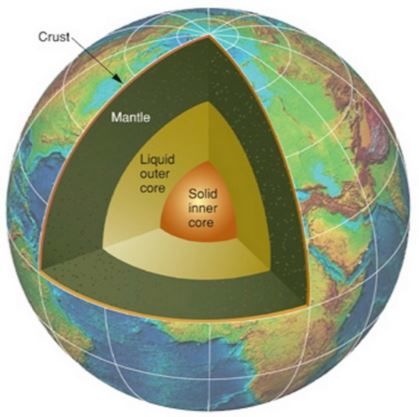
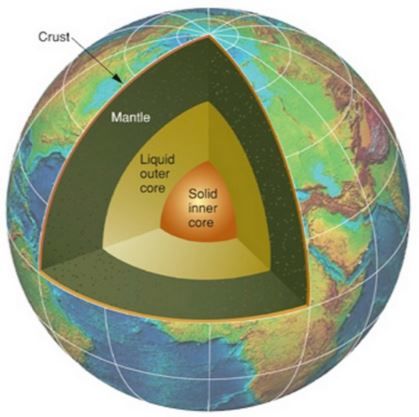
The diagram above shows a model of the real Internal Layers of Earth System. A model is...
30
A 3-D structure only of the real system
A diagram of the real system only
The real (actual) system
A diagram, visual, or 3-D view of a real system to help us better understand the system
Q 2/31
Score 0
The core can be considered a closed system. Why
30
No energy enters or leaves the core
No matter enters or leaves the core
No matter or energy enters or leaves the core
31 questions
Q.
The diagram above shows a model of the real Internal Layers of Earth System. A model is...
1
30 sec
Q.
The core can be considered a closed system. Why
2
30 sec
Q.
Can we change the boundary of our system which just included the core to include all three layers of the Earth?
3
30 sec
Q.
The boundary is now the crust of Earth. This can be considered a slightly open system. Why?
4
30 sec
Q.
The mantle floats on the core because it is
5
30 sec
Q.
As we dig into the crust deeper and deeper the temperature increases. At the particle level what is occurring?
6
30 sec
Q.
Heat transfers between the core and the mantle. Which is correct?
7
30 sec
Q.
The temperature of the crust is taken over the course of five days. Day 1: 25 C Day 2: 30 C Day 3: 27.5 C Day 4: 32 C Day 5: 35 C. What is the average for the five days?
8
60 sec
Q.
The temperature of the crust is taken over the course of five days. Day 1: 26 C Day 2: 30 C Day 3: 27.5 C Day 4: 33 C Day 5: 36 C. What is the average for the five days?
9
60 sec
Q.
Why is the ocean salty?
10
30 sec
Q.
Which is an energy transfer/transformation that is occurring in the Earth's interior?
11
30 sec
Q.
An experiment is performed on the real layers of the Earth system. The question was...how does is the temperature in a deep cave affected by the depth? identify the "conditions compared"
12
30 sec
Q.
An experiment is performed on the real layers of the Earth system. The question was...how does is the temperature in a deep cave affected by the depth? identify the "data collected"?
13
30 sec
Q.
An experiment is performed on the real layers of the Earth system. The question was...how does is the temperature in a deep cave affected by the depth? identify the "variable controlled"?
14
30 sec
Q.
Which does NOT describe a process of the Earth's Interior System?
15
30 sec
Q.
Which describes where in the system the mantle is being heated?
16
30 sec
Q.
Which does NOT describes a process in the interior of the Earth found within our model of the system above
17
30 sec
Q.
Which describes where in the system the differences in material are shown
18
30 sec
Q.
The diagram shows a drill used to drill out deep shafts into the Earth's crust. What is one feature that could be changed to make the drill safer for the workers/miners?
19
30 sec
Q.
Which describes scientific information a scientist could provide about safer drills?
20
30 sec
Q.
Which describes how an an engineer might use this to develop a safer drill?
21
30 sec
Q.
Which describes a way that collecting basalt would NOT be harmful to the ecosystem?
22
30 sec
Q.
Collecting basalt from the ocean floor would displace organisms that live in the area to other areas. Which describes scientific research that could be helpful in solving this harmful effect of collecting basalt?
23
30 sec
Q.
Collecting basalt from the ocean floor would cause erosion of the floor at a greater rate. This would make it so that organisms have less habitat to live in. Which describes scientific research that could be helpful in solving this harmful effect of collecting basalt?
24
30 sec
Q.
John has a claim. His claim is that the greater the pressure the greater the temperature. How could he test this claim?
25
30 sec
Q.
Which describes a science concept that would be needed to build a support structure so the house stays embedded in the crust better?
26
30 sec
Q.
Which describes how understanding the crust and what it's made of will help build a better support structure for the house
27
30 sec
Q.
How far did the object in the data table on the left move from 1-4 seconds?
28
120 sec
Q.
How far did the object move from 1-4 seconds for the data table on the right?
29
120 sec
Q.
What is the average speed for the data table on the left?
30
120 sec
Q.
Calculate the average speed for the data table on the left for the 1-4 second range: