Loading...


First Quarterly Examination in Science 9
Quiz by NOEL A. DE OCAMPO
Track each student's skills and progress in your Mastery dashboards
What organ systems work together to allow the exchange of gases and distribute nutrients although out the body?
It is a part of the respiratory system where gas exchange occurs.
The following are functions of the respiratory system EXCEPT:
What happens in the diaphragm when we exhale (breath out)?
What will happen if the epiglottis does not close the entrance of the airways?
Which is NOT a function of the circulatory system?
Which blood vessel carries blood away from the heart?
If a rupture occurs in the pulmonary artery, which passageway is affected?
Which path in the figure does the blood follow through
the heart as it returns from the head and body?
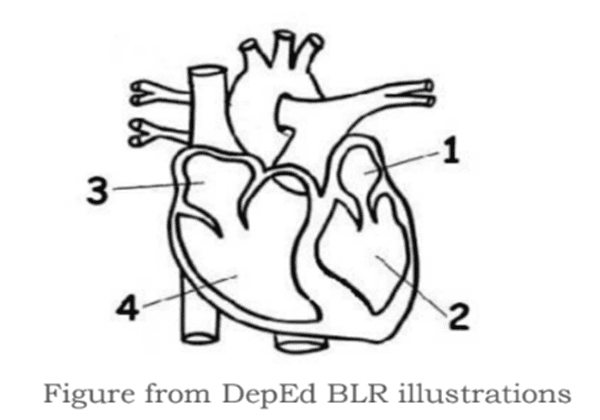
In which chamber does the blood flow while transporting fresh oxygen?
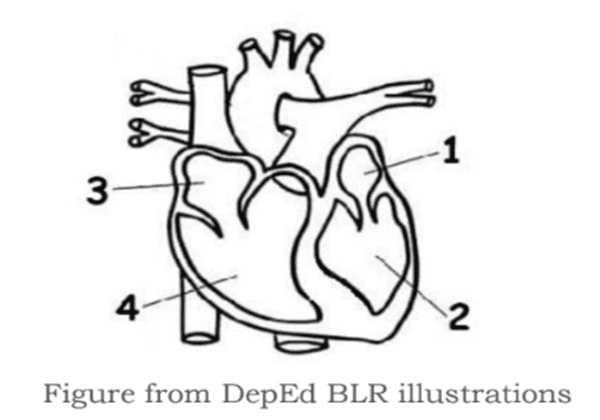
For the body to maintain homeostasis, the intake of oxygen into the lungs must be followed by which process?
How do the respiratory and circulatory systems work together?
When the body needs more oxygen, how does the circulatory system respond?
Smoking is the common cause of emphysema. What happens when you have emphysema?
What occurs when a blood clot blocks the blood supply from the heart?
How can you protect yourself from contractingCOVID-19?
What is being described in this situation: the elevation of blood pressure in the vessels gets too high that it can trigger other diseases?
Why do people end up eating fast foods, rather than eating fruits and vegetables?
What type of activity will weaken our lungs, and muscles, and makes our heart more inefficient?
It is a pattern of heredity in which one allele is not completely dominant over another.
Lactation is a characteristic manifested in females. This trait falls under
A purebred white gumamela is crossed with a purebred red gumamela. What percentage of their offspring is white gumamela?
In cattle, roan coat color (mixed red and white hairs) occurs in the heterozygous (RW)offspring of red (RR) and white (WW) homozygotes.
Which cross would produce offspring in the ratio of 1 red: 2 roan: 1 white?
Why is baldness mostly common among men?
ABO blood type is an example of multiple allele traits. If you have a blood type of AB+, what blood type/s can you receive?
In the ABO blood group system among humans, a man with type AB blood marries a woman with type A blood. What possible blood type might their sons inherit?
Which of the following indicates the number of chromosomes and sex chromosomes of a male?
What would be the parent’s genotype for color, if black offspring were produced from two white sheep parents?
Color blindness is an example of an X-linked trait. Who are the possible carriers of the color-blindness trait?
What type of inheritance is observed when a long radish crossed with round radishes, resulting in all oval radishes?
An extra finger in humans is rare but is due to a dominant gene. When one parent is normal, and the other parent has an extra finger but is heterozygous for the trait, what is the probability that the first child will be normal?
Which of the following best describes a genotype with a symbol of Aa?
Which refers to species of organisms whose population is so low that it has a great tendency to become extinct?
When can we say that a certain species is already extinct?
THE EXTINCTION CRISIS
It's frightening but true: Our planet is now in the midst of its sixth mass extinction of plants and animals — the sixth wave of extinctions in the past half-billion years. We're currently experiencing the worst spate of species die-offs since the loss of the dinosaurs 65 million years ago. Although extinction is a natural phenomenon, it occurs at a natural “background” rate of about 1 to 5species per year. Scientists estimate we're now losing species at up to 1,000times the background rate, with literally dozens going extinct every day. It could be a scary future indeed, with as many as 30 to 50% of all species possibly heading toward extinction by mid-century.
Unlike past mass extinctions, caused by events like asteroid strikes, volcanic eruptions, and natural climate shifts, the current crisis is almost entirely caused by us —humans. In fact, 99 % of currently threatened species are at risk from human activities, primarily those driving habitat loss, the introduction of exotic species, and global warming.
Species diversity ensures ecosystem resilience, giving ecological communities the scope they need to withstand stress. Thus while conservationists often justifiably focus their efforts on species-rich ecosystems like rainforests and coral reefs — which have a lot to lose — a comprehensive strategy for saving biodiversity must also include habitat types with fewer species, like grasslands, tundra, and polar seas — for which any loss could be irreversibly devastating. And while much concern over extinction focuses on globally lost species, most of the biodiversity's benefits take place at a local level, and conserving local populations is the only way to ensure genetic diversity critical for a species' long-term survival.
What is the main idea of the selection?
THE EXTINCTION CRISIS
It's frightening but true: Our planet is now in the midst of its sixth mass extinction of plants and animals — the sixth wave of extinctions in the past half-billion years. We're currently experiencing the worst spate of species die-offs since the loss of the dinosaurs 65 million years ago. Although extinction is a natural phenomenon, it occurs at a natural “background” rate of about 1 to 5species per year. Scientists estimate we're now losing species at up to 1,000times the background rate, with literally dozens going extinct every day. It could be a scary future indeed, with as many as 30 to 50% of all species possibly heading toward extinction by mid-century.
Unlike past mass extinctions, caused by events like asteroid strikes, volcanic eruptions, and natural climate shifts, the current crisis is almost entirely caused by us —humans. In fact, 99 % of currently threatened species are at risk from human activities, primarily those driving habitat loss, the introduction of exotic species, and global warming.
Species diversity ensures ecosystem resilience, giving ecological communities the scope they need to withstand stress. Thus while conservationists often justifiably focus their efforts on species-rich ecosystems like rainforests and coral reefs — which have a lot to lose — a comprehensive strategy for saving biodiversity must also include habitat types with fewer species, like grasslands, tundra, and polar seas — for which any loss could be irreversibly devastating. And while much concern over extinction focuses on globally lost species, most of the biodiversity's benefits take place at a local level, and conserving local populations is the only way to ensure genetic diversity critical for a species' long-term survival.
True or False: Extinction is a natural phenomenon.
THE EXTINCTION CRISIS
It's frightening but true: Our planet is now in the midst of its sixth mass extinction of plants and animals — the sixth wave of extinctions in the past half-billion years. We're currently experiencing the worst spate of species die-offs since the loss of the dinosaurs 65 million years ago. Although extinction is a natural phenomenon, it occurs at a natural “background” rate of about 1 to 5species per year. Scientists estimate we're now losing species at up to 1,000times the background rate, with literally dozens going extinct every day. It could be a scary future indeed, with as many as 30 to 50% of all species possibly heading toward extinction by mid-century.
Unlike past mass extinctions, caused by events like asteroid strikes, volcanic eruptions, and natural climate shifts, the current crisis is almost entirely caused by us —humans. In fact, 99 % of currently threatened species are at risk from human activities, primarily those driving habitat loss, the introduction of exotic species, and global warming.
Species diversity ensures ecosystem resilience, giving ecological communities the scope they need to withstand stress. Thus while conservationists often justifiably focus their efforts on species-rich ecosystems like rainforests and coral reefs — which have a lot to lose — a comprehensive strategy for saving biodiversity must also include habitat types with fewer species, like grasslands, tundra, and polar seas — for which any loss could be irreversibly devastating. And while much concern over extinction focuses on globally lost species, most of the biodiversity's benefits take place at a local level, and conserving local populations is the only way to ensure genetic diversity critical for a species' long-term survival.
Based on studies, who is the culprit of the current crisis of species extinction?
THE EXTINCTION CRISIS
It's frightening but true: Our planet is now in the midst of its sixth mass extinction of plants and animals — the sixth wave of extinctions in the past half-billion years. We're currently experiencing the worst spate of species die-offs since the loss of the dinosaurs 65 million years ago. Although extinction is a natural phenomenon, it occurs at a natural “background” rate of about 1 to 5species per year. Scientists estimate we're now losing species at up to 1,000times the background rate, with literally dozens going extinct every day. It could be a scary future indeed, with as many as 30 to 50% of all species possibly heading toward extinction by mid-century.
Unlike past mass extinctions, caused by events like asteroid strikes, volcanic eruptions, and natural climate shifts, the current crisis is almost entirely caused by us —humans. In fact, 99 % of currently threatened species are at risk from human activities, primarily those driving habitat loss, the introduction of exotic species, and global warming.
Species diversity ensures ecosystem resilience, giving ecological communities the scope they need to withstand stress. Thus while conservationists often justifiably focus their efforts on species-rich ecosystems like rainforests and coral reefs — which have a lot to lose — a comprehensive strategy for saving biodiversity must also include habitat types with fewer species, like grasslands, tundra, and polar seas — for which any loss could be irreversibly devastating. And while much concern over extinction focuses on globally lost species, most of the biodiversity's benefits take place at a local level, and conserving local populations is the only way to ensure genetic diversity critical for a species' long-term survival.
What ensures ecosystem resilience?
Which structure makes plants capable of producing their own food?
Oxygen and carbon dioxide are gases that cycle out in the ecosystem. Which of the following gases are important to photosynthesis?
The light-dependent reaction of photosynthesis must come first before the light-independent reaction because its products are important to the fixation of CO2. Which of the following is/are products of the light-dependent reaction?
Which of the following is the complete equation for photosynthesis?
Which of the following does not affect the rate of photosynthesis?
Chlorophyll is mostly located above the leaf of the plant to_____________.
Which of the following words/group of words are incorrectly paired?
If glucose and oxygen are the by-products of photosynthesis, what are the by-products of cellular respiration?
The following statements about cellular respiration are true EXCEPT?
Which of the following processes release energy?
I. Glycolysis III. Krebs cycle
II. Calvin Cycle IV. Electron transport chain
When cells break food into chemical energy, it undergoes three major processes: glycolysis, Krebs cycle, and electron transport chain.
Which of these processes of aerobic respiration produces the most ATP?
Which of the following statements correctly describes the difference between cellular respiration and photosynthesis?