Loading...


First Semester Warm Up Review
Quiz by Michelle
Track each student's skills and progress in your Mastery dashboards
Which circuit shown will produce light when the switch is closed?
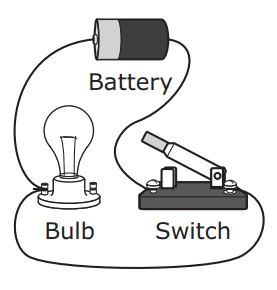
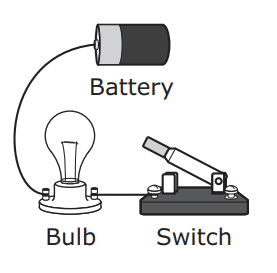
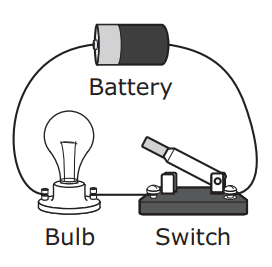
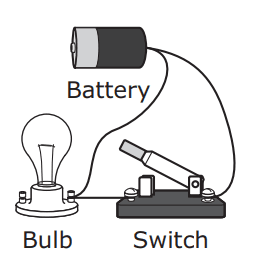
Which circuit shown will produce light when the switch is closed?
Which statement best explains why the sun appears to move across the sky during the day?
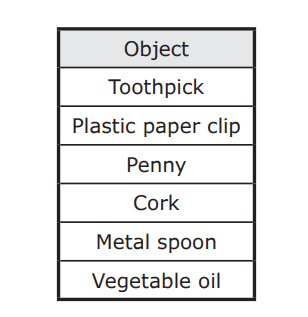
A student places objects in a bucket of water to determine if they will float.
Which set of items is less dense than water?
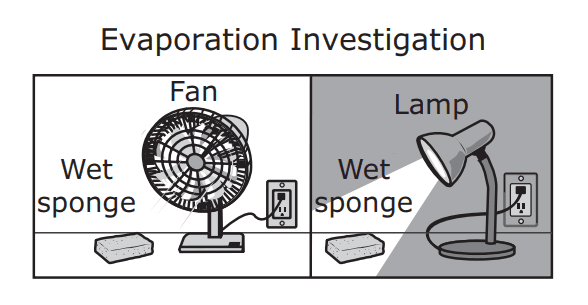
A student uses the setup shown to investigate ways to speed up evaporation.
Which forms of energy are being compared in the student’s investigation?
A student plans to make a chart that describes each process in the water cycle. Which sentence should the student use to describe the process of condensation?
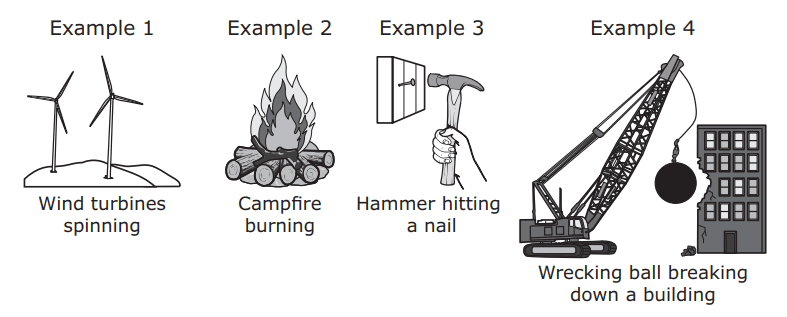
Examples of objects that use different types of energy to perform their functions are shown.
Which examples use mechanical energy to perform their functions?
A student is classifying objects. Answering which question will provide the best evidence that an object is a metal?
A student pours 14 grams of sugar into a jar filled with 500 milliliters of water. The student thoroughly stirs the sugar and water to make a solution.
Which change most likely occurs to the sugar when it is added to the water?
Students conduct an investigation with breakfast cereal. The first four steps of the students’ investigation are in the table shown.
The students are trying to determine the presence of which substance in the cereal?

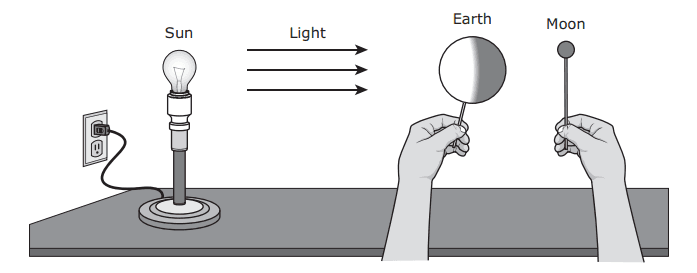
A student makes the model shown with objects representing the sun, Earth, and the moon to use in a class demonstration.
Which action should the student do with the objects to demonstrate a complete day-night cycle of Earth?
Students build a balloon-rocket car using a balloon, a straw, a water bottle, and some tape. When the straw is released by a student, the air from the balloon comes out. A diagram of the car is shown.
Which statement best describes the motion of the car when the straw is released?

The student is observing part of a plant with a microscope.
Which statement describes a behavior of light in the microscope?
