Loading...

French Revolution I
Quiz by Traquile Mind Music
Customize this quiz to suit your class
Instantly translate to 100+ languages
Tag the questions with any skills you have. Your dashboard will track each student's mastery of each skill.
Give this quiz to my class
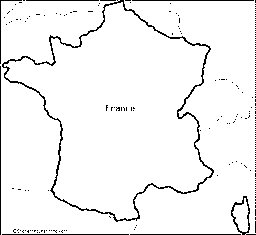
 The impact of the French Revolution in the Atlantic worldDemocratic Constitution in South Africa Struggle against Apartheid • Apartheid was the name of a system of racial discrimination unique to South Africa. • This system was particularly oppressive for the blacks. → They were forbidden from living in white areas. • Since 1950, the blacks, coloured and Indians fought against the apartheid system. • The African National Congress (ANC) was the umbrella organisation that led the struggle against the policies of segregation. • In 1964, Nelson Mandela and seven other leaders were sentenced to life imprisonment in 1964 for daring to oppose the apartheid regime in his country. Towards a New Constitution • As protests and struggles against apartheid had increased, the white regime changed its policies. • After 28 years of imprisonment, Nelson Mandela released from jail. • At the midnight of 26 April 1994, democracy was adopted as a form of government in South Africa. • After two years, a constitution came out which gave to its citizens the most extensive rights available in any country. Why do we need a Constitution? • A constitution is necessary because: → It generates a degree of trust and coordination that is necessary for different kind of people to live together. → It specifies how the government will be constituted, who will have power to take which decisions. → It lays down limits on the powers of the government and tells us what the rights of the citizens are. → It expresses the aspirations of the people about creating a good society. Making of the Indian Constitution • In 1928, Motilal Nehru and eight other Congress leaders drafted a constitution for India. • In 1931, the resolution at the Karachi session of the Indian National Congress dwelt on how independent India’s constitution should look like. • Factors contributed to the making of our Constitution. → Ideals of French Revolution → The practice of parliamentary democracy in Britain → The Bill of Rights in the US → The socialist revolution in Russia The Constituent Assembly • In July 1946, Elections to the Constituent Assembly were held. → The drafting of the document called the constitution was done Constituent Assembly. → Dr. Rajendra Prasad was the Chairman of the Constituent Assembly. → In December 1946, the first meeting was held. • After the country was divided into India and Pakistan, the Constituent Assembly also got divided. • The Assembly adopted the Constitution on 26 November 1949 but it came into effect on 26 January 1950. • To mark this day we celebrate January 26 as Republic Day every year. • The Constituent Assembly worked in a systematic, open and consensual manner. → First some basic principles were decided and agreed upon. → Then a Drafting Committee chaired by Dr. B.R. Ambedkar prepared a draft constitution for discussion. → More than two thousand amendments were considered. Philosophy of the Constitution • The Constitution begins with a short statement of its basic values which is called the Preamble to the constitution. The preamble focuses on: → Justice, social, economic and political. → Liberty of thoughts, expression, belief, faith and worship. → Equality of status and of opportunity. → Fraternity assuring the dignity of the individual and the unity and integrity of the nation.French Revolution, Industrial Revolution, and ImperialsimInfluences on American and French Revolution Enlightenment ReviewIntroduction to the French Revolution - Starter QuizEnlightenment ideas and the causes of the French RevolutionFrance Where Is It? France is a country in Europe. Other countries are to the east. To the south is Spain. The Atlantic Ocean is to the north and to the west. The United Kingdom is to the north. It is across a part of the Atlantic Ocean called the English Channel. Paris is the capital city of France. It is a very famous city. Millions of tourists visit Paris every year. More than ten million people live there. People. More than sixty-six million people live in France. Most people live and work in cities. Some have jobs helping tourists who visit France. Some people live in the countryside and grow food on farms. More than half of the land in France is used for farming. Most people in France speak French. Land. France has many different kinds of land. It has hills, forests, rivers, lakes, and beaches. Most of France is covered with low plains and hills. France also has five mountain ranges. They sit between France and other countries. The highest mountains are in the Alps. History. Long ago, France was called Gaul. Other countries took over Gaul many times. The Romans took it over first, and then the Franks took it from the Romans. France got its name from the Franks. For a long time, France was ruled by powerful kings. Then the French people fought against one king. This was called the French Revolution (1789–1799). Today, France is a democracy. Celebrations People in France celebrate the beginning of the revolution on July 14. They celebrate with fireworks and parades. Food. France is known for its food. One type of food is a long, thin loaf of bread. Many meals have more than one part. A meal may have soup, salad, a main course, and fruit for dessert. Conclusion France is a beautiful country with a long history. It has rolling hills, forests, and mountains. Its food is known around the world. What do you like most about France?french and indian war and american revolution, northwest territory, frontier wars, sectional issues and War of 1812, Underground Railroad