Loading...


Grade 8 2nd Quarter Pre-Test
Quiz by Daren Perez
Track each student's skills and progress in your Mastery dashboards
What is a linear inequality?
Which does not belong to the group?
Which linear inequality will have a broken line when graphed?
Points that lie on the broken line are solutions of the linear inequality.
When graphed, which linear inequality will give you a solid line?
Translate this in mathematical statement: "The total amount of the family spends for food (f) and educational expenses (e) is at most 8,000 pesos."
Which ordered pair is a solution of the inequality x + y > 1?
Carlo bought 5 apples and 2 oranges. The total amount he paid was at most Php 123. If x represents the number of apples and y be the number of oranges, which mathematical statement represents the given situation?
What is the relation of the set of ordered pairs {(0,4), (1,3), (2,2), (3,1)}?
Which set of ordered pairs represents a function?
Which equation represents a function?
Which equation is NOT a function?
Is it possible that a relation is said to be a function if the dependent variable
is determined by the independent variable(s)?
Is it true that a relation is said to be a function if the independent variable is
determined by the dependent variable(s)?
1. In the set of ordered pairs below, what is the domain?
{(1,2),(3,4), (5,6), (7,8)}
What is the range of values of the function f(x) = x + 3, if x = {-2, -1, 0, 1, 2}?
Which table of values is a linear function?
Which of the following graph shows a linear function?
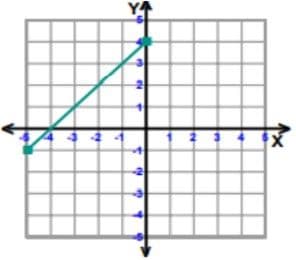
In the illustration, what is the domain?
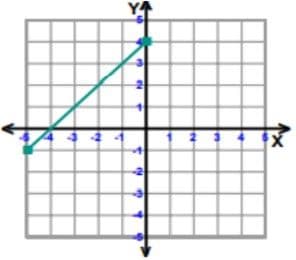
In the illustration, what is the range?
What is the mathematical statement of this statement below?
"A 3 ft mango tree (h) was planted in 2015 and has grown at an average rate of ¾ foot per year(y)."
In the situation "A 3 ft mango tree (h) was planted in 2015 and has grown at an average rate of ¾ foot per year(y)", what will be the height of the tree in 2020?
Which is the hypothesis in the given statement below?
"Ruby lives in Marikina, so she is a law-abiding citizen."
Which of the following is the proportion to make a statement valid?
Which is the if-then form of the statement “Learners studying in Marikina love Mathematics”?
What is the if-then form of the statement below?
Harold and Phoebe love to eat fruits and vegetables. They are healthy.
Which of the following statements derived −q →−p from p → q?
What is the converse of the statement, “If a polygon is a triangle, then it has three sides”?
What is the converse of a contrapositive statement?
In the converse statement below, what is the inverse statement?
If Nathan enjoys sour foods, then he likes citrus fruits.