Analyze and interpret data to provide evidence for how resource availability, disease, climate, and human activity affect individual organisms, populations, communities, and ecosystems.
Construct an explanation for the patterns of interactions observed in different ecosystems in terms of the relationships among and between organisms and abiotic components of the ecosystem. (Clarification statement: The interactions include, but are not limited to, predator-prey relationships, competition, mutualism, parasitism, and commensalism.)
Develop a model to describe the cycling of matter and the flow of energy among biotic and abiotic components of an ecosystem. (Clarification statement: Emphasis is on tracing movement of matter and flow of energy, not the biochemical mechanisms of photosynthesis and cellular respiration.)
Ask questions to gather and synthesize information from multiple sources to differentiate between Earth’s major terrestrial biomes (i.e., tropical rainforest, savanna, temperate forest, desert, grassland, taiga, and tundra) and aquatic ecosystems (i.e., freshwater, estuaries, and marine). (Clarification statement: Emphasis is on the factors that influence patterns across biomes such as the climate, availability of food and water, and location.)
Track each student's skills and progress in your Mastery dashboards
Give this quiz to my class
Q 1/10
Score 0
Scientists discover that chemicals dumped in a river have caused trout, a type of fish, to die. What other living things will be MOST affected by the trout dying?
30
bears that eat the trout
animals that drink the water
fishermen that catch the trout
plants that live at the edge of the river
Q 2/10
Score 0
Many chemicals are used to kill insects and protect plants. How could the removal of insects upset the balance of the ecosystem?
30
The plants would rapidly decrease in number.
Insects from other regions would replace the killed insects.
Animals that eat the insects would die as well.
The animals in the ecosystem would eat all the plants.
10 questions
Q.
Scientists discover that chemicals dumped in a river have caused trout, a type of fish, to die. What other living things will be MOST affected by the trout dying?
1
30 sec
S7L4c
Q.
Many chemicals are used to kill insects and protect plants. How could the removal of insects upset the balance of the ecosystem?
2
30 sec
S7L4c
Q.
In the hills of North Carolina, several different species of wrens live in one large pine tree. This is possible because the wrens
3
30 sec
S7L4a
Q.
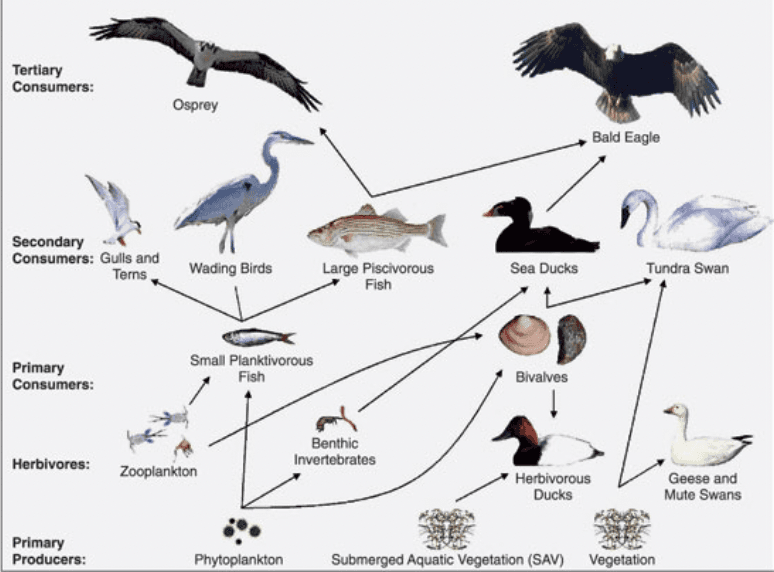
If the bald eagle was removed from this food web, what effect would this have on the population of the other species?
4
30 sec
S7L4c
Q.
Which BEST determines the number of wolves that can live in an area?
5
30 sec
S7L4c
Q.
Kudzu vines grow by climbing and wrapping around trees. Trees covered by kudzu can die because they are starved of sunlight. What type of relationship exists between the trees and the kudzu growing on them?
6
30 sec
S7L4a
Q.
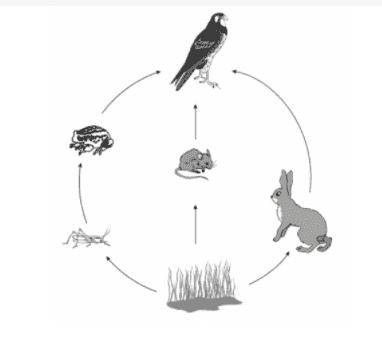
Consider this food web: Where is the largest amount of energy found in this food web?
7
30 sec
S7L4b
Q.
Which BEST explains the importance of nitrogen in the cycling of energy and matter?
8
30 sec
S7L4b
Q.
The two main processes by which plant cells absorb, release, and use energy are
9
30 sec
S7L4b
Q.
Which two factors determine the biome in a terrestrial area?