Obtain, evaluate, and communicate information to explain how organisms reproduce either sexually or asexually and transfer genetic information to determine the traits of their offspring.
Track each student's skills and progress in your Mastery dashboards
Give this quiz to my class
Q 1/3
Score 0
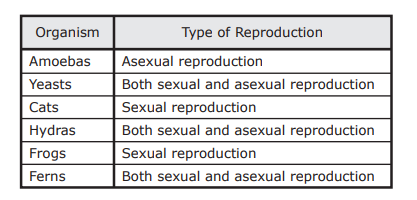
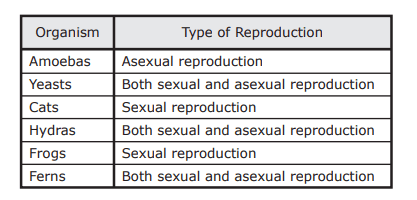
A group of students prepared a table listing the types of reproduction that occur in several organisms. Based on this information, which of the organisms can produce offspring that are genetically identical to the parent organism?
60
Amoebas, yeasts, hydras, and ferns only
Amoebas and yeasts only
Ferns only
Cats, hydras, frogs, and ferns only
Q 2/3
Score 0
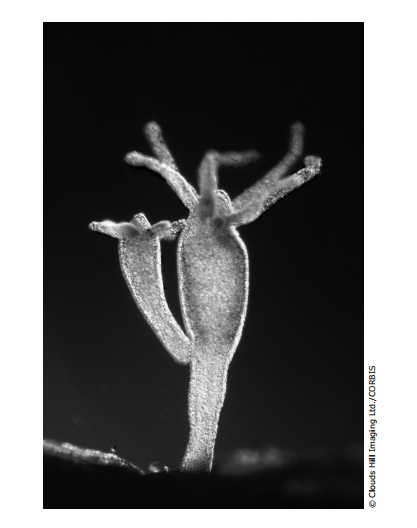
The hydra is a very small, simple animal that lives in water. Hydras reproduce asexually by budding, a process in which a bud breaks off an adult hydra and floats away. Which of the following best describes a hydra bud?
60
A hydra bud is genetically identical to the parent hydra.
A hydra bud contains genetic material from its two parents.
A hydra bud has half as much genetic material as the parent hydra.
A hydra bud has different mutations than the parent hydra.
3 questions
Q.
A group of students prepared a table listing the types of reproduction that occur in several organisms. Based on this information, which of the organisms can produce offspring that are genetically identical to the parent organism?
1
60 sec
S7L3
Q.
The hydra is a very small, simple animal that lives in water. Hydras reproduce asexually by budding, a process in which a bud breaks off an adult hydra and floats away. Which of the following best describes a hydra bud?
2
60 sec
S7L3
Q.
Certain species of whiptail lizards have only female individuals and no males. These lizards reproduce asexually. What is one disadvantage of asexual reproduction for these lizards?