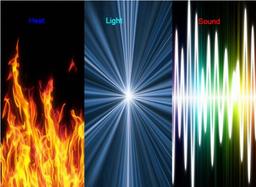
Forms of Energy - Illustrate that the sun's energy arrives as radiation with a wide range of wavelengths, including infrared, visible, and ultraviolet, and that white light is made up of a spectrum of many different colors.
Energy Transfer and Transformations - Observe and describe that heat flows in predictable ways, moving from warmer objects to cooler ones until they reach the same temperature.
Energy Transfer and Transformations - Recognize that adding heat to or removing heat from a system may result in a temperature change and possibly a change of state.
Track each student's skills and progress in your Mastery dashboards
Give this quiz to my class
Q 1/25
Score 0
What type of energy does the sun primarily emit that consists of various wavelengths, including infrared, visible, and ultraviolet?
30
Conduction
Radiation
Convection
Nuclear Energy
Q 2/25
Score 0
What is white light made of when it passes through a prism and spreads out into a spectrum?
30
Ultraviolet light only
Many different colors
A single color
Infrared light only
25 questions
Q.
What type of energy does the sun primarily emit that consists of various wavelengths, including infrared, visible, and ultraviolet?
1
30 sec
SC.7.P.10.1
Q.
What is white light made of when it passes through a prism and spreads out into a spectrum?
2
30 sec
SC.7.P.10.1
Q.
Which part of the sun's electromagnetic spectrum is visible to the human eye?
3
30 sec
SC.7.P.10.1
Q.
What natural phenomenon demonstrates the spectrum of visible light emitted by the sun?
4
30 sec
SC.7.P.10.1
Q.
What happens to white light when it passes through a prism?
5
30 sec
SC.7.P.10.1
Q.
What happens to light when it passes through a glass of water causing the appearance of a straw to be bent?
6
30 sec
SC.7.P.10.2
Q.
Which of the following scenarios is an example of light being absorbed?
7
30 sec
SC.7.P.10.2
Q.
What is the primary reason a pencil appears bent when placed in a glass of water?
8
30 sec
SC.7.P.10.2
Q.
Why does a green leaf appear green when observed in sunlight?
9
30 sec
SC.7.P.10.2
Q.
What causes a red apple to appear red under white light?
10
30 sec
SC.7.P.10.2
Q.
Why does a diamond sparkle brightly in light?
11
30 sec
SC.7.P.10.2
Q.
When a cup of hot coffee is placed in a room at a lower temperature, what happens to the heat energy from the coffee according to the principles of heat transfer?
12
30 sec
SC.7.P.11.4
Q.
Which statement best describes why a metal spoon feels colder than a wooden spoon when both are at the same room temperature?
13
30 sec
SC.7.P.11.4
Q.
Which of the following scenarios best illustrates the concept of thermal equilibrium?
14
30 sec
SC.7.P.11.4
Q.
Why does frost form on a car's windshield on a cold morning but not when the car is kept in a warm garage?
15
30 sec
SC.7.P.11.4
Q.
What is the primary reason your hands feel cold when you hold a cold drink?
16
30 sec
SC.7.P.11.4
Q.
Why does an ice cube placed in a glass of warm water melt faster than an ice cube left in a room at room temperature?
17
30 sec
SC.7.P.11.4
Q.
When a hot metal block is placed in contact with a cold metal block, what happens to the temperature of both blocks over time?
18
30 sec
SC.7.P.11.4
Q.
What happens when a cold soda can is taken out of the refrigerator and placed on a warm kitchen counter?
19
30 sec
SC.7.P.11.4
Q.
If you hold one end of a metal rod in a flame, why does the other end eventually become hot even if it is far from the flame?
20
30 sec
SC.7.P.11.4
Q.
What is the result when heat is removed from gaseous water (steam)?
21
30 sec
SC.7.P.11.1
Q.
What happens to the particles in a solid when heat is added and the solid turns into a liquid?
22
30 sec
SC.7.P.11.1
Q.
What happens to the temperature of a substance during a change of state, such as melting or boiling?
23
30 sec
SC.7.P.11.1
Q.
If you remove heat from water vapor, what process occurs?
24
30 sec
SC.7.P.11.1
Q.
Which process occurs when heat is added to ice at 0°C?