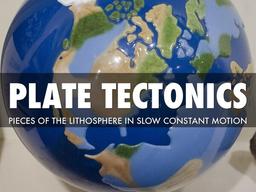
Earth Structures - Explore the scientific theory of plate tectonics by describing how the movement of Earth's crustal plates causes both slow and rapid changes in Earth's surface, including volcanic eruptions, earthquakes, and mountain building.
Earth Structures - Describe the layers of the solid Earth, including the lithosphere, the hot convecting mantle, and the dense metallic liquid and solid cores.
Earth Structures - Recognize that heat flow and movement of material within Earth causes earthquakes and volcanic eruptions, and creates mountains and ocean basins.
Track each student's skills and progress in your Mastery dashboards
Give this quiz to my class
Q 1/35
Score 0
Which geological event is most directly caused by the movement of Earth\'s crustal plates?
30
Tornadoes
Hurricanes
Earthquakes
Floods
Q 2/35
Score 0
What natural feature is formed when two continental crustal plates collide?
30
Oceans
Mountains
Valleys
Islands
35 questions
Q.
Which geological event is most directly caused by the movement of Earth\'s crustal plates?
1
30 sec
SC.7.E.6.5
Q.
What natural feature is formed when two continental crustal plates collide?
2
30 sec
SC.7.E.6.5
Q.
What geological process is primarily responsible for the formation of volcanic eruptions?
3
30 sec
SC.7.E.6.5
Q.
What happens at a transform plate boundary?
4
30 sec
SC.7.E.6.5
Q.
How does the movement of tectonic plates lead to the formation of oceanic trenches?
5
30 sec
SC.7.E.6.5
Q.
Which process is primarily responsible for the creation of new ocean floor?
6
30 sec
SC.7.E.6.5
Q.
Which type of plate boundary is most commonly associated with the formation of deep oceanic trenches?
7
30 sec
SC.7.E.6.5
Q.
What type of landform is created when magma from beneath the Earth\'s crust reaches the surface and cools?
8
30 sec
SC.7.E.6.5
Q.
Which phenomenon is a direct result of tectonic plate movement and often occurs along plate boundaries?
9
30 sec
SC.7.E.6.5
Q.
Which type of plate boundary is typically associated with the creation of mid-ocean ridges?
10
30 sec
SC.7.E.6.5
Q.
Which layer of the Earth is primarily responsible for the creation of the planet's magnetic field?
11
30 sec
SC.7.E.6.1
Q.
Which layer of the Earth is directly involved in the formation of earthquakes?
12
30 sec
SC.7.E.6.1
Q.
What is the primary role of the Earth's mantle in plate tectonics?
13
30 sec
SC.7.E.6.1
Q.
What characteristic differentiates the inner core from the outer core of the Earth?
14
30 sec
SC.7.E.6.1
Q.
Which layer of the Earth consists of both a solid and a liquid component?
15
30 sec
SC.7.E.6.1
Q.
Which layer of the Earth is the thinnest?
16
30 sec
SC.7.E.6.1
Q.
Which layer of the Earth is composed mainly of molten iron and nickel?
17
30 sec
SC.7.E.6.1
Q.
Which of the following layers of the Earth is responsible for tectonic plate movement?
18
30 sec
SC.7.E.6.1
Q.
Which layer of the Earth is composed predominantly of silicate minerals and acts as a semi-fluid layer upon which tectonic plates move?
19
30 sec
SC.7.E.6.1
Q.
What geological processes are primarily responsible for creating mountains and ocean basins?
20
30 sec
SC.7.E.6.7
Q.
Which natural phenomena are directly caused by the movement of tectonic plates?
21
30 sec
SC.7.E.6.7
Q.
What underlying process is mainly responsible for the occurrence of volcanic eruptions?
22
30 sec
SC.7.E.6.7
Q.
What causes the formation of ocean basins?
23
30 sec
SC.7.E.6.7
Q.
Which process contributes to the formation of new mountain ranges?
24
30 sec
SC.7.E.6.7
Q.
What causes the movement of tectonic plates on Earth?
25
30 sec
SC.7.E.6.7
Q.
How does the heat from Earth's interior affect the formation of ocean basins?
26
30 sec
SC.7.E.6.7
Q.
Which geological feature is formed as a result of subduction zones at convergent plate boundaries?
27
30 sec
SC.7.E.6.7
Q.
What is the primary cause of earthquakes along transform plate boundaries?
28
30 sec
SC.7.E.6.7
Q.
What is the primary process that leads to the formation of mid-ocean ridges?
29
30 sec
SC.7.E.6.7
Q.
What causes earthquakes to occur on Earth?
30
30 sec
SC.7.E.6.7
Q.
What results from the process of seafloor spreading at mid-ocean ridges?
31
30 sec
SC.7.E.6.7
Q.
What phenomenon often occurs at the boundaries where tectonic plates grind past each other?
32
30 sec
SC.7.E.6.7
Q.
Which process is primarily responsible for the formation of mountain ranges?
33
30 sec
SC.7.E.6.7
Q.
What geological process primarily causes the formation of mountains?
34
30 sec
SC.7.E.6.7
Q.
Which natural phenomenon is directly associated with the movement of molten rock beneath the Earth's surface?