Tag the questions with any skills you have. Your dashboard will track each student's mastery of each skill.
Give this quiz to my class
Q 1/17
Score 0
Which of the following occurs as ice turns into liquid water?
30
The mass of the ice increases.
Energy is absorbed by the ice.
Energy is released by the ice.
The temperature of the ice decreases.
Q 2/17
Score 0
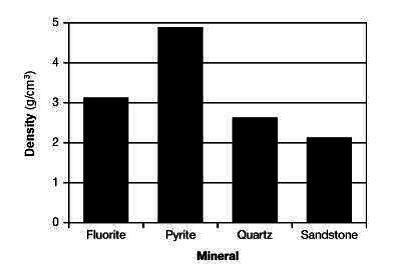
Objects with a density of 1g/cm3 or less will float in water. The following graph shows the density
of selected minerals.
30
all of the minerals will float
none of the minerals will float
only Pyrite will float
only Sandstone will float
17 questions
Q.
Which of the following occurs as ice turns into liquid water?
1
30 sec
Q.
Objects with a density of 1g/cm3 or less will float in water. The following graph shows the density
of selected minerals.
2
30 sec
Q.
Ellie is explaining to her classmates why water (H2O) is a pure substance and not a mixture.
Which of the following reasons could Ellis use to support her explanation?
3
30 sec
Q.
Materials can be classified as acids or bases according to their pH levels. This following are
pH levels of some common materials.
baking soda 9
deionized water 7
egg whites 8
lemon juice 2
milk 6
soda 4
Which of the materials are bases?
4
30 sec
Q.
A teacher places a hot serving spoon in a small bowl of ice cubes.
What change will occur?
5
30 sec
Q.
How do replication and repeated trials compare?
6
30 sec
Q.
The atomic models shown below were developed in order from left to right: first Thomson’s
model, then Rutherford’s, and finally, the current model of the atom. Why are these models useful?
7
30 sec
Q.
Atoms are made of smaller objects called sub-atomic particles.
Which of the following is NOT a sub-atomic particle found in atoms?
8
30 sec
Q.
Which of the following is a compound?
9
30 sec
Q.
In the model of an atom shown, what is the name of the part labeled A?
10
30 sec
Q.
In which of the phases of matter are atoms able to spread out the farthest from one another?
11
30 sec
Q.
Jenni reports that a 50 milliliters (mL) of unpopped popcorn kernels had
a mass of 200 grams (g).
12
30 sec
Q.
What is the name of the group of elements touching the zig-zag line as indicated on the periodic
table?
13
30 sec
Q.
Cheryl investigates the density of an object. She fills a graduated cylinder with water, as shown in
Figure 1. Cheryl knows the object has a mass of 16.0 grams (g) before she places the object in the
cylinder, as shown in Figure 2.
14
30 sec
Q.
What is the term for a substance that is made up of only one type of atom?
15
30 sec
Q.
John Dalton’s atomic theory stated that all matter is composed of elements, which are themselves
composed of atoms. Further, all atoms of a given element are identical in mass and properties.
More than one hundred years later, scientists learned that atoms of the same element could have
different masses. What does this illustrate about scientific theories?
16
30 sec
Q.
Wes mixes an acidic solution with a basic solution. What type of compound will be produced?