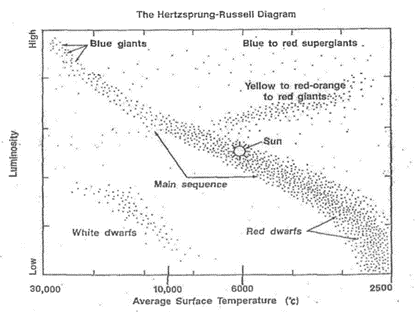
Communicate scientific ideas about the way stars, over their life cycle, produce elements. [Clarification Statement: Emphasis is on the way nucleosynthesis, and therefore the different elements created, varies as a function of the mass of a star and the stage of its lifetime.] [Assessment Boundary: Details of the many different nucleosynthesis pathways for stars of differing masses are not assessed.]
Construct an explanation of the Big Bang theory based on astronomical evidence of light spectra, motion of distant galaxies, and composition of matter in the universe. [Clarification Statement: Emphasis is on the astronomical evidence of the redshift of light from galaxies as an indication that the universe is currently expanding, the cosmic microwave background as the remnant radiation from the Big Bang, and the observed composition of ordinary matter of the universe, primarily found in stars and interstellar gases (from the spectra of electromagnetic radiation from stars), which matches that predicted by the Big Bang theory (3/4 hydrogen and 1/4 helium).]
Analyze data to support the claim that Newton’s second law of motion describes the mathematical relationship among the net force on a macroscopic object, its mass, and its acceleration. [Clarification Statement: Examples of data could include tables or graphs of position or velocity as a function of time for objects subject to a net unbalanced force, such as a falling object, an object rolling down a ramp, or a moving object being pulled by a constant force.] [Assessment Boundary: Assessment is limited to one-dimensional motion and to macroscopic objects moving at non-relativistic speeds.]
Create a computational model to calculate the change in the energy of one component in a system when the change in energy of the other component(s) and energy flows in and out of the system are known. [Clarification Statement: Emphasis is on explaining the meaning of mathematical expressions used in the model.] [Assessment Boundary: Assessment is limited to basic algebraic expressions or computations; to systems of two or three components; and to thermal energy, kinetic energy, and/or the energies in gravitational, magnetic, or electric fields.]
Develop and use models to illustrate that energy at the macroscopic scale can be accounted for as a combination of energy associated with the motions of particles (objects) and energy associated with the relative position of particles (objects). [Clarification Statement: Examples of phenomena at the macroscopic scale could include the conversion of kinetic energy to thermal energy, the energy stored due to position of an object above the earth, and the energy stored between two electrically-charged plates. Examples of models could include diagrams, drawings, descriptions, and computer simulations.]
Track each student's skills and progress in your Mastery dashboards