Loading...


Lecture 2, Part A
Quiz by Andre McBean
Tag the questions with any skills you have. Your dashboard will track each student's mastery of each skill.
Which of the following are NOT used by bacteria for locomotion (moving)?
Hans and Zacharias Janssen (~1590) invented the microscope by accident while trying to make telescope.
Anton von Leeuwenhoek called microbes streaks and threads when naming bacteria. ___________________ ~100 years later more properly defined them as Bacillium and Spirillium. Cocci were not yet recognized.
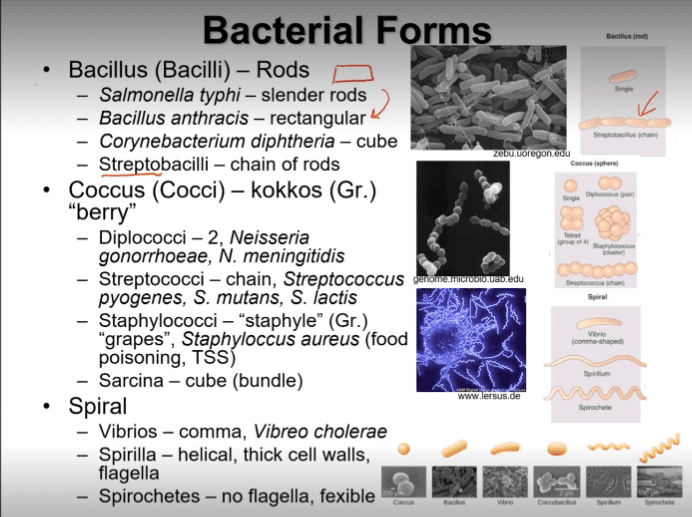
A chain of rod shaped bacteria is called ______________.
Which 2 of the three shapes have flagella for locomotion:
Which protein is the main component of bacterial flagella?
The part of the flagella that creates the waving motion outside of the bacterial cell walls is called the ________________.
The part of the flagella that anchors the flagella to the bacterial cell body is the _______.
Internal structures within the bacteria that are responsible for the wavelike movement of the outside portion of the flagella.
What is the differentiator between a gram-positive cell different from a gram-negative cell in the cases where there are flagella?
The direction of movement of the flagella are referred to as their ____________ for their directional capabilities in navigation of the bacteria.
What is the name of the clockwise locomotion of the bacteria?
What is the name of the counter-clockwise locomotion of the bacteria?
The term used to describe the movement of the bacteria in response to an outside stimulus.
What are the two types of Taxis (environmental responses)?
Which of the following taxis is a response to the presence of nutrients or chemicals?
Which of the following taxis is a response to the presence of light?
What suffix is used to describe a bacterial flagella arrangement?
What word is used to define a single flagella arrangement?
What word is used to define having flagella on both ends?
What word is used to define having flagella on one side that makes it lopsided?
What word is used to define having flagella on all sides?
What are pili?
Are pili typically seen in gram positive or gram negative cells?
The protein structure found within pili are called _______.
What is the function of pili?
Bacterial cells have the potential to produce capsules around themselves in an attempt to prevent desiccation (drying out), resist phagocytosis (being engulfed by cells such as natural killer cells) and become antibiotic resistant as well. What are the secretions that form that capsule layer?
When a thin layer of glycocalyces is secreted which are not enough to make a capsule, these sticky layers around the cell are called _____________.
When sticky layers (glycocalyces, slime layer) stick adjacent bacteria together in visble layers of bacteria on the surface of an object (such as a catheter), this thick visible layer of bacteria on the object is known as a ______________.

All true bacteria (eubacteria) except for mycoplasma contain _____________.
What is the purpose of the eubacteria cell wall?
The bacterial cell wall is surrounded by a thick layer of glycocalyces (the capsule around the cell wall) and is often times surrounded by a network of amino acids that gives it structure and rigidity, which acts as an additional layer of support besides its glycocalyces capsule above the cell wall. What is the name of this chain of amino acids?
The cell wall contains peptidoglycan and sits above the ____________.
What makes gram positive stand out under the microscope?
They have a thick layer of peptidoglycan consisting of 60-90% of it. This means that when the lab staining procedure is performed with crystal violet, they stain darker. Another unique feature is that they contain teichoic acids.
Since the cell walls of a gram positive are so fragile due to not having a capsule, inhibition of the protective layers from developing has been shown to be an effective means of antibiotic effectiveness. Which chemical is capable of interfering with peptidoglycan formation and thus leaving the cells susceptible to destruction:
Lysosomes (cell internal organelle) contains enzymes that can break down peptidoglycans.
A microbiologist identifies a bacterium and finds that its peptidoglycan layer above the cell membrane makes the bacteria a gram negative. Which of the following percentages of peptidoglycan is most probable for the bacteria found?
Does gram negative cells retain crystal violet during the staining procedure.
In place of the thicker layer of protective peptidoglycans, gram negative cells contain a second outside layer called the outer lipopolysaccharide. This layer contains endotoxins called ___________ which are only released if the outer layer is destroyed by outside organisms or chemical.
What is the term given to the space between layers as shown in the image provided:
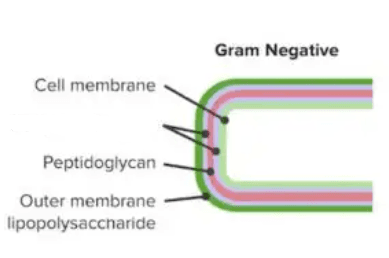
The ________________ contains both antimicrobial and disinfectants to combat and protect the bacteria if there are any molecules that pass through the lipopolysaccharide layer.
Prokaryotic cells do not have a:
Which of the following is NOT a characteristic of eukaryotic cells?
Which of the following structures is found in BOTH prokaryotic and eukaryotic cells?
Prokaryotic cells are larger than eukaryotic cells.
Eukaryotic cells have a double-stranded DNA molecule.
Eukaryotic cells can reproduce sexually and asexually.
Prokaryotic cells have a cell wall made of peptidoglycan, a complex carbohydrate and protein molecule. Eukaryotic cells also have a cell wall, but it is made of cellulose in plants and chitin in fungi. Animal cells do not have a cell wall.
What are Magnetosome inclusion bodies?
What are bacteriocins?
______________ are chemical compounds release by one bacterium to prevent the growth of another bacterium.
What is the function of Plasmids?
Are endospores produced by gram positive, gram negative, neither or both types of bacteria?
During endospore formation, what structure is used to enclose the DNA and create that hard protection from the extreme environment?
How long can an endospore last?
What treatment can be used to get rid of endospores?
Which of the following bacteria contain the most dangerous toxin known to man?
Why is it advised that you never give honey to a baby?
Which bacteria causes Tetanus?
Which bacteria is used to produce toxins for the beauty industry which transforms that toxin into Botox?
Clostridium is associated with canned or rusty metals.
This bacterium causes spasms that are so severe that they can break your bones.