Tag the questions with any skills you have. Your dashboard will track each student's mastery of each skill.
Give this quiz to my class
Q 1/44
Score 0
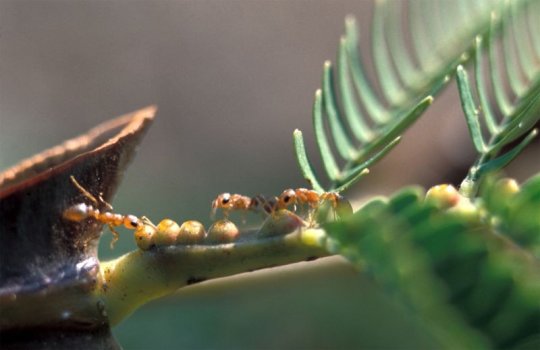
Ants burrow into a thorn of the Acacia tree to live and eat sugar secreted by the tree. These ants are a benefit to the Acacia because they attack the tree's predators.
What type of relationship do the ants and these trees share?
30
Parasitism
Commensalism
Mutualism
Competition
Q 2/44
Score 0
The following symbols represent what happens to an organism in an ecological relationship with another organism: (+ ) the organism is benefited ; (-) the organism is harmed; (0 ) the organism is not affected in any way. Which of the following scenarios represents COMPETITION?
120
+ 0
+ +
- -
+ -
44 questions
Q.
Ants burrow into a thorn of the Acacia tree to live and eat sugar secreted by the tree. These ants are a benefit to the Acacia because they attack the tree's predators.
What type of relationship do the ants and these trees share?
1
30 sec
Q.
The following symbols represent what happens to an organism in an ecological relationship with another organism: (+ ) the organism is benefited ; (-) the organism is harmed; (0 ) the organism is not affected in any way. Which of the following scenarios represents COMPETITION?
2
120 sec
Q.
The following symbols represent what happens to an organism in an ecological relationship with another organism: (+ ) the organism is benefited ; (-) the organism is harmed; (0 ) the organism is not affected in any way. Which of the following scenarios represents MUTUALISM?
3
120 sec
Q.
The following symbols represent what happens to an organism in an ecological relationship with another organism: (+ ) the organism is benefited ; (-) the organism is harmed; (0 ) the organism is not affected in any way. Which of the following scenarios represents PARASITISM?
4
120 sec
Q.
The following symbols represent what happens to an organism in an ecological relationship with another organism: (+ ) the organism is benefited ; (-) the organism is harmed; (0 ) the organism is not affected in any way. Which of the following scenarios represents COMMENSALISM?
5
120 sec
Q.
The following symbols represent what happens to an organism in an ecological relationship with another organism: (+ ) the organism is benefited ; (-) the organism is harmed; (0 ) the organism is not affected in any way. Which of the following scenarios represents PREDATION?
6
120 sec
Q.
Mangrove trees are common to the Florida Everglades. The tree roots serve as a place for freshwater oysters to attach when the tide is high, as shown in the picture below. The oysters are protected from predators when attached to the roots underwater. The oysters do not harm the trees nor do they provide any benefit to the trees.
Which of the following relationships is most similar to the relationship between the mangrove trees and
the oysters?
7
120 sec
Q.
Worms, bacteria, some insects and fungi are decomposers. What is their function in a food web?
8
120 sec
Q.
Remoras are small fish that attach to sharks but do not harm them. When sharks tear prey apart, remoras eat the leftovers.
What relationship do remoras have with sharks?
9
120 sec
Q.
When a bee drinks nectar from a flower, it gets pollen on its hind legs. When the bee visits another flower, it transfers pollen from the first flower to the second flower which helps the plants reproduce.
What type of relationship is this?
10
120 sec
Q.
Which of the following are examples of parasitism?
11
120 sec
Q.
Which of the following are examples of commensalism?
12
120 sec
Q.
What is something that keeps a population size down (like weather, competition, disease, etc)?
13
120 sec
Q.
Which of the following statements is NOT TRUE about the food web represented in the diagram?
14
120 sec
Q.
In a marine food web, algae and phytoplankton are
15
120 sec
Q.
What happens to a population when a resource that is a limiting factor in the environment suddenly becomes scarce?
16
120 sec
Q.
Food webs and pyramids are models used to represent feeding relationships between organisms. What happens to the energy as we move up (from producers to top predators) in the food web and pyramids?
17
120 sec
Q.
Structures in the human body work together to perform specific functions. The diagram below shows the organization of structures found in the human body. A picture of which of the following structures belongs in the box above?
18
120 sec
Q.
In a human body, which of the following represents the highest level of structural organization?
19
120 sec
Q.
Which of the following is not part of the cell theory?
20
120 sec
Q.
What is homeostasis?
21
120 sec
Q.
The survival of cells depends on maintaining homeostasis.
What will happen to a cell if homeostasis is not maintained?
22
120 sec
Q.
Plant cells are different from animal cells. Compared to the structures in an animal cell, which of the following structures is found only in a plant cell?
23
120 sec
Q.
Choose the name and cellular process that match the organelle shown in the photo.
24
120 sec
Q.
In biology class, Zach observes cells. Each cell has a structure that separates the inside of the cell from the environment.
Which structure is Zach observing?
25
120 sec
Q.
In order to maintain homeostasis, the systems of the human body work together to keep a constant internal temperature.
Which of the following best describes how the human body
responds in a cold environment?
26
120 sec
Q.
Manuel eats lunch in the cafeteria every day. How does his digestive system make use of the lunch he eats?
27
120 sec
Q.
In science class, Rupert learns about the different systems of the human body.
What are three functions of the system shown above?
28
120 sec
Q.
Amy goes to the doctor because she is not feeling well. The doctor carefully looks for anything abnormal in Amy’s pharynx. The doctor then listens through his stethoscope for abnormal sounds in Amy’s bronchi and alveoli. Which body system is the doctor examining?
29
120 sec
Q.
Which of the following identifies the levels of classification in correct order?
30
120 sec
Q.
Which of the following are the three main classification domains?
31
120 sec
Q.
An important characteristic that ALL vertebrate have is
32
120 sec
Q.
Which of the following statements correctly describes a kingdom of Domain Eukarya?
33
120 sec
Q.
Which of the following is least likely to cause a species to become extinct due to changes in the environment?
34
120 sec
Q.
According to the theory of evolution, what may have contributed to the extinction of the woolly mammoth?
35
120 sec
Q.
What is evolution?
36
120 sec
Q.
The gene for curled ears (C) is dominant over the gene for straight ears (c). The picture shows a cat with curled ears (Cc) and a cat with straight ears (cc).
What percent of the offspring are expected to have curled ears as a result of a cross between the cats shown?
37
120 sec
Q.
Leigh Ann is learning about the differences between inherited traits and learned behaviors in organisms. For example, she knows that being able to read is learned, while having straight or curly hair is inherited.
How does a person inherit a trait such as hair texture?
38
120 sec
Q.
The diagram below shows the results of crossing a pea plant with round seeds and a pea plant with wrinkled seeds. What can be determined from the results of the experiment?
39
120 sec
Q.
DNA contains genes that provide instructions for inherited traits.
What is the relationship between the genes and chromosomes?
40
120 sec
Q.
Teresa mows the lawn and notices that bits of grass are left behind on the lawn. Over time, the bits of grass disappear. What is the best explanation for this observation?
41
120 sec
Q.
One of the largest cypress trees in Florida has a tree trunk with a diameter of about 3.5 m. What is the source of most of the carbon in the cypress tree’s trunk?
42
120 sec
Q.
Green plants produce their own food during photosynthesis. They use carbon dioxide and water to produce sugar molecules (glucose). Which of these substances is also a product of photosynthesis?
43
120 sec
Q.
Carbon exists in many forms on Earth. The diagram below shows part of the carbon cycle. What is happening in Step 1?