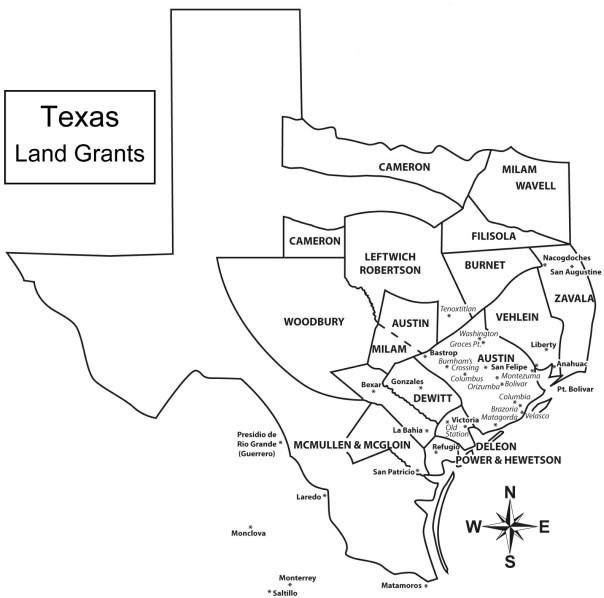
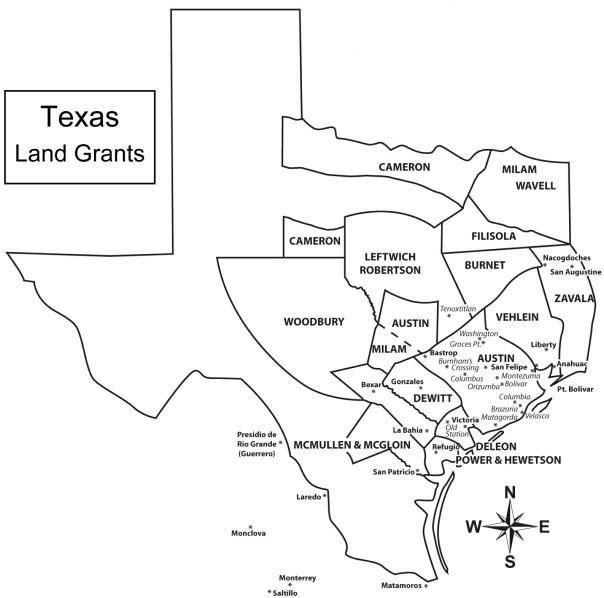
Create and interpret thematic maps, graphs, charts, models, and databases representing various aspects of Texas during the 19th, 20th, and 21st centuries;
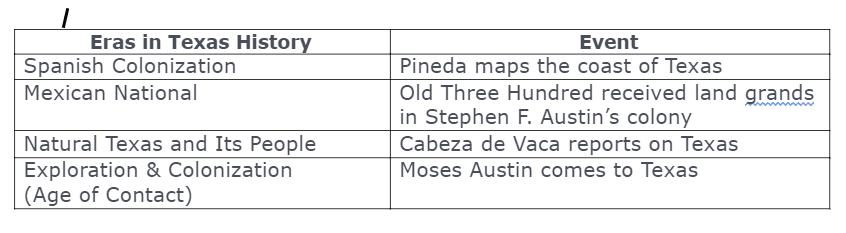
Identify the major eras in Texas history, describe their defining characteristics, and explain why historians divide the past into eras, including Natural Texas and its People; Age of Contact; Spanish Colonial; Mexican National; Revolution and Republic; Early Statehood; Texas in the Civil War and Reconstruction; Cotton, Cattle, and Railroads; Age of Oil; Texas in the Great Depression and World War II; Civil Rights and Conservatism; and Contemporary Texas;
Apply absolute and relative chronology through the sequencing of significant individuals, events, and time periods;
Explain the significance of the following dates: 1519, mapping of the Texas coast and first mainland Spanish settlement; 1718, founding of San Antonio; 1821, independence from Spain; 1836, Texas independence; 1845, annexation; 1861, Civil War begins; 1876, adoption of current state constitution; and 1901, discovery of oil at Spindletop.
Identify the individuals, issues, and events related to Mexico becoming an independent nation and its impact on Texas, including Texas involvement in the fight for independence, José Gutiérrez de Lara, the Battle of Medina, the Mexican federal Constitution of 1824, the merger of Texas and Coahuila as a state, the State Colonization Law of 1825, and slavery;
Identify the contributions of significant individuals, including Moses Austin, Stephen F. Austin, Erasmo Seguín, Martín De León, and Green DeWitt, during the Mexican settlement of Texas;
Analyze and interpret geographic distributions and patterns in Texas during the 19th, 20th, and 21st centuries.
Contrast Spanish, Mexican, and Anglo purposes for and methods of settlement in Texas.
Analyze how immigration and migration to Texas in the 19th, 20th, and 21st centuries have influenced Texas;
Track each student's skills and progress in your Mastery dashboards