Tag the questions with any skills you have. Your dashboard will track each student's mastery of each skill.
Give this quiz to my class
Q 1/48
Score 0
Macrophages differentiate into mast cells in tissues.
30
False
True
Q 2/48
Score 0
Of the following cell types, which are involved in antigen sampling?
30
Thrombocytes
Eosinophils
Erythrocytes
Dendritic cells
48 questions
Q.
Macrophages differentiate into mast cells in tissues.
1
30 sec
Q.
Of the following cell types, which are involved in antigen sampling?
2
30 sec
Q.
Chemokines
3
30 sec
Q.
Interferon
4
30 sec
Q.
Tumor necrosis factors
5
30 sec
Q.
Interleukins
6
30 sec
Q.
Colony stimulating factors
7
30 sec
Q.
__________ can push debris/virsues out of the respiratory tract.
8
30 sec
Q.
Defensins
9
30 sec
Q.
Lysozyme
10
30 sec
Q.
Lactoferrin
11
30 sec
Q.
Peroxidase
12
30 sec
Q.
What type of cells are the first to arrive at the breach of a barrier?
13
30 sec
Q.
Lymphocytes are innate immune system cells.
14
30 sec
Q.
Adaptive immunity is always active.
15
30 sec
Q.
T-helper cells interact with epitopes on MHC I complexes.
16
30 sec
Q.
T-cytotoxic cells interact with epitopes on MHC I complexes.
17
30 sec
Q.
T-helper cells interact with epitopes via MHC II complexes.
18
30 sec
Q.
T-cytotoxic cells interact with epitopes via MHC II complexes.
19
30 sec
Q.
Dendritic cells only possess MHC II complexes.
20
30 sec
Q.
MHC I complexes are associated with endogenous antigens.
21
30 sec
Q.
Endogenous antigens are antigens taken up by a cell.
22
30 sec
Q.
Exogenous antigens are antigens taken up by a cell.
23
30 sec
Q.
_______________ can develop into plasma cells.
24
30 sec
Q.
B-cells and T-cells originate in _________________.
25
30 sec
Q.
Characteristics of adaptive immunity include:
26
30 sec
Q.
T-dependent antigens can activate B-cells without T-helper cells.
27
30 sec
Q.
NK cells
28
30 sec
Q.
B plasma cells
29
30 sec
Q.
B memory cells
30
30 sec
Q.
Of the following options, which most accurately lists secondary lymphoid organs?
31
30 sec
Q.
In parasitism
32
30 sec
Q.
In mutualism
33
30 sec
Q.
In commensalism
34
30 sec
Q.
A patient comes into a doctor's office with complaints of a spreading rash, headache, diarrhea, upset stomach, and fever. What type of infection is the patient exhibiting?
35
30 sec
Q.
What type of infection is caused by toxins in circulation?
36
30 sec
Q.
Endotoxins are a part of Gram-negative membranes.
37
30 sec
Q.
Select the correct course of infection:
38
30 sec
Q.
Primary infection
39
30 sec
Q.
Artificial immunity is gained through normal events.
40
30 sec
Q.
A patient comes in reporting a bug bite, with swelling, redness, and pain of their lower leg. What type of infection is the patient exhibiting?
41
30 sec
Q.
The B subunit of the A/B toxin is the active portion.
42
20 sec
Q.
The A subunit of the A/B toxin is the active portion.
43
20 sec
Q.
Antibodies of which of the following immunoglobulin subclasses is predominately associated with a secondary immune response?
44
20 sec
Q.
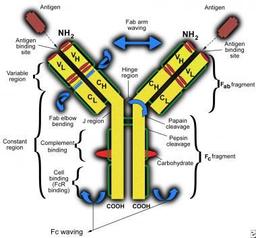
From the IgG illustration, which label best depicts the heavy chain?
45
20 sec
Q.
From the IgG illustration, which label best depicts the antigen-binding site?
46
20 sec
Q.
From the IgG illustration, which label best depicts the variable region?
47
20 sec
Q.
From the IgG illustration, which label best depicts the light chain?