Loading...

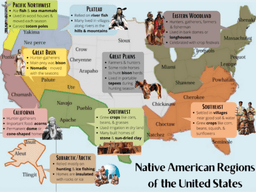
native american regions character traits, geography, climate, food, economy
Quiz by Amy Adams
Customize this quiz to suit your class
Instantly translate to 100+ languages
Tag the questions with any skills you have. Your dashboard will track each student's mastery of each skill.
Give this quiz to my class
Which Native American region is known for being farmers and hunters, using teepees when following the buffalo?
Which Native American region is known for settling in villages and growing corn, beans, squash and sunflowers?
 Native American Regions and TreatiesRegions/Native American Vocab PracticeNative American Tribes, Regions, and ESPN Colonial Period Early colonial settlements were similar in that each developed near the coastline. EX) Jamestown (1607) Plymouth (1620) New England Colonies- the New England Colonies developed initially as religious outposts by various subjugated groups. Influenced by good harbors, abundant forests, rocky soil, and a short growing season. Geographic factors influenced the economy of New England by promoting the growth of trade and manufacturing. Developed villages with town-hall meetings. Had small farms and commercial fishing. American Indians were viewed by the Puritans as needing to be saved from their sinful ways since they were not Christians. In the early years of English colonization, Puritans did not openly embrace the American Indians but relied on them for help in the difficult early years for survival. As the English population increased, so did the conflict with natives of the area. A series of bloody wars (King Philip’s War and the Pequot Wars) during the colonial period between the Puritans and the American Indians of New England Southern Colonies- The climate (long growing season), rich soil, and deep rivers of the southeastern U.S. had a major impact on the history of the U.S. before 1860 because the region provided agricultural products that were processed in the North and in Europe. Developed plantations (large farms that used slave labor) because of fertile land and a long growing season. Relations with American Indians in the Southern Colonies began somewhat as a peaceful coexistence. As more English colonists began to arrive and encroach further into native lands, the relationship became more violent. Mid Atlantic (Middle Colonies)- were created from the previous Dutch New Netherland colony and had good harbors and river systems that shaped their development. The Hudson and Delaware Rivers provided highways to the interior of North America. Furs acquired from American Indians through trade for European goods were transported toward the coast along swift rivers. Later, the region’s farmers were able to use the rivers to ship wheat and other agricultural goods to markets in other colonies and Europe. The rivers also provided colonists access to manufactured goods imported from European markets. Harbors in cities such as Philadelphia and New York City allowed the Mid-Atlantic Colonies to grow into major commercial hubs for all of England’s American colonies. Ship building was common in the mid Atlantic colonies. The natives (American Indians) who resided there were typically relied upon for trade with the English and not the target of war, as was often the case in the other English colonial regions. Pennsylvania, in particular, treated the American Indians with more respect as evidenced by William Penn’s insistence on compensating the natives for their lanTo the Lakota, and other indigenous people on North America's Great Plains, the bison was an essential part of their culture ( expressed in the quote on the previous page). The bison provided meat for nutrition, a hide for clothing and shelter, bones for tools, and fat for soap. The bison was also central to their religious beliefs. So, when European settlers hunted the bison nearly to extinction, Lakota culture suffered. Culture is central to a society and the identity of its people, as well as its continued existence. Therefore, geographers study culture as a way to understand similarities and differences among societies across the world, and in some cases, to help preserve these societies. Analyzing Culture All of a group's learned behaviors, actions, beliefs, and objects are a part of culture. It is a visible force seen in a group's actions, possessions, and influence on the landscape. For example, in a large city you can see people working in offices, factories, and stores, and living in high-rise apartments or suburban homes. You might observe them attending movies, concerts, or sporting events. Culture is also an invisible force guiding people through shared belief systems, customs, and traditions. Culture is learned, in that it develops through experiences, and not merely transmitted through genetics. For example, many people in the United States have developed a strong sense of competitiveness in school and business, and believe that hard work is a key to success. These types of elements, visible and invisible, are cultural traits. A series of interrelated traits make up a cultural complex, such as the process of steps and acceptable behaviors related to greeting a person in different cultures. A single cultural artifact, such as an automobile, may represent many different values, beliefs, behaviors and traditions and be representative of a cultural complex. Since culture is learned there are many ways that one generation passes its culture to the next. Children and adults learn traits three ways: • imitation, as when learning a language by repeating sounds or behaviors from a person or television • informal instruction, as when a parent reminds a child to say "please" • formal instruction, as when students learn history in school 132 HUMAN GEOGRAPHY: AP" EDITION CULTURAL COMPLEX OF THE AUTOMOBILE The automobile provides much more than just transportation, as it reflects many values that are central to American culture. Origins of Culture The area in which a unique culture or a specific trait develops is a culture hearth. Classical Greece was a culture hearth for democracy more than 2,000 years ago. New York City was a culture hearth for rap music in the 1970s. Geographers study how cultures develop in hearths and diffuse-or spread-to other places. Geographers also study taboos, behaviors heavily discouraged by a culture. For example, many cultures have taboos against eating certain foods, such as pork or insects. What is considered taboo changes over time. In the United States, marriages between Protestants and Catholics were once taboo, but they are not widely opposed now. Traditional, Folk, and Indigenous Cultures With the beginning of the Industrial Revolution in the late 18th century, modern transportation and communication connected people as never before and led to extensive cultural mixing, especially as cities have grown. The world prior to this time was very different; however, remnants of the past are still evident in our modern cultures. Traditional, folk, and indigenous cultures share some important characteristics and are often grouped together, but they do have some subtle differences. Traditional Culture Recently, the meanings of traditional, folk, and indigenous culture have begun to merge, causing geographers to debate when each should be used. Increasingly, the term traditional culture is used to encompass all three cultural designations. All three types share the function of passing down long-held beliefs, values, and practices and are generally resistant to rapid changes in their culture. Folk Culture The beliefs and practices of small, homogenous groups of people, often living in rural areas that are relatively isolated and slow to change, are known as folk cultures. Like all cultures, they demonstrate the diverse ways that people have adapted to a physical environment. For example, people around the world learned to make shelters out of available resources, whether 3.1: INTRODUCTION TO CULTURE 133 it was snow or mud bricks or wood. However, people used similar resources such as wood differently. In Scandinavia, people used trees to build cabins. In the American Midwest, people processed trees into boards, built a frame, and attached the boards to it. Many traits of folk culture continue today. Corn was first grown in Mexico around 10,000 years ago, and it is still grown there today. While many elements of folk culture exist side by side with modern culture, there are people whose societies have changed little, if at all, from long ago. These people practice traditional cultures, those which have not been affected by modern technology or influences. They often live in remote regions, such as some small tribes in the Amazon rainforest, and have scant knowledge of the outside world. As the lines continue blurring between cultural designations, the Amish of Pennsylvania are often referenced as both folk and traditional culture. Indigenous Culture When members of an ethnic group reside in their ancestral lands, and typically possess unique cultural traits, such as speaking their own exclusive language, they are considered an indigenous culture. Some indigenous peoples have been displaced from their native lands, but still practice their indigenous culture. Native Americans in the United States, such as the Navajo, have kept indigenous cultural practices. First Nations of Canada, such as the Inuit, have also retained their indigenous culture. Globalization and Popular Culture As a result of the Industrial Revolution, improvements in transportation and communication have shortened the time required for movement, trade, or other forms of interaction between two places. This development, known as space-time compression (see Topics 1.4 and 3.6), has accelerated culture change around the world. In 1817, a freight shipment from Cincinnati needed 52 days to reach New York City. By 1850, because of canals and railroads, it took half that long. And by 1852, it took only 7 days. Today, an airplane flight takes only a few hours, and digital information takes seconds or less. Similar change has occurred on the global scale. People travel freely across the world in a matter of hours, and communication has advanced to a point where people share information instantaneously across the globe. The increased global interaction has had a profound impact on cultures, from spreading English across the world to instant sharing of news, events and music. Globalization specifically refers to the increased integration of the world economy since the 1970s. The process of intensified interaction among peoples, governments, and companies of different countries around the globe has had profound impacts on culture. The culture of the United States is intertwined with globalization. Through the influence of its corporations, Hollywood movies, and government, the United States exerts widespread influence in other countries. But other countries also shape American culture. For example, in 2019, the National Basketball Association included players from 38 countries or territories. When cultural traits- such as clothing, music, movies, and types of 134 HUMAN GEOGRAPHY: AP. EDITION businesses-spread quickly over a large area and are adopted by various groups, they become part of popular culture. Elements of popular culture often begin in urban areas and diffuse quickly through globalization processes such as the media and Internet. These elements can quickly be adopted worldwide, making them part of global culture. People around the world follow European soccer, Indian Bollywood movies, and Japanese animation known as anime. With people in many nations wearing similar clothes, listening to similar music, and eating similar food, popular cultural traits often promote uniformity in beliefs, values, and the cultural landscape across many places The cultural landscape, also known as the built environment (see Topic 3.2), is the modification of the environment by a group and is a visible reflection of that group's cultural beliefs and values. Traditional Culture to Popular Culture Popular culture emphasizes trying what is new rather than preserving what is traditional. Many people, especially older generations or those who follow a folk culture, openly resist the adoption of popular cultural traits. They do this by preserving traditional languages, religions, values, and foods. While older generations often resist the adoption of popular culture, they seldom are successful in keeping their traditional cultures from changing, especially among the young people of their society. One clash between popular and traditional culture is occurring in Brazil. As the population expands to the interior of the rain forest, many indigenous cultures, like the Yanamamo tribe, have more contact with outside groups. Remaining isolated by the forest is becoming increasingly difficult as many young people from the indigenous cultures become exposed to popular culture and begin to integrate into the larger Brazilian society. As the young people leave their communities, they are more likely to accept popular culture at the expense of their indigenous cultural heritage, which threatens the very existence of their folk culture. Traditional culture typically exhibits horizontal diversity, meaning each traditional culture has its own customs and language that makes it distinct from other culture groups. Yet, people people within each group are usually homogeneous, or very similar to each other. By contrast, popular culture typically exhibits vertical diversity, meaning that modern urban societies are usually heterogeneous, or exhibiting differences, within the society and usually contain numerous multiethnic neighborhoods. However, on a global scale popular cultures are relatively similar with the same type of malls, shops, fast food, and clothing. Urban global culture centers are not identical, yet, global cities often do not have as much horizontal diversity across space as folk cultures. 3.1: INTRODUCTION TO CULTURE 135 COMPARING TRADITIONAL AND POPULAR CULTURE Trait Traditional Culture Popular or Global Culture Society • Rural and isolated location • Urban and connected location • Homogeneous and • Diverse and multiethnic indigenous population population • Most people speak an • Many people speak a global indigenous or ethnic local language such as English or language Arabic • Horizontal diversity • Vertical diversity Social • Emphasis on community and • Emphasis on individualism and Structure conformity making choices • Families live close to each • Dispersed families other • Weakly defined gender roles • Well-defined gender roles Diffusion • Relatively slow and limited • Relatively rapid and extensive • Primarily through relocation • Often hierarchical • Oral traditions and stories • Social media and mass media Buildings and • Materials produced locally, • Materials produced in distant Housing such as stone or grass factories, such as steel or glass • Built by community or owner • Built by a business • Similar style for community • Variety of architectural styles • Different between cultures • Similar between cities • Traditional architecture • Postmodern / contemporary architecture Food • Locally produced • Often imported • Choices limited by tradition • Wide range of choice • Prepared by the family or • Purchased in restaurants community Spatial Focus • Local and regional • National and global Artifacts, Mentifacts, and Sociofacts Whether a cultural attribute is considered traditional, folk, indigenous, or popular in nature, it is valuable to differentiate between elements of culture that can be seen and those that can not. There are artifacts that comprise the material culture, which consists of tangible things, or those that can be experienced by the senses. Art, clothing, food, music, sports, and housing types are all tangible elements of culture. Another element of the study of artifacts is understanding the techniques to use or build a specific artifact. Artifacts can be unique to a particular culture, or can be shared. For example, people of all cultures need to communicate through language, yet there are many groups that possess languages unique to their culture. The ability to read, write and understand the English language is an artifact of importance for much of popular global culture. 136 HUMAN GEOGRAPHY: AP" EDITION Mentifacts comprise a group's nonmaterial culture and consist ofintangible concepts, or those not having a physical presence. Beliefs, values, practices, and aesthetics (pleasing in appearance) determine what a cultural group views as acceptable and desirable. Mentifacts can also be unique or shared. People of many cultures possess an belief in one or many deities, and often the deities are unique to that culture. The belief in a god is a mentifact-the religious building or symbols are artifacts. Cultural groups also possess sociofacts, which are the ways people organize their society and relate to one another. Taken altogether, people tend to see the whole of their culture as greater than the sum of its individual parts. Sociofacts are embodied through families, governments, sports teams, religious organizations, education systems, and other social constructs. As with artifacts and mentifacts, sociofacts may also be unique or similar to other societies. Families are the foundations of most societies, yet what constitutes the structure of a family may vary widely between cultural groups. For example, Western cultures tend to view the nuclear family, consisting of the parents and their children as the basic family unit. By contrast, in many Western African cultures the norm is the extended family, consisting of several generations and other family members such as cousins living under one roof.Texas Regions/ Native Americans of TexasRegions and Native Americans of TexasRichard Bland College (RBC), Virginia’s selective, two-year, residential, liberal arts transfer institution, was born through innovation. In 1959, years before the Virginia Community College system was imagined, Frank Ernst – a Gateway region native, entrepreneur, and retired executive of Hopewell’s Allied Chemical Plant – proposed the creation of an institution grounded in the liberal arts tradition with opportunities for specialized training in in-demand fields such as engineering to the State Council of Higher Education. After discussions with Virginia Tech and the University of Virginia, Ernst found a willing partner in the College of William & Mary, the second-oldest university in the United States, who founded Richard Bland College in 1960. RBC has since offered multiple certificates and university-parallel two-year degrees. The College was named for the Virginia statesman and champion of public rights, Richard Bland. Son and grandson of successful planters, Richard Bland was educated at The College of William and Mary. From 1742 until his death in 1776, he represented the area in which the College is now located, first in the House of Burgesses, and later, with the adoption of a state constitution, in the House of Delegates. He also served as a delegate from Virginia in both the First and Second Continental Congresses. It seems fitting, therefore, that an institution of higher learning located in an area served for so many years by this distinguished Virginia patriot and scholar, should derive its name from one whom Jefferson described “as the most learned and logical man of those who took prominent lead in public affairs.” Before the Civil War, the property on which the College is now located was a plantation owned by the Gurley family. It became an important part of the Union-occupied territory during the 1864-1865 Siege of Petersburg. The present campus was the scene of two battles during that campaign. Shortly after the turn of the century, Hatcher Seward established a dairy and cattle farm on the former Gurley property and constructed two farmhouses. Today they serve as the President’s residence and the Hospitality House. In the early 1900s, the still-beautiful grove of pecan trees was planted. The farm was used as a work camp for about twenty conscientious objectors during World War I. The Commonwealth of Virginia authorized Central State Hospital to purchase the land in 1932 for use as the Petersburg Training School and Hospital for African-American Youth. That institution was moved in 1959, and the land, still owned by the Commonwealth, became the location for the establishment of Richard Bland College of The College of William and Mary. Under the guidance of Colonel (Ret.) James M. Carson, the former hospital and training facility was transformed into Richard Bland College, and classes were held beginning in 1961. In the late 1960s, Ernst Hall (named for a local business leader influential in the establishment of the college) was added to the original campus. In addition, a Student Center Library building and a gymnasium also were constructed in the early 1970s. Colonel Carson retired as the founding President of the College in 1973. From 1973 through 1975, Dr. Cornelius Laban, Professor of Biology, Emeritus, served as the Acting President of Richard Bland College. In 1975, Dr. Clarence Maze succeeded Colonel Carson as Richard Bland College’s second President. During his tenure, Richard Bland College expanded its academic programs, added an Asian water garden that was designed by Dr. Maze and expanded international programs and travel. In recognition of his service to the College, the renovated administration building was named Maze Hall upon his retirement in 1996. In 1996, Dr. James B. McNeer succeeded Dr. Clarence Maze as Richard Bland College’s third President. Dr. McNeer introduced a residential life program and oversaw the addition of the Residential Village in 2008. The Residential Village was comprised of two dormitories, Freedom Hall and Patriot Hall, which housed 250 students. A new Science and Technology Building was added in 2010, and in recognition of his service to the College, this building was named James B. McNeer Hall. Dr. McNeer retired in 2012. In 2012, Dr. Debbie L. Sydow succeeded Dr. James McNeer as Richard Bland College’s fourth president. Dr. Sydow expanded the reach, range and diversity of students attending Richard Bland College. She oversaw a physical campus transformation through extensive building renovation and new construction, creation of a Business Innovation Park, and conservation of the iconic pecan grove and water garden. President Sydow reinstituted intercollegiate athletics in 2013 and has since hailed three NJCAA national championship teams. She supported the Foundation’s emergence as a vibrant, entrepreneurial organization led by a Board of Directors composed largely of alumni, and she secured the largest private gift in College history to launch the W&M Promise Scholars program. By effectively leveraging partnerships, President Sydow boosted work-based learning and expanded academic and career pathways for students.