Construct a function to model a linear relationship between two quantities. Determine the rate of change and initial value of the function from a description of a relationship or from two (x, y) values, including reading these from a table or from a graph. Interpret the rate of change and initial value of a linear function in terms of the situation it models, and in terms of its graph or a table of values.
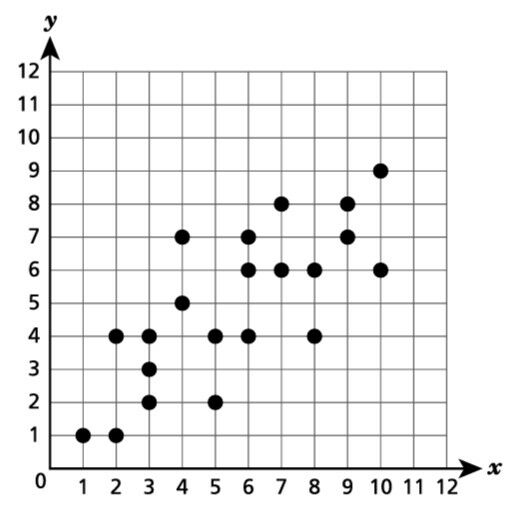
Understand that straight lines are widely used to model relationships between two quantitative variables. For scatter plots that suggest a linear association, informally fit a straight line, and informally assess the model fit by judging the closeness of the data points to the line.
Verify experimentally angles are mapped to angles of the same measure.
Solve linear equations with rational number coefficients, including equations whose solutions require expanding expressions using the distributive property and combining like terms.
Compare properties of two functions each represented in a different way (algebraically, graphically, numerically in tables, or by verbal descriptions).
Use similar triangles to explain why the slope m is the same between any two distinct points on a non-vertical line in the coordinate plane; derive the equation y = mx for a line through the origin and the equation y = mx + b for a line intercepting the vertical axis at b.
Given the formulas for the volume of cones, cylinders, and spheres, solve mathematical and real- world problems.
Use square root and cube root symbols to represent solutions to equations of the form x^2 = p and x^3 = p, where p is a positive rational number. Know square roots of perfect squares up to 225 and cube roots of perfect cubes up to 125. Know that the square root of a non-perfect square is irrational.
Use the equation of a linear model to solve problems in the context of bivariate measurement data, interpreting the slope and intercept.
Understand that a two-dimensional figure is congruent to another if the second can be obtained from the first by a sequence of rotations, reflections, and translations. Given two congruent figures, describe a sequence that exhibits the congruence between them.
Interpret the equation y = mx + b as defining a linear function, whose graph is a straight line. Recognize examples of functions that are not linear.
Know that a two-dimensional figure is similar to another if the corresponding angles are congruent and the corresponding sides are in proportion. Equivalently, two two-dimensional figures are similar if one is the image of the other after a sequence of rotations, reflections, translations, and dilations. Given two similar two-dimensional figures, describe a sequence that maps the similarity between them on the coordinate plane.
Use informal arguments to establish facts about the angle sum and exterior angle of triangles, about the angles created when parallel lines are cut by a transversal, and the angle-angle criterion for similarity of triangles.
Know and apply the properties of integer exponents to generate equivalent numerical expressions.
Explain a proof of the Pythagorean Theorem and its converse.
Verify experimentally lines are mapped to lines, and line segments to line segments of the same length.
Recognize when linear equations in one variable have one solution, infinitely many solutions, or no solutions. Give examples and show which of these possibilities is the case by successively transforming the given equation into simpler forms.
Use rational approximations of irrational numbers to compare the size of irrational numbers, locate them approximately on a number line, and estimate the value of expressions.
Understand that a function is a rule that assigns to each input exactly one output. The graph of a function is the set of ordered pairs consisting of an input and the corresponding output.
Track each student's skills and progress in your Mastery dashboards