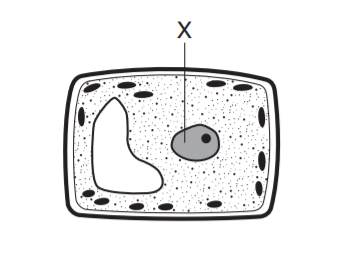
Most cells have cell membranes, genetic material, and cytoplasm. Some cells have a cell wall and/or chloroplasts. Many cells have a nucleus.
Many plants have roots, stems, leaves, and reproductive structures. These orga- nized groups of tissues are responsible for a plant’s life activities.
In all environments, organisms interact with one another in many ways. Relationships among organisms may be competitive, harmful, or beneficial. Some species have adapted to be dependent upon each other with the result that neither could survive without the other.
During respiration, cells use oxygen to release the energy stored in food. The respi- ratory system supplies oxygen and removes carbon dioxide (gas exchange).
The nervous and endocrine systems interact to control and coordinate the body’s responses to changes in the environment, and to regulate growth, development, and reproduction. Hormones are chemicals produced by the endocrine system; hormones regulate many body functions.
In sexual reproduction, sperm and egg each carry one-half of the genetic informa- tion for the new individual. Therefore, the fertilized egg contains genetic information from each parent.
Disease breaks down the structures or functions of an organism. Some diseases are the result of failures of the system. Other diseases are the result of damage by infection from other organisms (germ theory). Specialized cells protect the body from infectious disease. The chemicals they produce identify and destroy microbes that enter the body.
The probability of traits being expressed can be determined using models of genetic inheritance. Some models of prediction are pedigree charts and Punnett squares.
Human activities such as selective breeding and advances in genetic engineering may affect the variations of species.
The methods for obtaining nutrients vary among organisms. Producers, such as green plants, use light energy to make their food. Consumers, such as animals, take in energy-rich foods.
Cancers are a result of abnormal cell division.
Patterns of development vary among plants. In seed-bearing plants, seeds contain stored food for early development. Their later development into adulthood is character- ized by varying patterns of growth from species to species.
Patterns of development vary among animals. In some species the young resemble the adult, while in others they do not. Some insects and amphibians undergo metamor- phosis as they mature.
Given adequate resources and no disease or predators, populations (including humans) increase. Lack of resources, habitat destruction, and other factors such as pre- dation and climate limit the growth of certain populations in the ecosystem.
The environment may be altered through the activities of organisms. Alterations are sometimes abrupt. Some species may replace others over time, resulting in long- term gradual changes (ecological succession).
In multicellular organisms, cell division is responsible for growth, maintenance, and repair. In some one-celled organisms, cell division is a method of asexual reproduction.
Each gene carries a single unit of information. A single inherited trait of an individ- ual can be determined by one pair or by many pairs of genes. A human cell contains thousands of different genes.
The Law of Conservation of Mass states that during an ordinary chemical reaction matter cannot be created or destroyed. In chemical reactions, the total mass of the reactants equals the total mass of the products.
Most activities in everyday life involve one form of energy being transformed into another. For example, the chemical energy in gasoline is transformed into mechanical energy in an automobile engine. Energy, in the form of heat, is almost always one of the products of energy transformations.
Plates may collide, move apart, or slide past one another. Most volcanic activity and mountain building occur at the boundaries of these plates, often resulting in earth- quakes.
Air masses form when air remains nearly stationary over a large section of Earth’s surface and takes on the conditions of temperature and humidity from that location. Weather conditions at a location are determined primarily by temperature, humidity, and pressure of air masses over that location.
Fossil fuels contain stored solar energy and are considered nonrenewable resources. They are a major source of energy in the United States. Solar energy, wind, moving water, and biomass are some examples of renewable energy resources.
There are more than 100 elements. Elements combine in a multitude of ways to produce compounds that account for all living and nonliving substances. Few elements are found in their pure form.
Fronts are boundaries between air masses. Precipitation is likely to occur at these boundaries.
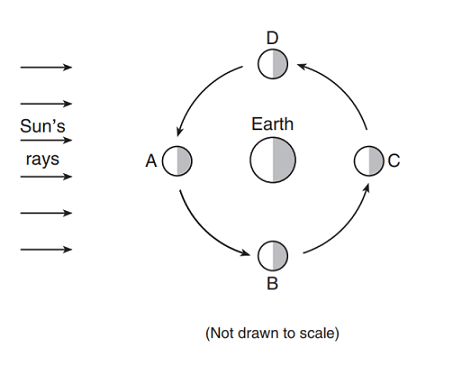
Most objects in the solar system have a regular and predictable motion. These motions explain such phenomena as a day, a year, phases of the Moon, eclipses, tides, meteor showers, and comets.
Light passes through some materials, sometimes refracting in the process. Materials absorb and reflect light, and may transmit light. To see an object, light from that object, emitted by or reflected from it, must enter the eye.
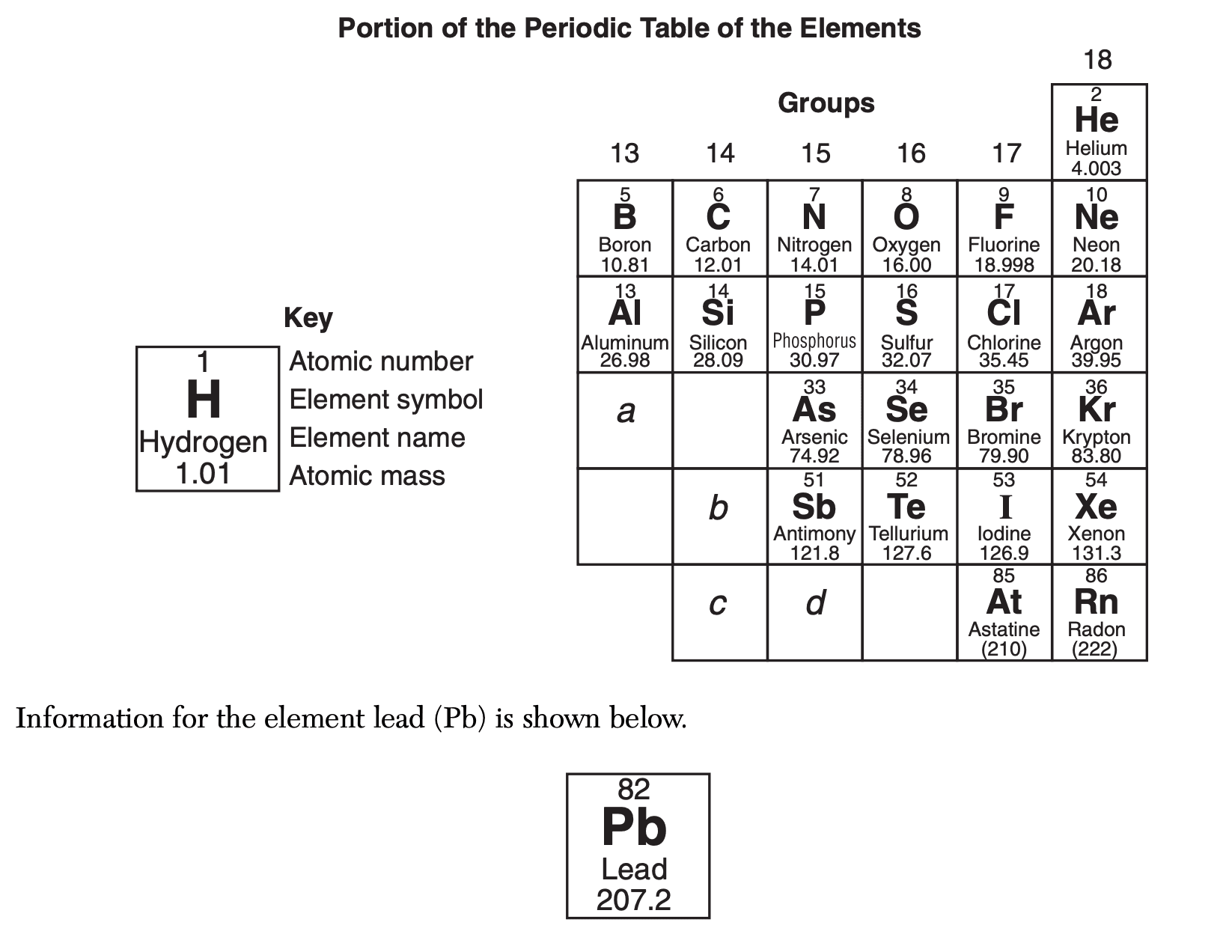
The periodic table is one useful model for classifying elements. The periodic table can be used to predict properties of elements (metals, nonmetals, noble gases).
use and interpret graphs and data tables
apply mathematical equations to describe relationships among variables in the natural world
Simple machines include a lever, a pulley, a wheel and axle, and an inclined plane. A complex machine uses a combination of interacting simple machines, e.g., a bicycle.
A machine can be made more efficient by reducing friction. Some common ways of reducing friction include lubricating or waxing surfaces.
A solid has definite shape and volume. Particles resist a change in position.
Heat can be transferred through matter by the collisions of atoms and/or mole- cules (conduction) or through space (radiation). In a liquid or gas, currents will facilitate the transfer of heat (convection).
An object’s motion is the result of the combined effect of all forces acting on the object. A moving object that is not subjected to a force will continue to move at a con- stant speed in a straight line. An object at rest will remain at rest.
Every object exerts gravitational force on every other object. Gravitational force depends on how much mass the objects have and on how far apart they are. Gravity is one of the forces acting on orbiting objects and projectiles.
quantify patterns and trends
Track each student's skills and progress in your Mastery dashboards