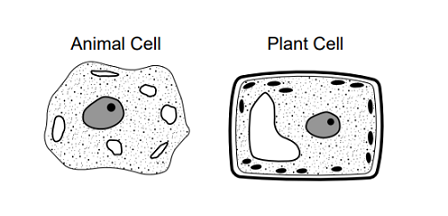
The way in which cells function is similar in all living things. Cells grow and divide, producing more cells. Cells take in nutrients, which they use to provide energy for the work that cells do and to make the materials that a cell or an organism needs.
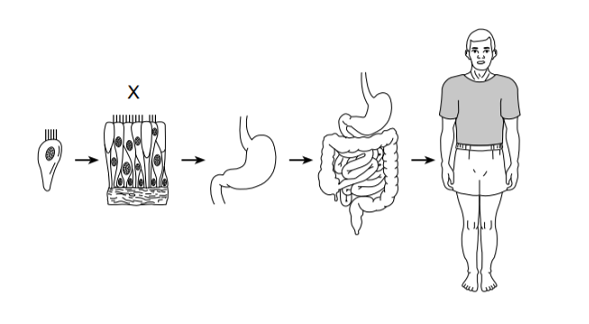
Cells are organized for more effective functioning in multicellular organisms. Levels of organization for structure and function of a multicellular organism include cells, tissues, organs, and organ systems.
Multicellular animals often have similar organs and specialized systems for carry- ing out major life activities.
Patterns of development vary among animals. In some species the young resemble the adult, while in others they do not. Some insects and amphibians undergo metamor- phosis as they mature.
During respiration, cells use oxygen to release the energy stored in food. The respi- ratory system supplies oxygen and removes carbon dioxide (gas exchange).
Many plants have roots, stems, leaves, and reproductive structures. These orga- nized groups of tissues are responsible for a plant’s life activities.
Hereditary information is contained in genes. Genes are composed of DNA that makes up the chromosomes of cells.
In sexual reproduction, sperm and egg each carry one-half of the genetic informa- tion for the new individual. Therefore, the fertilized egg contains genetic information from each parent.
In all organisms, genetic traits are passed on from generation to generation.
The processes of sexual reproduction and mutation have given rise to a variety of traits within a species.
Fertilization and/or development in organisms may be internal or external.
The survival of an organism depends on its ability to sense and respond to its external environment.
A population consists of all individuals of a species that are found together at a given place and time. Populations living in one place form a community. The commu- nity and the physical factors with which it interacts compose an ecosystem.
Photosynthesis is carried on by green plants and other organisms containing chlorophyll. In this process, the Sun’s energy is converted into and stored as chemical energy in the form of a sugar. The quantity of sugar molecules increases in green plants during photosynthesis in the presence of sunlight.
The environment may be altered through the activities of organisms. Alterations are sometimes abrupt. Some species may replace others over time, resulting in long- term gradual changes (ecological succession).
use and interpret graphs and data tables
Overpopulation by any species impacts the environment due to the increased use of resources. Human activities can bring about environmental degradation through resource acquisition, urban growth, land-use decisions, waste disposal, etc.
In multicellular organisms, cell division is responsible for growth, maintenance, and repair. In some one-celled organisms, cell division is a method of asexual reproduction.
Since the Industrial Revolution, human activities have resulted in major pollution of air, water, and soil. Pollution has cumulative ecological effects such as acid rain, global warming, or ozone depletion. The survival of living things on our planet depends on the conservation and protection of Earth’s resources.
The apparent motions of the Sun, Moon, planets, and stars across the sky can be explained by Earth’s rotation and revolution. Earth’s rotation causes the length of one day to be approximately 24 hours. This rotation also causes the Sun and Moon to appear to rise along the eastern horizon and to set along the western horizon. Earth’s revolution around the Sun defines the length of the year as 365 1/4 days.
Weather describes the conditions of the atmosphere at a given location for a short period of time.
Moons are seen by reflected light. Our Moon orbits Earth, while Earth orbits the Sun. The Moon’s phases as observed from Earth are the result of seeing different por- tions of the lighted area of the Moon’s surface. The phases repeat in a cyclic pattern in about one month.
Most objects in the solar system have a regular and predictable motion. These motions explain such phenomena as a day, a year, phases of the Moon, eclipses, tides, meteor showers, and comets.
Substances enter the atmosphere naturally and from human activity. Some of these substances include dust from volcanic eruptions and greenhouse gases such as carbon dioxide, methane, and water vapor. These substances can affect weather, climate, and living things.
Different forms of energy include heat, light, electrical, mechanical, sound, nuclear, and chemical. Energy is transformed in many ways.
The rock at Earth’s surface forms a nearly continuous shell around Earth called the lithosphere.
The Law of Conservation of Mass states that during an ordinary chemical reaction matter cannot be created or destroyed. In chemical reactions, the total mass of the reactants equals the total mass of the products.
The dynamic processes that wear away Earth’s surface include weathering and erosion.
The Sun is a major source of energy for Earth. Other sources of energy include nuclear and geothermal energy.
Continents fitting together like puzzle parts and fossil correlations provided initial evidence that continents were once together.
Density can be described as the amount of matter that is in a given amount of space. If two objects have equal volume, but one has more mass, the one with more mass is denser.
Gases have neither a determined shape nor a definite volume. Gases assume the shape and volume of a closed container.
High-pressure systems generally bring fair weather. Low-pressure systems usually bring cloudy, unstable conditions. The general movement of highs and lows is from west to east across the United States.
Folded, tilted, faulted, and displaced rock layers suggest past crustal movement.
During a physical change a substance keeps its chemical composition and proper- ties. Examples of physical changes include freezing, melting, condensation, boiling, evaporation, tearing, and crushing.
The periodic table is one useful model for classifying elements. The periodic table can be used to predict properties of elements (metals, nonmetals, noble gases).
There are more than 100 elements. Elements combine in a multitude of ways to produce compounds that account for all living and nonliving substances. Few elements are found in their pure form.
Simple machines include a lever, a pulley, a wheel and axle, and an inclined plane. A complex machine uses a combination of interacting simple machines, e.g., a bicycle.
Track each student's skills and progress in your Mastery dashboards