Design and implement investigative procedures, including making observations, asking well defined questions, formulating testable hypotheses, identifying variables, selecting appropriate equipment and technology, evaluating numerical answers for reasonableness, and identifying causes and effects of uncertainties in measured data.
Generate and interpret graphs and charts describing different types of motion, including investigations using real-time technology such as motion detectors or photogates.
Track each student's skills and progress in your Mastery dashboards
Give this quiz to my class
Q 1/5
Score 0
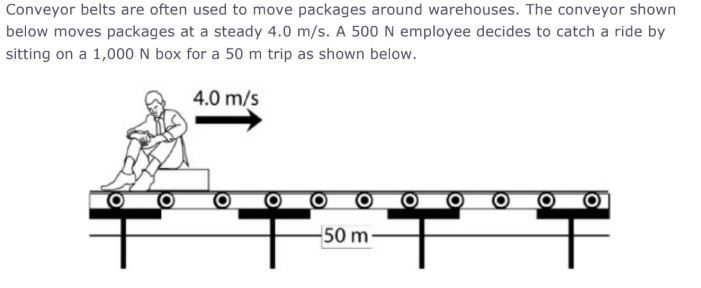
What are the variables provided in the situation above?
60
V=4.0m/s, F(employee)=500N, F(box)=1,000N, d=500m
V=4.0m/s, F(employee)=500N, F(box)=1,000N, d=50m
V=4.0m/s, F(employee)=50N, F(box)=100N, d=50m
V=10.0m/s, F(employee)=500N, F(box)=1,000N, d=50m
Q 2/5
Score 0
What equation do you need to calculate the work done?
60
W=F/d
W=F+d
W=Fd
W=d/F
5 questions
Q.
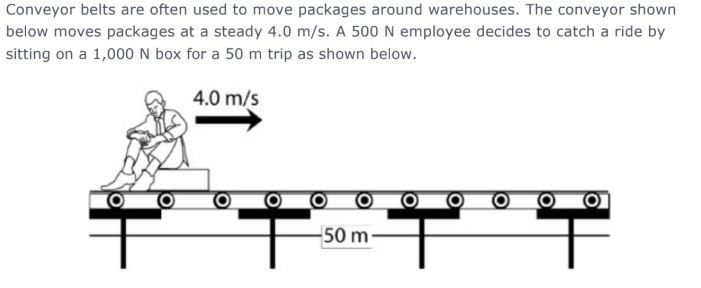
What are the variables provided in the situation above?
1
60 sec
112.39.c.2.d
Q.
What equation do you need to calculate the work done?
2
60 sec
112.39.c.2.j
Q.
What is the work done by the employee on the box shown above?
3
60 sec
112.39.c.6.a
Q.
What is the work done by the conveyor belt on the box and the employee?
4
60 sec
112.39.c.6.a
Q.
What would the work vs. distance graph for the conveyor belt look like?