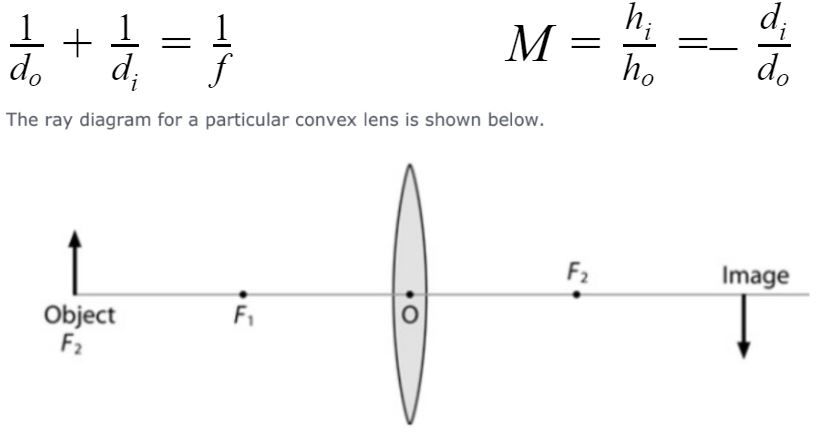
Describe and predict image formation as a consequence of reflection from a plane mirror and refraction through a thin convex lens.
Track each student's skills and progress in your Mastery dashboards
Give this quiz to my class
Q 1/5
Score 0
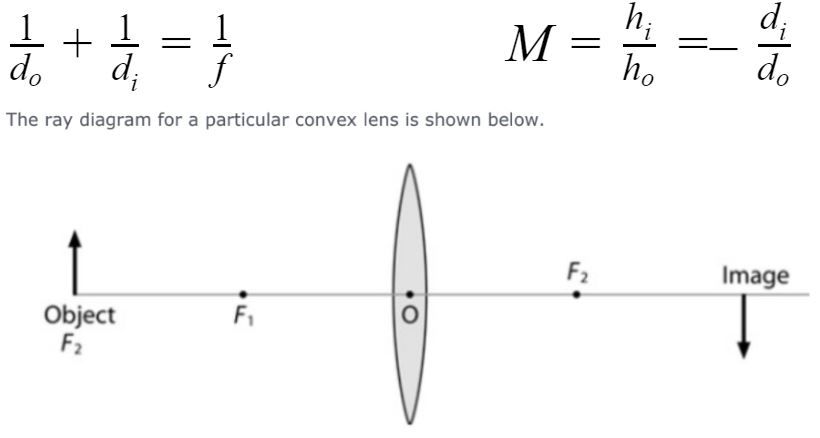
Is the convex lens above a converging lens or diverging lens?
120
Converging
Both
Diverging
Neither
Q 2/5
Score 0
What equation is necessary to solve for the focal length?
120
M=hi/ho=-di/do
v=f/`
1/do+1/di=1/f
T=1/f
5 questions
Q.
Is the convex lens above a converging lens or diverging lens?
1
120 sec
112.39.c.7.e
Q.
What equation is necessary to solve for the focal length?
2
120 sec
112.39.c.7.e
Q.
Refer to the above diagram. If an object placed 10.0 cm in front of the lens produces an image 15 cm from the lens on the opposite side, what is the magnitude of the focal length for the lens?
3
120 sec
112.39.c.7.e
Q.
If the image distance was doubled, what would the new focal length be? (from number 3 do=10cm, di=15cm).
4
120 sec
112.39.c.7.e
Q.
Calculate the magnification of the image with the information from number 3 (di=10cm, do=15cm), then calculate the magnification of the image from the information from number 4 (di=10cm, do=30cm).